Installation guide
 Owner’s manual
 Error Codes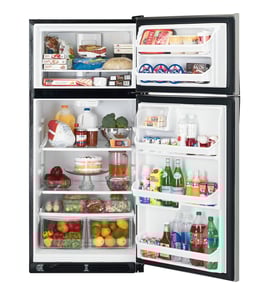



What are the advantages of a top mount fridge?
A top-mount refrigerator like the Frigidaire FFTR1814TBB gives you a traditional layout with the freezer on top, straightforward temperature controls, and easy installation clearances. In many kitchens, this style is a practical choice because it is simple to place, simple to service, and efficient for everyday food storage.
- Classic layout: freezer on top, fresh food below.
- Simple airflow and setup: fewer complex features to manage.
- Flexible placement: the installation guidance calls for ⅜ inch at the sides and top and 1 inch at the back for air circulation.
- Door sealing and alignment are easy to check: proper leveling helps doors close and seal correctly.
- Good produce storage options: many top-mount designs include crispers with humidity control guidance for leafy vs. non-leafy produce.
Top-mount models are often easier to fit into existing cutouts because the cabinet footprint is straightforward and the clearance requirements are clear.
| What to plan for | Typical top-mount benefit | What to do on FFTR1814TBB |
|---|---|---|
| Air circulation | Helps cooling performance and efficiency | Follow the clearances in the FFTR1814TBB owner’s manual |
| Door closing | Better sealing, fewer warm spots | Level the cabinet so it tilts slightly front-to-back |
| Water hookup (if equipped) | Simple rear connection | Use the steps in the FFTR1814TBB installation guide |
A refrigerator that is positioned with the right clearances and leveled correctly tends to cool more evenly, keep door gaskets sealing, and avoid issues like temperature swings or excess moisture. That protects food quality and helps the refrigerator run efficiently.
Last updated: February 2026
What is the upper part of a fridge called?
On a Frigidaire FFTR1814TBB top-mount refrigerator, the upper compartment is the freezer. It is the section designed to keep foods frozen, and it typically includes freezer storage features such as an ice tray and shelves or bins (depending on configuration). See the compartment layout in the FFTR1814TBB owner's manual.
Most top-mount refrigerators like the Frigidaire FFTR1814TBB use the freezer section to create and circulate cold air for both compartments.
- Freezer shelf or full shelf (varies by model configuration)
- Ice tray (common in this style)
- Freezer door bins or racks for smaller items
- Airflow outlets that help move cold air to the fresh food section
- Temperature control settings that affect freezer performance
| Common name | What it means | Where it is |
|---|---|---|
| Freezer | Frozen-food compartment | Upper section on a top-mount refrigerator |
| Fresh food section | Main refrigerator compartment | Lower section |
| Door bin/rack | Storage on the inside of the door | Freezer door or refrigerator door |
| Crisper drawers | Produce storage drawers | Fresh food section (lower) |
Knowing the correct name helps when you are troubleshooting cooling issues, reading temperature and airflow instructions, or ordering the right Frigidaire replacement parts for the correct compartment.
For proper cooling and airflow, we follow the installation clearance guidance for this refrigerator (typical guidance includes 3/8 inch at the sides and top and 1 inch at the rear). Those clearances help the freezer and refrigerator sections maintain stable temperatures; refer to the FFTR1814TBB installation guide for placement and leveling details.
Last updated: February 2026
Is the Frigidaire FFTR1814TBB garage ready?
The Frigidaire FFTR1814TBB top-mount refrigerator is not identified as “garage ready” in the product documentation for this model. For reliable cooling in a garage, we recommend confirming the approved ambient temperature range in the FFTR1814TBB owner’s manual before installing it in an unconditioned space.
A “garage ready” refrigerator is designed to keep safe temperatures when the surrounding air gets very cold or very hot. Before placing FFTR1814TBB in a garage, check for:
- Minimum and maximum room temperature ratings for operation
- Notes about unheated spaces, freezing conditions, or high-heat locations
- Guidance on temperature control behavior in cold weather (freezer may not run enough)
- Clearance and ventilation requirements around the cabinet
- Electrical and outlet requirements (dedicated circuit recommendations)
Use this as a practical way to decide if a garage install is likely to work well.
| Garage condition | What typically happens | What we recommend |
|---|---|---|
| Below freezing for long periods | Fresh food section can freeze; compressor may run less | Use a garage-rated unit or move the refrigerator indoors |
| Very hot (often above 90°F) | Longer run times; warmer temps; higher energy use | Improve ventilation and keep coils clean; consider a garage-rated unit |
| Mild, mostly 50°F to 90°F | Usually stable performance | Confirm the manual’s operating range and clearances |
If you proceed with a garage install, these steps reduce temperature swings and moisture issues:
- Keep the refrigerator level and ensure doors close and seal fully
- Leave proper airflow space behind and above the unit
- Avoid placing it in direct sun or next to a heater or water heater
- Set temperatures after the unit stabilizes for 24 hours
- If you have an ice maker connected, do not route the water line where it can freeze (a common garage issue)
In a garage, ambient temperature extremes can prevent the refrigerator from cycling normally. That can lead to frozen produce, soft ice cream, food safety concerns, and higher energy use even when the refrigerator itself is working correctly.
Last updated: February 2026
Is Frigidaire Gallery high end?
Frigidaire Gallery is not a high-end (luxury) line; it is a mid-range step up from basic Frigidaire models, with more design and feature upgrades, but it typically sits below premium lines. Your Frigidaire FFTR1814TBB top-mount refrigerator is a standard Frigidaire model, not a Gallery unit; confirm the exact series in the FFTR1814TBB owner's manual.
In most Frigidaire refrigerator lineups, you can think of the tiers like this:
- Frigidaire (standard): practical features, value-focused pricing
- Frigidaire Gallery: upgraded finishes and convenience features, mid-range pricing
- Frigidaire Professional: premium styling and higher-end performance features
“High end” typically refers to premium materials, advanced cooling systems, and higher price points. Here is a simple way to compare:
| Line | Typical market position | What you usually get |
|---|---|---|
| Frigidaire (standard) | Value to mid | Core cooling, straightforward controls |
| Frigidaire Gallery | Mid-range | More feature upgrades and styling |
| Frigidaire Professional | Premium | Higher-end design and performance-focused features |
Use these checks on your refrigerator and paperwork:
- Look for “Gallery” branding on the badge or inside the fresh food section
- Check the model tag (often inside the refrigerator compartment)
- Match your model number to the documentation in the FFTR1814TBB owner's manual
- Compare your control layout and features to the manual’s “Features at a Glance” section
Knowing whether you have Frigidaire, Gallery, or Professional helps you set expectations for features and also helps us match the right parts and troubleshooting steps for your exact refrigerator.
Last updated: February 2026
Do Frigidaire refrigerators have water filters?
Yes, many Frigidaire refrigerators can use a water filter, but it depends on the exact features on your model. For the Frigidaire FFTR1814TBB, filtration is only relevant if your refrigerator is connected to a water supply for an ice maker; models without a water connection do not use a water filter.
Check these common signs:
- Your refrigerator has an ice maker and a connected water line
- The installation instructions mention connecting a water supply line
- You see a filter housing or a filter location called out in the documentation
- You have an inline filter installed on the water line behind the refrigerator
- You notice reduced ice production when the water supply is restricted
For model-specific locations and setup details, use the FFTR1814TBB owner’s manual.
| Refrigerator setup | Water filter needed? | What you’ll maintain |
|---|---|---|
| No ice maker, no water line | No | Basic cleaning and temperature settings |
| Ice maker connected to house water | Sometimes | Water line, shutoff valve, and optional filtration |
| Inline filter added to water line | Yes (inline type) | Replace inline filter on schedule |
A filter only helps if water is actually feeding the refrigerator (usually for ice). If you add filtration, it can improve taste and reduce sediment, but it also adds a maintenance item that can restrict flow when it gets clogged.
If you are working with filtration on a Frigidaire refrigerator, follow the steps in how to replace the water filter in a Frigidaire refrigerator to identify filter styles and replacement basics.
Last updated: February 2026
What is the most common problem with Frigidaire refrigerators?
The most common Frigidaire refrigerator issue is not cooling properly. On the Frigidaire FFTR1814TBB top-mount refrigerator, the fastest wins are checking power, confirming the temperature controls are not set to “0,” and making sure airflow is not blocked so cold air can circulate.
- Not cooling or weak cooling: verify the unit is running, controls are set correctly, and vents are not blocked by food.
- Frost build-up in the freezer: points to a defrost or airflow issue; look for heavy frost on the back freezer panel.
- Runs constantly: often caused by warm room temps, frequent door openings, dirty condenser area, or a door not sealing.
- Odors: usually a cleaning and food-storage issue.
- Light not working: bulb or door switch issue.
Use the FFTR1814TBB owner's manual “Before You Call” section as your checklist.
- Make sure the refrigerator is plugged into a dedicated 115V, 60 Hz, 15A outlet.
- Confirm the refrigerator/freezer control is not set to “0.”
- If it just stopped, allow 20 minutes in case it is in a defrost cycle.
- Give temperature changes 24 hours to stabilize.
- Check door sealing; a poor seal can cause warm temps, frost, and constant running.
| Symptom | Most likely cause | What to do next |
|---|---|---|
| Fresh food warm, freezer cold | Airflow restriction | Clear vents, avoid overpacking |
| Heavy frost in freezer | Defrost system problem | Inspect for frost pattern; service if needed |
| Constant running | Door leak or heat load | Check gasket, clean, reduce door openings |
| Odor | Spills or uncovered food | Clean interior, wrap foods |
If you find a torn or warped seal, replacing the gasket is a common fix. For this model, options include the refrigerator door gasket (black) 242193212 (fresh food door) or the refrigerator freezer door gasket (black) 242193209 (freezer door).
Cooling and frost complaints usually come down to airflow, temperature control settings, and door sealing. Fixing those basics first prevents food spoilage, reduces energy use, and avoids unnecessary part replacements.
Last updated: February 2026
Why is my Frigidaire top mount freezer not freezing?
If your Frigidaire FFTR1814TBB top-mount refrigerator freezer is not freezing, the most common causes are an incorrect control setting, restricted airflow from frost buildup, dirty condenser coils, or an evaporator fan that is not running. Start with the temperature controls, then check airflow and fan operation using the FFTR1814TBB owner's manual.
- Confirm the refrigerator/freezer control is not set to “0” (off).
- Set the freezer colder, then wait 24 hours for temperatures to stabilize.
- Make sure vents are not blocked by food packages (air must circulate).
- Check that the freezer door closes fully and seals all the way around.
- Listen for the evaporator fan in the freezer; it should run when cooling is needed.
- Control settings and time: After any adjustment, give the unit 24 hours to stabilize.
- Defrost cycle: If cooling seems to pause, wait about 20 minutes and recheck.
- Airflow and frost pattern: Heavy frost on the back freezer panel points to a defrost problem.
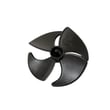
- Evaporator fan: If the fan is not running, cold air will not move through the freezer and fresh food section. If needed, replace the refrigerator evaporator fan motor 242077705.
| What you notice | Most likely cause | What we do first |
|---|---|---|
| Freezer warm, fridge OK | Freezer control too warm, airflow issue | Set colder; clear vents; wait 24 hours |
| Freezer warm, frost on back wall | Defrost system issue | Inspect defrost heater and thermostat |
| No fan sound in freezer | Evaporator fan motor not running | Check for obstruction; test/replace motor |
| Both sections warming | Dirty coils, sealed system, or compressor issue | Clean coils; verify condenser fan (if equipped) |
A freezer that cannot reach temperature forces longer run times, risks food safety, and can lead to ice buildup that blocks airflow. Correct control settings and strong airflow are the fastest path back to normal freezing.
Last updated: February 2026