Owner’s manual
 Error Codes


How many cubic feet is my Kenmore refrigerator by model number?
Your Kenmore side-by-side refrigerator model 10659299994 has its exact cubic-foot capacity listed on the model and serial number label inside the fresh food compartment, and it may also be shown in the specifications section of the 10659299994 owner's manual. Using the rating label is the most accurate method for your exact configuration.
Fast ways to find the cubic-foot capacity
Use these checks in order; they work best for Kenmore 106-series refrigerators:
- Check the rating plate inside the refrigerator compartment (commonly on an inside wall); it lists model and serial information and often includes key specs.
- Look in the specifications section of the 10659299994 owner's manual for capacity and dimensions.
- Compare your cabinet style (side-by-side) and features (ice and water dispenser, filter housing) to confirm you are reading the correct label.
- Do not rely on “similar model” capacities; small model-number changes can mean different liner sizes and usable space.
What you should look for on the label
The manual notes the model and serial number label is located on the inside wall of the refrigerator compartment. When you find it, record these items:
- Model number (should match 10659299994)
- Serial number
- Purchase date (helpful for service history)
- Any printed capacity or “cu. ft.” specification
Typical capacity range (helpful for a quick estimate)
If you need a working estimate before you locate the label, most Kenmore side-by-side refrigerators in this style commonly fall in the 20 to 26 cu. ft. range. Use the label or manual to confirm the exact number for model 10659299994.
| Method | Accuracy | What you need |
|---|---|---|
| Rating plate inside fridge | Highest | Flashlight, 1 minute |
| Manual specifications | High | 10659299994 owner's manual |
| “Typical range” estimate | Medium | None |
Why it matters
Cubic-foot capacity affects how you shop for replacement shelves and bins, plan food storage, and compare efficiency and fit. It also helps when ordering parts for your exact Kenmore model.
Last updated: February 2026
What causes a side-by-side refrigerator to stop cooling?
On a Kenmore 10659299994 side-by-side refrigerator, a “not cooling” problem is most often caused by lost power, incorrect temperature control settings, blocked air vents that stop airflow between compartments, or a failed cooling/defrost component (like the evaporator fan or defrost bi-metal). See the owner's manual for control and airflow guidance.
Quick checks we recommend first (no tools)
- Confirm the refrigerator has power and the interior lights come on.
- Verify the refrigerator and freezer controls are not set too warm; wait 24 hours after any adjustment.
- Make sure food packages are not blocking the top and bottom vents; blocked vents prevent proper airflow.
- Limit door openings and confirm doors close fully; frequent openings quickly warm the compartments.
- If you just loaded a large amount of food, allow several hours for temperatures to recover.
Airflow and control settings: what matters on this model
Your 10659299994 is designed to circulate cold air between the freezer and fresh food sections. When vents are blocked, the temperature controls cannot regulate properly, so one or both sections can warm up.
| Symptom | Most likely cause | What to do next |
|---|---|---|
| Freezer cold, refrigerator warm | Airflow restriction or damper issue | Clear vents; if airflow stays weak, check the damper system |
| Both sections warm | Power issue, control setting, or cooling system problem | Verify power and settings; listen for fans/compressor |
| Cooling comes and goes | Defrost system issue or intermittent fan | Check for frost buildup and fan operation |
When a part is likely involved
If the controls are set correctly and vents are clear, we focus on the components that move air, manage defrost, and supply cooling.
Common suspects for this model include:
- Evaporator fan area (you may hear the fan circulating air when it is running)
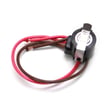
- Defrost system components such as the refrigerator defrost bi-metal WPW10225581
- Sealed system components (compressor/evaporator) if the unit runs but never cools
Why it matters
A side-by-side depends on steady airflow from the freezer to the refrigerator section. A simple vent blockage or control setting can mimic a major failure; checking those first prevents unnecessary part replacement and helps restore safe food temperatures faster.
Last updated: February 2026
Where is the model number on a Kenmore side by side refrigerator?
On Kenmore side-by-side refrigerator model 10659299994, the model number is printed on the model and serial number label located on the inside wall of the refrigerator (fresh food) compartment. You can confirm the exact label location and how to record it in the owner's manual.
Where to look (fast checklist)
- Open the refrigerator (fresh food) door, not the freezer door
- Look along the inside wall of the refrigerator compartment
- Check near the upper side walls and around the crisper area
- Look for a sticker that lists both Model and Serial
- Write down the full model number exactly as shown (for this unit: 10659299994)
What you will see on the label
The label typically includes both identifiers; the model number is what we use to match parts like an ice maker assembly or water inlet valve.
| Label item | What it’s used for | Example for this refrigerator |
|---|---|---|
| Model number | Matching correct parts and diagrams | 10659299994 |
| Serial number | Identifying production details | Varies by unit |
Why it matters
Using the exact model number helps us match the right Kenmore refrigerator parts for your configuration (for example, dispenser components, door bins, or ice maker-related parts). A single digit difference can change which parts fit.
Last updated: February 2026
What are the most common problems with Kenmore refrigerators?
The most common problems we see on Kenmore refrigerators like model 10659299994 are cooling issues, water leaks, ice maker or dispenser troubles, and unusual noises. These usually trace back to airflow restrictions, defrost system faults, or water supply and filtration issues; the 10659299994 owner's manual troubleshooting section helps narrow it down fast.
Most common symptoms and what they usually mean
- Not cooling or warm temperatures: dirty condenser coils, evaporator fan airflow problems, or frost buildup from a defrost issue.
- Water dripping at the dispenser: air in the water lines after a filter change, or the glass not held under the spout long enough.
- Low water flow at the dispenser: a clogged or misinstalled water filter, or a weak water supply.
- Ice maker not making ice: water supply problem, inlet valve issue, or ice maker assembly failure.
- Leaks inside the refrigerator: often a drain or water line issue.
- Noises (buzzing, rattling, clicking): fan blade interference, fan motor wear, or ice buildup contacting a fan.
Quick checks we recommend first (before replacing parts)
- Confirm temperatures: set fresh food near 37°F and freezer near 0°F.
- Check airflow: make sure vents are not blocked by food packages.
- Inspect for frost buildup on the freezer back panel (a strong clue of a defrost problem).
- If the dispenser drips: hold the cup under the spout 2 to 3 seconds after releasing the lever.
- If water flow is slow: remove the filter and test flow; if flow improves, replace the filter.
Parts that commonly solve these problems on model 10659299994
| Problem area | Common suspect | Example part on this model |
|---|---|---|
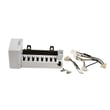
| Ice maker not working | Ice maker module/assembly | Ice maker assembly - refrigerator ice maker by whirlpool 4317943 |
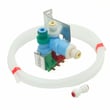
| No ice or no water | Water inlet valve not opening | Refrigerator inlet valve W10408179 |
| Frost buildup, warm temps | Defrost thermostat (bi-metal) | Refrigerator defrost bi-metal WPW10225581 |
| Noise or poor airflow | Fan blade damage/ice contact | Refrigerator evaporator fan blade WP2169142 |
Why it matters
Catching the symptom early prevents food spoilage and helps avoid secondary damage, like a fan blade hitting ice or a dispenser drip turning into a puddle. Simple steps (coil cleaning, correct filter seating, proper dispenser use) often restore normal operation without major repairs.
Last updated: February 2026
How to tell if a Kenmore refrigerator compressor is bad?
If your Kenmore 10659299994 side-by-side refrigerator is warm and the compressor runs almost nonstop, repeatedly clicks, or is unusually hot to the touch, the compressor or its start components may be failing. We confirm by ruling out airflow and defrost issues first, then checking compressor operation and electrical readings (see the 10659299994 owner's manual).
Quick symptoms that point to a compressor problem
- Refrigerator and freezer temperatures rise even though the unit seems to be running
- Repeated clicking every few minutes (often a start device trying and failing)
- Compressor is very hot and shuts off, then tries again later
- Compressor is silent when it should be running (with lights on and controls set correctly)
- You hear normal fans, but cooling does not improve
Rule out common look-alikes first (important)
Many “bad compressor” calls are actually airflow, dirty coils, or defrost problems.
- Clean the condenser coils; dirty coils reduce heat transfer and make the compressor work harder
- Listen for normal operating sounds; some clicking, gurgling, and longer run times can be normal on efficient systems
- Check door sealing; warm air leaks can mimic a weak sealed system
- Verify the evaporator fan is moving air (freezer fan noise is a good sign)
If you suspect a defrost issue (frost-packed freezer back wall, weak airflow), a failed defrost thermostat can contribute; for this model, the refrigerator defrost bi-metal WPW10225581 is a common sealed-system look-alike part.
What we check to confirm (basic vs. definitive)
| Check | What you do | What it suggests |
|---|---|---|
| Coil condition | Vacuum coils and restore airflow | Dirty coils can cause long run times and poor cooling |
| Sound pattern | Note clicking vs. steady hum | Clicking often points to start device overload or compressor lock |
| Heat at compressor | Carefully feel for excessive heat after running | Overheating can indicate high load or internal compressor trouble |
| Electrical tests | Continuity, amperage draw, start components | Confirms compressor or start device failure (best done by a tech) |
Why it matters
A compressor is part of the sealed refrigeration system. Misdiagnosing it can lead to unnecessary high-cost parts. Ruling out coil cleaning, airflow, and defrost problems first helps you target the real failure and restore proper cooling faster.
Last updated: February 2026