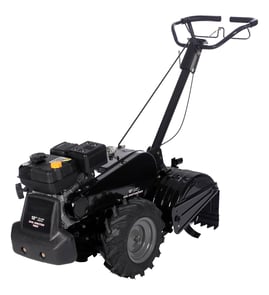
Do you push or pull a rear tine tiller?
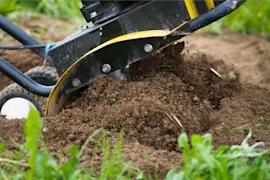
With an MTD rear-tine tiller like model 21A-340-000, you typically guide it and let it pull itself forward. The drive wheels move the tiller ahead while the rear tines dig; you keep a firm grip and steer rather than forcing it by pushing or pulling hard.
How to handle it while tilling
- Start in a low gear and use a moderate throttle so the tiller stays controllable.
- Keep both hands on the handles and steer with small corrections.
- Walk beside the freshly tilled strip (not on it) to avoid footprints and uneven compaction.
- If it surges forward, reduce throttle or shift to a slower gear.
- If it digs in and stalls, lift slightly on the handles to reduce tine bite, then continue.
Push vs. pull: what you should feel
| What you feel at the handles | What it usually means | What to do |
|---|---|---|
| It “wants to go” forward | Wheels are driving and tines are biting normally | Guide it; do not fight it |
| It drags and won’t advance | Tines are too deep, soil is too hard, or speed is too low | Raise depth stake, make a shallow first pass |
| It lunges or bounces | Too much throttle, too fast a gear, or rocky roots | Slow down; clear debris |
Why it matters
Letting the tiller pull itself forward gives you straighter passes, more even soil breakup, and less strain on your arms and back. Forcing it by pushing or pulling usually makes the tiller harder to control and can leave an uneven seedbed.
Helpful related reading
If you need help confirming you have the right model number before ordering parts or looking up diagrams, use how to find your appliance model number (and what it means for parts).
Last updated: February 2026
Where is the model number on a tiller?
On an MTD rear-tine tiller like model 21A-340-000, the model number is printed on a product ID label (a sticker or metal tag) attached to the tiller frame. It is most often on the tine shield/guard area, near the engine, or on the front of the unit.
Common places to check first
- Tine shield or tine guard (rear of the unit near the tines)
- Frame rail near the engine mount
- Front frame or handle support bracket
- Near the fuel tank area (on the frame, not on the plastic tank itself)
- Under the handlebar area where cables route
What the label looks like (and what to copy)
The label usually includes several identifiers. For parts lookup, we recommend copying:
| Label item | What it means | What to write down |
|---|---|---|
| Model number | Identifies the tiller version | 21A-340-000 (exactly as shown) |
| Serial number | Identifies your specific unit | Full serial number |
| Date code (if shown) | Helps match production run | The full code |
Tips if the label is dirty or hard to read
- Brush off packed soil and wipe with a damp rag; let it dry before reading.
- Use a flashlight at a low angle to make faded printing stand out.
- Take a close-up photo and zoom in to read worn characters.
- If the sticker is scratched, look for a second tag on the opposite side of the frame.
Why it matters
The exact model number and any serial or date code help us match the correct MTD parts diagrams and avoid ordering the wrong belts, tines, pulleys, or hardware for your rear-tine tiller.
For more help matching the correct model format for parts lookup, use how to find your appliance model number (and what it means for parts).
Last updated: February 2026
Are rear tine Tillers better?
Rear-tine tillers are better when you need maximum traction and stability for tougher jobs, especially breaking new ground or working soil with roots and rocks. For an MTD 21A-340-000 rear-tine tiller, the rear-tine design is built for larger areas and more demanding soil conditions than most front-tine models.
When a rear-tine tiller is the better choice
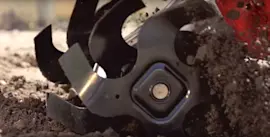
Rear-tine tillers typically outperform lighter tillers in challenging conditions because the tines are behind the wheels, helping the machine pull itself forward while maintaining control.
- Breaking new ground (compacted, never-tilled soil)
- Tilling rocky soil or areas with small roots
- Preparing larger garden plots where consistent depth matters
- Working on uneven terrain where stability reduces bouncing
- Mixing in compost or amendments more evenly across a wide area
Rear-tine vs. front-tine: quick comparison
| Feature | Rear-tine tiller (like MTD 21A-340-000) | Front-tine tiller |
|---|---|---|
| Best for | New ground, tough soil, larger plots | Existing beds, lighter soil |
| Traction/control | Higher | Lower |
| Effort to operate | Less “wrestling” | More push/pull effort |
| Typical weight | Heavier | Lighter |
What “better” depends on
A rear-tine tiller is the right tool when your priority is performance in difficult soil. If your priority is portability, tight spaces, or occasional light cultivation, a smaller tiller can be the better fit.
Why it matters
Choosing the right tine style reduces operator fatigue, helps you maintain a consistent tilling depth, and lowers the chance of the machine skipping or bouncing when it hits rocks or roots.
Helpful next step for parts and model matching
If you are comparing options or ordering maintenance items for your MTD 21A-340-000, confirm the model number from the ID tag first so you get the correct diagrams and part listings. Use how to find your appliance model number (and what it means for parts) as a quick reference.
Last updated: February 2026
Are 21A-340-000 Tillers any good?
Yes. The MTD 21A-340-000 rear-tine tiller is a solid, practical choice for typical home garden work when it’s properly maintained and set up; most owners value its digging performance and overall value, with the most common complaints tied to setup, adjustments, and normal wear items.
What “good” means for this model
A rear-tine tiller like the MTD 21A-340-000 is considered “good” when it:
- Breaks up soil consistently without excessive bouncing or stalling
- Tracks straight and feels controllable at a steady pace
- Starts reliably and holds a stable idle under load
- Has tines that bite and self-feed without needing you to force it
- Does not leak fuel or oil and does not slip belts during tilling
Quick self-check before you judge performance
Many “not good” experiences come from initial setup or a simple adjustment issue. Before deciding, we recommend checking:
- Tine condition: rounded or bent tines reduce bite and make the machine feel weak
- Belt tension and engagement: slipping belts cause poor tine drive and inconsistent digging
- Throttle and choke operation: partial choke or low throttle can mimic power loss
- Depth stake setting: too deep too fast makes any tiller bog down
- Fuel quality: old fuel causes hard starting, surging, and stalling
Typical use fit (what it’s best at)
| Task | Fit for a rear-tine tiller like 21A-340-000 | Notes |
|---|---|---|
| New garden beds in average soil | Good | Work in passes; don’t try full depth immediately |
| Mixing compost into existing beds | Very good | Shallow depth gives the best blend |
| Heavy clay or rocky soil | Fair | Expect slower progress and more tine wear |
| Tight spaces and narrow rows | Fair | Rear-tine units are larger and need turning room |
Why it matters
A tiller can feel “bad” when it’s simply set too deep, running on stale fuel, or slipping a drive belt. Getting the depth, throttle, and tine drive right is what turns a rear-tine tiller into a dependable soil-prep tool.
Helpful resource for finding the right parts
If you’re evaluating yours because it’s not performing like it should, confirm the exact model number and then match parts by model to avoid ordering the wrong belt, tine, or hardware: how to find your appliance model number (and what it means for parts).
Last updated: February 2026