Owner’s manual
 Error Codes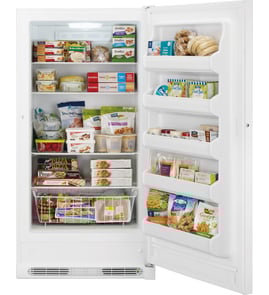


Where is the model number on a Kenmore upright freezer?
On a Kenmore upright freezer like model 25321042412, the model number is printed on a rating label inside the cabinet or around the door opening. Common spots include the upper interior (ceiling area), a side wall, behind the kick plate, or on the back of the unit; confirm the exact label location in the 25321042412 owner's manual.
- Inside the freezer on the ceiling or upper side wall
- On the left or right interior wall near the front opening
- On the door frame (around the gasket sealing surface)
- Behind the kick plate at the bottom front
- On the rear exterior panel
The rating label usually includes the model number plus other identifiers. Record these exactly:
- Model number (for example, 25321042412)
- Serial number
- Electrical rating (volts/amps)
- Manufacturing code/date (varies by unit)
| Where you found it | What it helps with |
|---|---|
| Inside cabinet or door frame | Fastest way to confirm the exact model for parts lookup |
| Behind kick plate | Common on freestanding freezer designs |
| Back of unit | Helpful when the interior label is missing or unreadable |
Using the exact model number prevents ordering the wrong Kenmore upright freezer parts (like a door gasket, thermostat, or handle hardware) and helps match diagrams and troubleshooting steps to your specific build.
Last updated: February 2026
What is the average lifespan of an upright freezer?
Most upright freezers, including the Kenmore 25321042412, typically last 12 to 15 years; a realistic overall range is 10 to 20 years with normal household use. Keeping airflow clear and the door sealing tightly does the most to reach the high end of that range.
- Condenser cleanliness: dust buildup makes the compressor run hotter and longer.
- Door seal condition: air leaks create frost and constant run time.
- Room conditions: garages and hot, humid spaces shorten life.
- How often the door is opened: frequent openings add moisture and load.
- Leveling and door closing: a door that does not self-close leads to warm air intrusion.
Use the 25321042412 owner's manual for the exact cleaning and care steps for your freezer.
- Vacuum or brush the condenser area regularly.
- Keep at least a few inches of clearance around the cabinet for airflow.
- Check the gasket for gaps; clean it with mild soap and water.
- Confirm the door closes firmly; replace worn closing hardware if needed.
- Avoid overpacking so air can circulate inside.
| What you notice | Most common cause | Best next step |
|---|---|---|
| Runs constantly, warm temps | Dirty condenser, poor airflow | Clean coils, improve clearance |
| Heavy frost, ice buildup | Door not sealing | Inspect gasket and hinges |
| Door pops open or will not stay shut | Worn closer/hinge alignment | Check door closer and leveling |
| Loud clicking, no cooling | Start/relay or compressor issue | Professional diagnosis recommended |
An upright freezer that runs longer than it should uses more electricity and wears the sealed system faster. Basic upkeep (especially airflow and sealing) reduces run time, protects the compressor, and helps food stay consistently frozen.
Last updated: February 2026
Does a Kenmore upright freezer have a reset button?
Kenmore upright freezers like model 25321042412 typically do not have a dedicated “reset” button. Most reset actions are done by power-cycling the freezer or using the temperature control interface (if your model has electronic controls); the exact reset method is listed in the 25321042412 owner's manual.
- Power reset: unplug the freezer (or switch off the breaker) for 5 minutes, then restore power.
- Control reset (if electronic): look for Up/Down temperature buttons just inside the cabinet; some versions reset when both are held together for several seconds.
- Clear a false warm alarm: after power is restored, allow the freezer time to pull down to temperature before assuming a fault.
- Thermostat models: turning the control to OFF (if present), waiting 1 minute, then turning it back on acts like a soft reset.
- Confirm the temperature control is set colder (aim for about 0°F).
- Make sure the door seals tightly; a torn gasket can cause warm temps and long run times.
- Listen for the compressor and fan operation; no sound can point to a power or control issue.
- Check for heavy frost on the back wall (possible defrost airflow problem).
- Verify the outlet has power and the cord is fully seated.
| Symptom | What it usually means | What we do next |
|---|---|---|
| Runs constantly, not cold enough | Warm air leak or dirty condenser area | Inspect door seal, airflow, and condenser area |
| Clicking, then stops | Start device or compressor issue | Schedule service level diagnosis |
| Heavy frost buildup | Defrost system or door not sealing | Defrost fully, then recheck sealing |
A “reset” can clear a control glitch after a power outage, but it will not fix mechanical issues like a failing compressor, a bad thermostat, or a leaking door seal. Using the correct reset method also prevents unnecessary part replacement.
Last updated: February 2026
Why is my Kenmore upright freezer not freezing?
If your Kenmore upright freezer model 25321042412 isn’t freezing, the problem is usually airflow, temperature control, or a sealed-system issue. Start with quick checks (power, settings, door seal, and condenser cleaning); then move to thermostat and compressor-related diagnostics using the 25321042412 owner's manual.
- Confirm the outlet has power and the cord is fully seated; inspect the freezer power cord for damage.
- Set the temperature control colder and wait 24 hours for stabilization.
- Make sure the door closes tightly and isn’t held open by bins or packages.
- Check for heavy frost on the back wall (often points to a defrost or airflow problem).
- Clean dust from the condenser area; poor heat release can stop proper freezing.
| What’s wrong | Typical symptoms | What to do next |
|---|---|---|
| Dirty condenser or restricted airflow | Runs a lot, weak freezing | Clean condenser; improve clearance and airflow |
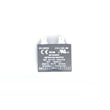
| Bad temperature control | Warmer than setting, inconsistent temps | Test/replace the freezer temperature control thermostat 5304514707 |
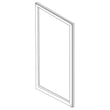
| Door not sealing | Frost buildup, warm spots near door | Inspect gasket; consider gasket,white 5304506131 if torn or deformed |
| Sealed-system or compressor problem | Runs but won’t get cold, or clicks on/off | Check for steady running and heat at condenser; service is typically required |
When an upright freezer can’t move heat out (dirty condenser) or can’t circulate cold air (frost/air blockage), temperatures rise quickly and food safety is affected. Catching a door-seal or thermostat issue early also prevents excessive run time and strain on the compressor.
- Unplug the freezer before accessing wiring or controls.
- If you use a meter, follow safe testing practices from how to use a multimeter to test electrical parts video.
- If the compressor is hot and repeatedly clicking, stop troubleshooting and have the sealed system checked.
Last updated: February 2026
Why is my Kenmore freezer leaking water on the floor?
Water on the floor from your Kenmore upright freezer model 25321042412 is usually caused by a defrost drain problem: meltwater from the automatic defrost cycle cannot flow to the drain pan, so it overflows and leaks out the front or bottom.
- Drain tube iced over or clogged (food debris, ice, or sludge blocks the drain)
- Drain pan shifted or cracked (water misses the pan)
- Door not sealing (warm air creates excess frost that later melts)
- Freezer not level (water runs the wrong direction during defrost)
- Heavy frost buildup from frequent openings or a weak door close
- Unplug the freezer.
- Remove lower bins/shelves and look for ice on the freezer floor.
- If you see ice, melt it with a hair dryer on low or warm towels (keep water away from wiring).
- Find the drain opening and flush it with hot water using a turkey baster.
- Confirm the cabinet is slightly tilted back so the door self-closes.
If the leak follows heavy frost or you notice gaps around the door, these model-compatible parts are commonly involved:
| Symptom you notice | What it points to | Example part for this model |
|---|---|---|
| Frost around door edge, moisture near gasket | Door gasket not sealing | Gasket,white 5304506131 |
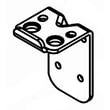
| Door pops open or does not stay shut | Door closing/cam issue | Tappan refrigerator door closer 5304511026 |
A leaking freezer is often a sign of restricted defrost drainage or excess frost production. Fixing the drain and restoring a tight door seal helps prevent repeat leaks, ice sheets on the bottom, and temperature swings that can affect frozen food.
For drain location and access details specific to model 25321042412, follow the steps in the 25321042412 owner's manual.
Last updated: February 2026
How many cubic feet is a Kenmore model 25321042412 freezer?
Kenmore upright freezer model 25321042412 is a 20.6 cu. ft. class upright freezer (commonly listed as about 20 to 21 cu. ft. depending on rounding). For the exact published capacity for your unit, confirm the “Capacity” line in the 25321042412 owner's manual.
Retailers and spec sheets often round the same capacity differently. Use these guidelines when comparing models.
- 20.6 cu. ft.: typical precise “total” capacity listing
- 20 cu. ft. or 21 cu. ft.: rounded total capacity
- “Usable” capacity: slightly lower because shelves, bins, and airflow channels take space
- If you are planning placement, check exterior dimensions in the manual too
| Spec label | What it means | What to use it for |
|---|---|---|
| Total capacity | Full interior volume rating | Comparing freezer sizes |
| Usable capacity | Space you can realistically pack | Storage planning |
| Rounded capacity | Marketing-friendly number | Quick shopping comparisons |
Capacity affects how much food you can store without blocking airflow. Overpacking an upright freezer reduces circulation around the evaporator and can cause warm spots or longer run times.
If the door does not seal well, frost buildup can reduce usable space and cooling performance.
- Inspect the door seal for gaps, tears, or hardened sections
- Clean the gasket and cabinet mating surface with mild soap and water
- Make sure the freezer is level so the door closes firmly
- Replace a worn seal with the correct part for your model
Helpful part reference: gasket,white 5304506131
Last updated: February 2026