Installation guide
 Owner’s manual


What model is my Kenmore Elite dishwasher?
Your Kenmore Elite dishwasher model number is printed on the rating label located just inside the dishwasher door opening, typically along the left-hand side of the tub frame. Match that number exactly (for example, 2214815N612) when looking up parts and manuals.
Check these common spots on Kenmore dishwashers:
- Inside the door opening on the left side of the tub frame (most common)
- Along the top edge of the door opening
- On the right side of the tub frame (less common)
- On the side of the door itself (some designs)
Record the information exactly as shown on the label:
- Model number (used to match the correct parts diagrams)
- Serial number (helps identify production details for the unit)
- Any suffix letters/numbers after the model (they can change compatible parts)
Kenmore Elite dishwashers often share similar looks across multiple series, but internal parts like the door latch, water inlet valve, heating element, and racks can differ by model. Using the exact model number prevents ordering the wrong replacement part.
| Item on label | What it’s used for | When you need it |
|---|---|---|
| Model number | Parts compatibility and diagrams | Always, before ordering parts |
| Serial number | Unit identification details | Helpful for service and exact configuration |
Once you confirm your model number, use the matching documentation for operating and care details:
- Review the 2214815N612 owner's manual for label location guidance, cycle features, and care tips.
Last updated: February 2026
Does the Kenmore Elite dishwasher have a filter to clean?
Yes. The Kenmore Elite dishwasher model 2214815N612 uses a removable filter system that you should clean periodically to prevent poor washing, odors, and draining issues. For the exact filter location and removal details for your unit, follow the steps in the owner's manual.
We recommend cleaning the filter whenever you notice grit on dishes, slow draining, or a musty smell.
- Turn off the dishwasher and let it cool if it just ran.
- Remove the lower rack to access the filter area.
- Rotate the upper filter assembly about a quarter turn counterclockwise to unlock it.
- Lift out the upper filter, then grasp and pull the lower filter forward to remove it.
- Rinse both filters under running water; use a soft brush to remove stuck-on soil.
- Reinstall the lower filter first, then lock the upper filter back in place.
A clean filter helps, but it will not fix every wash or drain complaint. Check these common causes next:
- Spray arms clogged with debris or hard-water buildup
- Overloading or blocking the detergent dispenser
- Low rinse aid causing poor drying and spotting
- Drain path restrictions (air gap, disposer inlet, or hose routing)
- Door not closing and latching consistently
| Symptom | Most common cause | What to do next |
|---|---|---|
| Grit on glasses | Filter or spray arm debris | Clean filter; clear spray arm holes |
| Water left in tub | Drain restriction | Inspect drain hose routing and sink connection |
| Cloudy film | Low rinse aid or hard water | Fill rinse aid; run a cleaner cycle |
| Poor drying | No rinse aid, plastic-heavy load | Use rinse aid; adjust loading |
Your dishwasher recirculates wash water through the sump area; when the filter is clogged, water flow drops and soils can redeposit on dishes. Keeping the filter clean helps the pump, spray arms, and drain system work as designed.
Last updated: February 2026
How many cubic feet is my Kenmore Elite washer?
Your Kenmore Elite 2214815N612 is a dishwasher model, not a washer; dishwashers are not rated in cubic feet the way laundry washers are. For the correct capacity-style specs for this model (rack layout, place settings, and cycle details), use the 2214815N612 owner's manual.
Dishwasher “capacity” is typically described by how many place settings it holds and how the racks are configured.
Common capacity indicators include:
- Place settings (typical full-size built-in units are often around 12 to 16)
- Rack count and adjustability (upper rack height adjusters, third rack)
- Silverware basket size and layout
- Tall-tub clearance for plates and cookware
| Appliance type | Capacity is usually listed as | What it tells you |
|---|---|---|
| Laundry washer | Cubic feet (cu. ft.) | How much clothing the tub holds |
| Dishwasher | Place settings and rack layout | How many dishes fit per load |
Using the right capacity measurement helps you compare appliances accurately and choose the right replacement parts. For example, if racks are hard to roll or won’t stay aligned, that is a rack hardware issue, not a “capacity” issue.
If you are troubleshooting rack fit or movement on this Kenmore Elite dishwasher, these model-matched parts are commonly involved:
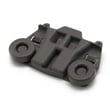
- Dishwasher dishrack roller assembly, lower WPW10195417
- Dishwasher dishrack adjuster WPW10546503
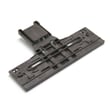
- Dishwasher dishrack, upper W10727422
Last updated: February 2026
Is it worth repairing a Kenmore dishwasher?
Yes, repairing a Kenmore Elite dishwasher like model 2214815N612 is worth it when the problem is a common wear item (rack rollers, latch, inlet valve, drain hose) and the tub and motor are in good shape; you typically spend far less than replacement and avoid a full reinstall. Use the 2214815N612 installation guide to understand what’s involved if a repair requires pulling the dishwasher.
Repair usually makes sense when the dishwasher is cleaning well overall and you’re dealing with a specific failure.
- The door won’t latch or the unit won’t start because the door isn’t closing securely (common latch issues)
- You have a fill problem tied to the inlet valve or supply connection
- You have a drain issue related to the drain hose routing or a worn hose
- Racks are hard to roll, sagging, or not adjusting correctly (rollers and adjusters wear out)
- The dishwasher is otherwise quiet, not leaking, and cycles normally
| Symptom | Likely area | Example part on this model |
|---|---|---|
| Door won’t close or start | Door latch | Dishwasher door latch WPW10653840 |
| Not filling or fills slowly | Water inlet | Dishwasher water inlet valve WPW10327249 |
| Not draining or leaking at hose | Drain path | Dishwasher drain hose 8269144A |
| Lower rack falls off track | Rack wheels | Dishwasher dishrack roller assembly, lower WPW10195417 |
Replacement is the practical call when repairs stack up or the core wash system is failing.
- Multiple breakdowns in a short period (more than one major repair in a year)
- Persistent leaks from the tub area or recurring electrical issues
- Poor wash performance even after cleaning filters and spray paths
- A major drive or wash-circulation failure that requires a high-cost motor/sump repair
A dishwasher repair can be a quick, targeted fix, but replacement becomes smarter when the failure is in the core wash system or when you’re repeatedly paying for labor and downtime.
- Confirm the door closes and latches firmly (a mis-latch can mimic a “won’t start” problem)
- Look for obvious leaks under the unit and at the drain hose connection
- Verify the water supply is on and the fill line is not kinked
- If you need to pull the dishwasher, follow enclosure and clearance guidance so the motor and lines are protected (covered in the installation instructions)
Last updated: February 2026
What are common problems with Kenmore dishwashers?
Common problems with the Kenmore Elite dishwasher model 2214815N612 include not starting (often a door-latch issue), not draining, poor cleaning from weak spray, leaks around the door, and drying problems tied to heating. For model-specific operating checks and safety steps, use the 2214815N612 installation guide.
- Won’t start or stops mid-cycle: door not latching, control not responding, power supply issue
- Won’t drain: kinked or blocked drain hose, drain path restriction, pump issue
- Not cleaning well: clogged spray path, diverter not routing water correctly, loading issues
- Leaking: lower door seal wear, door not closing evenly, hose connection seepage
- Not drying: heating circuit issue, heater problem, rinse aid or cycle selection
- Confirm the door closes firmly and the latch engages; a weak latch can prevent the cycle from starting.
- Verify the dishwasher is properly installed with correct utility routing so hoses and wiring do not contact the motor.
- Check the drain hose routing for kinks and make sure it is not pinched behind the unit.
- Run hot water at the sink before starting a cycle to improve wash performance.
- Clean the interior and follow routine maintenance steps to prevent odor and buildup.
| Symptom | Common part involved | Example part on this model |
|---|---|---|
| Won’t start | Door latch | Dishwasher door latch WPW10653840 |
| Won’t fill | Water inlet valve | Dishwasher water inlet valve WPW10327249 |
| Won’t drain or drains poorly | Drain hose | Dishwasher drain hose 8269144A |
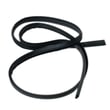
| Leaks at bottom of door | Lower door seal | Dishwasher door seal, lower W10909089 |
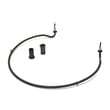
| Not drying | Heating element | Element assembly W10703867 |
These symptoms often overlap. For example, a door that is slightly out of balance can stress the latch and cause intermittent “won’t start” complaints. The installation guide also calls out critical safety and fit items (grounding, keeping lines away from the motor, and avoiding carpeted flooring) that directly affect reliability.
Last updated: February 2026