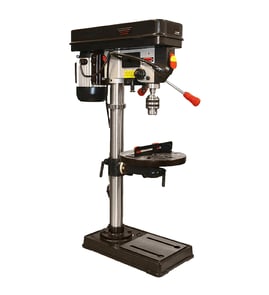

Are there any American made drill presses?
Yes, American-made drill presses still exist, but they are typically premium, industrial-grade machines or rebuilt vintage tools. For a Craftsman 351226150 10" drill press, most comparable new benchtop models in this size and price range are commonly manufactured overseas, while USA-made options are usually heavier-duty and higher cost.
Country-of-origin can vary by brand, model line, and production year. In practice, you will see three common buckets:
- New, USA-made industrial presses: built for production shops; higher horsepower, heavier castings, and tighter tolerances.
- Vintage USA-made presses: older Delta, Rockwell, Walker-Turner, and similar machines; often excellent if restored and properly aligned.
- Imported hobby and light-duty presses: the most common category for 10-inch benchtop drill presses.
Use these checks before you buy, especially if “made in USA” is a must-have:
- Look for a country-of-origin plate on the head or motor housing.
- Ask for the exact model number and serial number, then confirm the manufacturing location for that specific unit.
- Verify spindle runout and quill play; precision matters more than paint.
- Confirm parts availability (belts, bearings, switches, quill return spring).
- Check power requirements (120V vs 240V) and motor condition.
| What you care about | USA-made industrial or restored vintage | Typical imported 10-inch benchtop |
|---|---|---|
| Price | Higher | Lower |
| Weight and rigidity | Higher | Moderate |
| Precision potential | High (if in good condition) | Varies by model |
| Parts support | Varies by age/brand | Often available, model-specific |
A drill press is all about alignment and rigidity. If you are drilling accurate holes in metal, using Forstner bits, or doing repeatable woodworking, a heavier USA-made (or well-restored vintage) press can deliver better results than a lighter benchtop unit.
For help confirming you have the right Craftsman model before ordering parts or comparing alternatives, use how to find your appliance model number (and what it means for parts).
Last updated: February 2026
How much does a Craftsman 351226150 drill press weigh?
The exact weight for the Craftsman 351226150 drill press varies by configuration (bench mounting, motor, and accessories), but most 10-inch benchtop drill presses of this type typically weigh about 50 to 80 lb. Use the model number to match the correct specs and parts for your specific unit.
Most Craftsman 10-inch drill presses similar to model 351226150 fall into these ranges:
- 50 to 60 lb: lighter benchtop builds, minimal accessories
- 60 to 80 lb: heavier head casting, larger motor, more robust table
- 80 lb+: uncommon for 10-inch benchtop units; usually indicates a larger floor model
If you need the weight for moving, shipping, or mounting, these checks get you the most accurate number:
- Look for a rating/spec label on the head, column, or base
- Check any original carton or packing slip if you still have it
- Weigh the drill press in two pieces (head assembly and base/column) using a bathroom scale
- Remove add-ons before weighing (vise, work light, auxiliary table, chuck key holder)
- Record whether it is bench-mounted or free-standing during measurement
| Task | What we plan for | Why |
|---|---|---|
| Carrying | 2 people for 60 lb+ | Safer control of the head and column |
| Bench mounting | 3/4-inch plywood top minimum (typical) | Reduces flex and vibration |
| Lifting | Separate head from column when possible | Prevents tipping and back strain |
Weight affects stability, drilling accuracy, and safety. A heavier head and base usually means less vibration, cleaner holes, and less chance of the drill press walking on the bench during larger bit or hole saw work.
For model identification help before ordering parts, use how to find your appliance model number (and what it means for parts).
Last updated: February 2026
What do you need to do to raise or lower the table of the drill press?
To raise or lower the table on your Craftsman 351226150 10" drill press, we unlock the table clamp, move the table to the desired height using the table lift mechanism (or by supporting and sliding it on the column), then re-lock the clamp so the table cannot slip during drilling.
- Unplug the drill press for safety.
- Support the table with one hand (tables are heavy and can drop suddenly).
- Loosen the table lock or clamp lever so the table bracket can move on the column.
- Use the table crank/handle (if equipped) to raise or lower the table; otherwise slide the table assembly up or down the column in a controlled way.
- Re-tighten the table lock or clamp lever firmly.
- Confirm the table is secure by pushing down and side-to-side before drilling.
Common causes and what we do:
| Symptom | Likely cause | What to do |
|---|---|---|
| Table will not budge | Clamp still tight | Loosen the lock lever more, then try again while supporting the table |
| Table moves but binds | Dust, rust, or pitch on the column | Clean the column and apply a light coat of dry lubricant or paste wax |
| Table drops when unlocked | Worn clamp surfaces or not enough tightening | Tighten firmly; if it still slips, inspect the clamp and bracket for wear |
| Crank turns but table does not lift | Lift gear/rack issue (if equipped) | Inspect the rack and pinion area for damage or misalignment |
A properly locked table keeps the workpiece level and prevents the bit from grabbing, which improves hole accuracy and reduces the chance of the workpiece spinning or the table shifting mid-cut.
For electrical troubleshooting while the tool is unplugged (for example, checking a switch or cord), we use a meter and follow safe testing practices in how to use a multimeter to test electrical parts video.
Last updated: February 2026
Where is the model number on a Craftsman drill press?
On Craftsman drill press model 351226150, the model number is printed on the drill press identification plate or label. On many Craftsman drill presses, that label is most often found on the head (motor/pulley housing) or on the column; check the base last.
Start with the spots that are most commonly used on Craftsman drill presses:
- Head assembly (motor or belt/pulley cover area), often near the switch
- Side or rear of the head casting
- Column near the base or behind the table support
- Rear of the base or the side of the base casting
- Inside the belt cover (occasionally)
The tag can be a metal plate, foil label, or printed sticker. Write down everything you see.
| Label item | Example | Why we need it |
|---|---|---|
| Model number | 351226150 | Matches the correct parts diagrams and lists |
| Serial number | Varies | Helps identify production run details |
| Electrical rating | Volts/amps/Hz | Useful for motor and switch troubleshooting |
Use these steps to still get the right parts:
- Look for adhesive residue or a faded outline where a label used to be
- Check the motor nameplate for electrical ratings (not the drill press model, but helpful)
- Note key features (belt cover style, table crank style, switch location) to compare with diagrams
- Clean the area gently; sawdust and oil can hide printing
Craftsman drill presses share many similar-looking parts across different versions. Using the exact model number 351226150 prevents ordering the wrong belt, switch, chuck, spindle, or quill components.
For a quick walkthrough on locating and using the ID tag, see how to find your appliance model number (and what it means for parts).
Last updated: February 2026
Who made Craftsman drill presses?
Craftsman drill presses were built by multiple manufacturers over the years under the Craftsman name, so the maker depends on the era and the specific model. For the Craftsman 351226150 10" drill press, the most reliable way to identify the original manufacturer is to match the model number and data plate details using how to find your appliance model number (and what it means for parts).
Craftsman-branded drill presses have commonly been sourced from different companies across decades. These are the names customers most often run into when researching vintage and newer units:
- King-Seeley (many older, vintage Craftsman tools)
- Emerson Electric (common on mid-era Craftsman drill presses)
- Atlas Press Company (some early Craftsman tool production)
- Walker-Turner (some early to mid vintage units)
- Later production from various global suppliers (varies by year and retailer ownership)
Because Craftsman used multiple suppliers, we recommend identifying the maker using the drill press itself, not just the Craftsman badge.
- Find the data plate or rating label (often on the head, column, or base)
- Record the full model number (for this page: 351226150) and any serial number
- Note motor specs (HP/amps/voltage) and the wiring diagram location if present
- Look for casting marks or stamped codes on the head or pulley cover
- Compare those details when ordering parts to ensure correct fit
This is a practical way to think about Craftsman tool IDs when you are trying to trace origin.
| What you have | What it usually indicates | Why it helps |
|---|---|---|
| Full model number (example: 351226150) | A specific production run and supplier relationship | Best key for parts lookup |
| Serial number | Factory and build sequence | Helps date the unit |
| Data plate codes | Internal manufacturer identifiers | Can point to the OEM |
The original manufacturer affects parts compatibility (belts, pulleys, quill bearings, switches, and depth stop hardware). Two Craftsman drill presses can look similar but use different spindle assemblies or motor mounts, so matching the exact model number prevents wrong-part returns.
Last updated: February 2026