Installation guide
 Owner’s manual
 Error Codes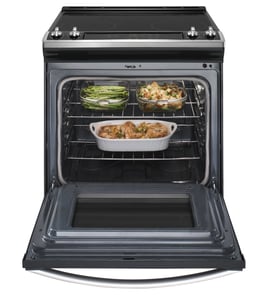




Do electric stoves use a lot of electricity?
Electric stoves like the GE JBS60DK2WW can use a noticeable amount of electricity, but the real cost depends on how long you cook and which elements you use. Most cooktop elements and ovens cycle on and off to hold temperature, so they rarely draw maximum wattage continuously.
Typical electricity use (what to expect)
Electric ranges are high-wattage appliances, but they are used in short bursts compared to HVAC or water heating.
- Cooktop surface elements commonly draw about 1,000 to 3,000 watts each, depending on size and setting.
- Oven bake and broil elements commonly draw about 2,000 to 5,000 watts.
- The oven often cycles power to maintain temperature (you may hear relays clicking); this is normal.
- Using lids, matching pan size to the element, and avoiding long preheats reduces energy use.
- If cooking seems slow, your home voltage or cookware can be a factor (flat-bottom pans heat more efficiently).
Quick cost estimate (kWh and dollars)
Your electric bill is based on kilowatt-hours (kWh). Use this simple estimate:
- kWh = (watts ÷ 1,000) × hours used
| Example use | Approx. power | Time | Approx. energy |
|---|---|---|---|
| One 2,000W burner on medium-high | 2.0 kW | 1 hour | 2.0 kWh |
| Oven baking at 3,000W average cycling | 3.0 kW | 1 hour | 3.0 kWh |
| Simmering on a small element (1,200W) | 1.2 kW | 1 hour | 1.2 kWh |
For model-specific operating tips and features that affect energy use (preheat behavior, element sizes, special modes), follow the guidance in the JBS60DK2WW owner’s manual.
Why it matters
Understanding wattage helps you estimate operating cost, choose the right surface element for the pan, and spot performance issues. For example, if a burner will not maintain a rolling boil, the manual points to cookware fit and household voltage as common causes.
Last updated: January 2026
How many amps is a GE electric range?
Most GE electric ranges, including model JBS60DK2WW, are designed for a 240-volt, 40- or 50-amp dedicated circuit; the exact required amperage depends on the range’s rated wattage and the breaker size specified for your installation.
What to check for the correct amperage
Use these quick checks to match your home wiring to the range requirements:
- Look for the circuit breaker size labeled in your electrical panel (commonly 40A or 50A).
- Confirm the wire gauge feeding the range circuit (commonly 8 AWG for 40A, 6 AWG for 50A; copper conductors).
- Verify the range is on a dedicated 240V circuit (no other appliances on that breaker).
- Check the rating label on the range (often behind the storage drawer or behind the oven door area) for watts/amps.
- Follow the connection method and strain relief details in the JBS60DK2WW installation guide.
Typical amp draw (what you will see in real use)
Even on a 40A or 50A circuit, the range does not pull full current all the time. Heating elements cycle on and off to hold temperature.
| Range function | Typical electrical load | What that means for amps |
|---|---|---|
| One surface element | Moderate | Cycles; varies by element size and setting |
| Bake element | High | Cycles to maintain set temperature |
| Broil element | High | Often higher draw while broiling |
| Multiple elements at once | Highest | Most likely time to approach circuit capacity |
Why it matters
Using the correct amperage protects the wiring and helps prevent nuisance breaker trips, slow heating, and overheated connections at the terminal block. If you see heat damage or arcing at the power connection, replacing the range terminal block WB17T10011 is a common repair after the underlying wiring issue is corrected.
Last updated: January 2026
What type of electric stove is best?
The best type of electric stove depends on how you cook: induction is fastest and most precise, radiant smooth-top is the most common all-around choice, and coil is the most budget-friendly. Your GE JBS60DK2WW is a radiant glass cooktop range, so cookware fit and flatness matter as much as features. See the JBS60DK2WW owner’s manual for cookware and cooking-mode guidance.
Quick comparison: induction vs radiant vs coil
| Type | Best for | Pros | Tradeoffs |
|---|---|---|---|
| Induction | Speed, control, efficiency | Very fast boil, precise simmer, cooler cooktop | Needs magnetic cookware, higher upfront cost |
| Radiant smooth-top (glass) | Everyday cooking, easy wipe-down | Widely available, even heating, modern look | Slower response than induction; glass can scratch |
| Coil | Value and durability | Lowest cost, simple parts | Less even heating; harder to clean |
What we recommend for a radiant glass cooktop like GE JBS60DK2WW
Radiant glass cooktops perform best when the pan makes full contact with the surface and heats evenly.
- Use flat-bottom cookware; warped or ridged bottoms heat unevenly.
- Avoid letting pans boil dry; overheated metal can bond to the glass.
- Skip woks with support rings; use a flat-bottom wok instead.
- Choose cookware materials that match your goal: shiny pans for even baking, dark coated pans for more browning.
- Do not cover the oven bottom with foil or liners; trapped heat can damage the range.
Cookware tips that improve results (and protect the cooktop)
- Best everyday choices: stainless steel or aluminum with a flat, smooth base.
- Use with caution: cast iron unless specifically designed for glass cooktops (it can scratch and heats slowly).
- Avoid for performance: glass-ceramic and stoneware on the cooktop (poor performance and may scratch).
Why it matters
Choosing the “best” electric stove is really about matching heat control and cookware to your cooking style. On radiant glass models like JBS60DK2WW, the right pans help you get faster heat-up, more even baking, and fewer cooktop stains or scratches.
Last updated: January 2026