Installation guide
 Owner’s manual
 Error Codes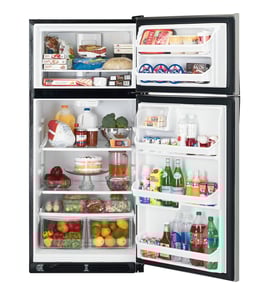



Are top mount or bottom mount fridges better?
For most households, a top-mount refrigerator like the Frigidaire FFHT1816PS3 is the better all-around choice because it’s typically more energy-efficient and less expensive to buy and repair; a bottom-mount is often better for convenience because fresh food sits at eye level.
| Feature | Top mount (freezer on top) | Bottom mount (freezer on bottom) |
|---|---|---|
| Fresh-food access | You bend more | More comfortable, less bending |
| Freezer access | Easier to reach | You bend more |
| Energy use (typical) | Often lower | Often higher |
| Purchase price (typical) | Often lower | Often higher |
| Repair cost (typical) | Often lower | Often higher |
- You want strong value and lower operating cost.
- You use the freezer often and want it at a comfortable height.
- You prefer simpler features and fewer components to maintain.
- You want a layout that’s easy to fit in many kitchens.
- You use fresh food most and want it at eye level.
- You want less bending for everyday items (milk, produce, leftovers).
- You prefer wider refrigerator shelves and drawers (common on many bottom-mount designs).
“Better” usually comes down to how you load groceries and how often you use the freezer. If you open the refrigerator door far more than the freezer, a bottom-mount can feel more comfortable day to day. If you want efficiency and simplicity, a top-mount like FFHT1816PS3 is usually the smarter long-term value.
A fridge that isn’t level can have doors that don’t close as smoothly, which hurts cooling performance and can waste energy. For FFHT1816PS3, follow the leveling and clearance guidance in the FFHT1816PS3 installation guide.
- Keep the cabinet level side-to-side.
- Slightly tilt the refrigerator back so doors close freely.
- Maintain airflow clearances around the sides, top, and back.
Last updated: January 2026
What is the life expectancy of a top freezer refrigerator?
A top-freezer (top-mount) refrigerator like the Frigidaire FFHT1816PS3 typically lasts 10 to 15 years. With consistent basic care (good airflow, clean seals, stable temperatures), many units reach the upper end of that range before major sealed-system repairs become more likely.
- Condenser airflow and cleanliness: restricted airflow makes the compressor work harder.
- Door seal condition: air leaks cause longer run times and moisture problems.
- Temperature stability: frequent warm-ups and overstuffing increase wear.
- Defrost performance: heavy frost can reduce cooling and strain the system.
- Electrical supply: a dedicated grounded outlet helps prevent nuisance power issues.
Use these habits to reduce compressor run time and prevent common failures:
- Keep the refrigerator level and slightly tilted back so doors close reliably.
- Confirm the door seals fully contact the cabinet on all sides.
- Set temperatures, then allow about 24 hours for temperatures to stabilize after adjustments.
- Clean spills and manage odors; covered foods help prevent lingering smells.
- Replace failed interior lighting promptly if needed (a working light switch also confirms the door is closing correctly).
| Item | Typical target | Why it matters |
|---|---|---|
| Refrigerator section | ~37°F | Food safety and less compressor run time |
| Freezer section | ~0°F | Proper ice production and stable freezing |
| After temp changes | ~24 hours to stabilize | Prevents over-adjusting and temperature swings |
If your FFHT1816PS3 is near the 10 to 15 year mark, these issues often signal higher-cost repairs:
- Warm refrigerator with a cold freezer (airflow or defrost issue)
- Loud or intermittent fan noise
- Frost buildup on the back freezer panel
- Doors not sealing, causing sweating or ice buildup
For model-specific operating and care guidance (including leveling and temperature setting basics), follow the FFHT1816PS3 owner's manual.
Knowing the typical lifespan helps you decide whether to maintain, repair, or plan a replacement. Simple steps like keeping doors sealing and temperatures stable reduce run time, which is the biggest driver of wear on a top-freezer refrigerator.
Last updated: January 2026
What are the disadvantages of a top mount fridge?
Top-mount refrigerators like the Frigidaire FFHT1816PS3 are reliable and efficient, but the main disadvantages are convenience and organization: you bend more to reach fresh food, the freezer is at eye level, and premium features (like in-door ice and water) are less common. See the FFHT1816PS3 owner's manual for model-specific features and setup details.
- Fresh-food access is lower: you reach down more often for produce, drinks, and leftovers.
- Less “grab-and-go” organization: many top-mount designs have fewer specialty bins and adjustable zones than some bottom-freezer styles.
- Fewer built-in dispenser options: in-door water and ice are less common on this style.
- Freezer can feel crowded: stacking is common, and small items can get buried.
- Door swing and placement limits: you may need extra space on the hinge side for full door opening.
Some “disadvantages” are really setup issues that affect performance and usability. For FFHT1816PS3, we recommend:
- Level the cabinet so doors close freely; the refrigerator should tilt about 1/4 inch (6 mm) front-to-back.
- Keep airflow clear; do not block the toe grille.
- Follow clearance guidance for ventilation: 3/8 inch at sides and top, 1 inch at the back.
- If you do not connect a water supply, keep the ice maker turned OFF.
| Concern | What you can do | Why it helps |
|---|---|---|
| Bending to reach fresh food | Store daily items on upper shelves | Reduces strain and improves access |
| Tight door swing near a wall | Allow extra hinge-side space | Prevents door interference |
| Temperature complaints after changes | Wait 24 hours after control changes | Stabilizes cooling before re-adjusting |
Top-mount refrigerators are often chosen for value and simplicity, but layout and placement affect day-to-day comfort. Proper leveling, clearances, and control adjustments help the FFHT1816PS3 run efficiently and keep temperatures stable.
Last updated: January 2026
What is the most common problem with a Frigidaire refrigerator?
Cooling problems are the most common issue we see with Frigidaire refrigerators, including the Frigidaire FFHT1816PS3. Most “not cold enough” complaints trace back to restricted airflow, dirty condenser coils, a weak evaporator fan, or doors that are not sealing tightly; start with the checks in the FFHT1816PS3 owner's manual.
- Refrigerator section is warm but freezer seems OK
- Freezer is warm and ice cream is soft
- Frost buildup on the back wall of the freezer
- Fridge runs a lot or seems louder than normal
- Water leaks or puddles near the unit
- Confirm power and controls: Make sure the plug is fully seated and the temperature controls are not set to “0” (that setting stops cooling even though lights may still work). See the FFHT1816PS3 owner's manual.
- Clean condenser coils: Dust and pet hair reduce heat transfer and can cause long run times and warm temps.
- Check airflow: Do not block vents with food packages; leave space around the back wall.
- Inspect door gaskets: Look for gaps, tears, or areas that do not grip paper when the door is closed.
- Listen for the evaporator fan: In many top-mount designs, a failing fan reduces cold air circulation to the fresh food section.
If basic cleaning and airflow checks do not help, these parts are often involved:
| Symptom | Common cause | Example part for FFHT1816PS3 |
|---|---|---|
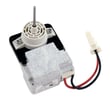
| Fridge warm, freezer OK | Weak/no evaporator airflow | Refrigerator evaporator motor 242077705 |
| Warm temps, long run time | Poor heat removal under/behind unit | Refrigerator condenser fan motor 242018301 |
| Heavy frost, warming over time | Defrost system not clearing frost | Refrigerator defrost heater 242044008 |
Cooling issues usually get worse over days to weeks. A small airflow restriction can turn into temperature swings, food spoilage, and excessive compressor run time. Addressing the basics early (controls, coils, airflow, door seal) prevents bigger repairs.
Last updated: January 2026