Owner’s manual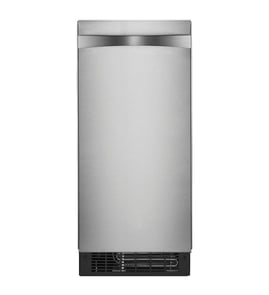







What is the average lifespan of an ice maker?
Most freestanding residential ice makers like KitchenAid model KUIS15NRTB0 typically last about 5 to 10 years. With consistent cleaning, good water quality, and proper leveling and ventilation, it’s common to reach the upper end of that range.
Typical lifespan ranges
| Ice maker type | Typical lifespan | What most affects it |
|---|---|---|
| Residential freestanding (like KUIS15NRTB0) | 5 to 10 years | Water hardness, cleaning frequency, airflow |
| Light commercial / higher-duty units | 7 to 10 years | Duty cycle, maintenance schedule |
| Well-maintained units in ideal conditions | Up to 15 years | Excellent water quality and regular descaling |
What extends the life of KUIS15NRTB0
Mineral scale is the biggest long-term wear factor in the water system. The manual notes that hard water can require system cleaning as often as every 6 months.
- Clean and descale the ice maker system on a regular schedule (more often with hard water)
- Keep the unit level to prevent operational issues (ice can hang between the evaporator plate and cutter grid if the unit is not level)
- Maintain good airflow around the cabinet so the refrigeration system can reject heat
- Use water that is properly filtered or treated for hardness when possible
- Follow the shutdown, vacation, and restart steps to avoid stagnant water and scale buildup
For the exact cleaning cycle and care steps for this model, follow the KUIS15NRTB0 owner’s manual.
Signs your ice maker is nearing end-of-life
- Ice production slows even after a full cleaning cycle
- Ice quality changes (thin, hollow, or fused slabs)
- Repeated freezing issues at the evaporator plate or cutter grid area
- Water system problems that return soon after service
- Unusual increases in noise beyond the normal operating sounds
Why it matters
A freestanding ice maker is a small refrigeration system plus a water system. When scale builds up, the unit works harder, parts wear faster, and ice production and quality drop. Regular cleaning and correct setup protect expensive components like the compressor and evaporator.
Last updated: January 2026
Why is my KitchenAid icemaker not making ice?
If your KitchenAid freestanding ice maker model KUIS15NRTB0 isn’t making ice, the most common causes are the control being OFF, a power issue, the unit not being level (ice stuck between the evaporator and cutter grid), or mineral scale buildup that needs a cleaning cycle. Use the steps in the KUIS15NRTB0 owner's manual to confirm normal startup and troubleshooting.
Quick checks that fix most “no ice” problems
- Confirm the ice maker control is set to ON.
- Verify the power cord is plugged into a grounded 3-prong outlet (no adapter or extension cord).
- Check the home fuse or circuit breaker and reset if needed.
- Make sure the unit is level; ice can jam between the evaporator plate and cutter grid if it’s out of level.
- Run a cleaning cycle if ice production has dropped or scale is suspected.
What “normal” looks like after startup
When you first start KUIS15NRTB0, it can sound like water is running continuously because it performs a rinse cycle before it begins making ice (about 5 minutes). After that, the ice maker cycles at preset temperatures and the bin sensor monitors ice level.
| Symptom | Likely cause | What to do first |
|---|---|---|
| Runs but no ice drops | Ice jam at evaporator/cutter grid | Level the unit; then run a cleaning cycle |
| No lights/no sound | Power supply problem | Check outlet, breaker/fuse |
| Ice production slowed | Mineral scale buildup | Clean the ice making system |
| Thin/soft/clumpy ice | Water quality or low usage | Filter/treat water; break up clumps |
Parts that commonly relate to “no ice” on this model
If the basics check out and you still have no ice, these model-listed parts are often involved in water delivery or ice sensing:
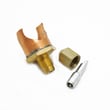
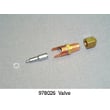
- Valve WPW10217917 (water inlet valve)
- Water tube W10823511 (water tube)
- Ice maker bin thermostat WPW10503764 (bin thermostat)
Why it matters
This ice maker is designed to circulate water over a freezing plate and then release a sheet of ice onto a cutter grid. If the unit is out of level or scale builds up, the sheet may not release or cut correctly, stopping production and stressing components.
Last updated: January 2026
Is it worth replacing the ice maker on a refrigerator?
Yes, it’s worth replacing a refrigerator ice maker when the refrigerator cools normally and the problem is limited to the ice system (water supply, valve, thermostat, or wiring). If cooling performance is poor or major repairs are piling up, replacement is the better value. For care and troubleshooting steps that prevent repeat failures, use the KUIS15NRTB0 owner's manual.
Quick decision checklist
- Replace the ice maker if the refrigerator temperature is stable and only ice production is affected.
- Replace the refrigerator if cooling is unreliable, the compressor is struggling, or multiple systems are failing.
- Choose a standalone unit if you want ice production independent of the refrigerator.
- Do maintenance first if ice is thin or output is low (condenser airflow, scale, room temperature).
- If you see ice hanging up between the evaporator plate and cutter grid, level the unit first.
What we check first (often fixes “bad ice maker” symptoms)
The KitchenAid KUIS15NRTB0 manual highlights common causes of low production: hot room temperatures, dirty condenser airflow, and scale buildup.
- Clean lint and dust from the condenser area.
- Run a cleaning cycle if you see white scale.
- Confirm the drain cap is tight (a loose cap can cause thin ice or no ice).
- Verify the unit is level so ice releases and cuts correctly.
Repair vs. replace: common scenarios
| Symptom | Most common path | Best choice |
|---|---|---|
| Fridge cools fine, no ice | Ice-system repair | Replace ice maker/ice parts |
| Ice is thin or slow | Maintenance and water checks | Repair and maintain |
| Fridge not cooling well | Sealed-system diagnosis | Replace refrigerator |
Parts that commonly relate to ice problems on KUIS15NRTB0
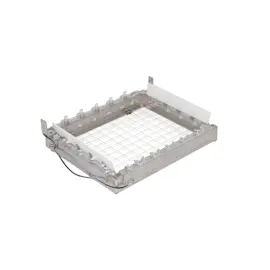
- Ice maker cutter grid WP2313637 (cuts the ice sheet into cubes)
- Freestanding ice maker cleaner W11179302 (removes scale that reduces production)
Why it matters
Ice makers are sensitive to airflow, water quality, and temperature. Fixing the root cause first helps you avoid buying parts you do not need and improves long-term reliability.
Last updated: January 2026