Installation guide
 Owner’s manual
 Error Codes


How do I find the size of my Kenmore refrigerator?
To find the size of your Kenmore refrigerator model 10651564104, we use two different measurements: the outside dimensions (height, width, depth) and the storage capacity (cubic feet). Your owner's manual shows installation clearances and setup details; for exact cabinet dimensions, measure the refrigerator itself.
Use a tape measure and record in inches:
- Height: floor to top of hinge cover (or top of cabinet if you need cabinet-only height)
- Width: left edge to right edge across the front
- Depth: front of doors to back (measure with handles and without handles if possible)
- Door swing clearance: leave room for doors to open fully
For this style of refrigerator, we follow the clearance guidance in the manual:
- 1/2 inch space on each side and at the top for ventilation
- At least 2 inches next to a fixed wall (varies by setup) so doors can swing open
- Extra space behind if you have an ice maker and water line connection
If you want a quick estimate of cubic feet (useful for comparing models), we calculate the inside volume:
- Measure interior height, width, and depth of the fresh food section and freezer section
- Multiply each section’s measurements (in inches) to get cubic inches
- Add the two sections together
- Divide by 1,728 (cubic inches per cubic foot)
| What you’re measuring | Where to measure | What you get |
|---|---|---|
| Outside size | Exterior cabinet and doors | Fit in opening, door clearance |
| Storage capacity | Interior usable space | Approximate cubic feet |
Outside dimensions help you avoid delivery and installation problems (tight alcoves, door swing, ventilation). Cubic feet helps you understand how much food the refrigerator can actually hold.
Last updated: February 2026
What is error 15 on Kenmore refrigerator?
On Kenmore refrigerator model 10651564104, “error 15” is commonly shown as Er 15 or Er IS and points to an ice maker sensor problem (the control detects the in-door ice maker sensor is not reading correctly). Use the owner's manual to confirm the display behavior and run the recommended checks.
- Power reset: unplug the refrigerator (or switch off the breaker) for 5 minutes, then restore power.
- Make sure the ice maker area is not jammed with ice; clear any stuck cubes using a plastic utensil.
- Confirm the freezer temperature is cold enough for ice production (most side-by-sides run best near 0°F in the freezer).
- If you recently emptied the bin, allow 24 hours for normal ice production to resume.
- If a water filter is installed, reseat it; a clogged or misinstalled filter can contribute to ice maker symptoms.
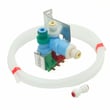
If the ice maker is not filling, overfilling, or the dispenser water flow is weak, the water inlet valve is a common suspect. For this model, the matching part is the refrigerator inlet valve W10408179.
| Symptom you notice | Most likely area to inspect | Common next step |
|---|---|---|
| No ice, no fill sound | Water supply, inlet valve | Check shutoff valve and line; test/replace inlet valve |
| Small/hollow cubes | Restricted water flow | Check filter seating/clog; verify supply pressure |
| Ice maker cycles but no harvest | Ice maker module/sensor | Inspect ice maker; consider replacing assembly |
If the basic checks do not clear the code, these model-compatible parts are frequently involved:
- Whirlpool refrigerator ice maker assembly 2198597 (ice maker module and sensor-related issues)
- Refrigerator inlet valve W10408179 (no fill, slow fill, intermittent fill)
An ice maker sensor error can stop ice production and, in some cases, lead to repeated cycling or poor cube quality. Addressing the cause early helps protect the ice maker, water system, and freezer temperature stability.
Last updated: February 2026
What is the average lifespan of 10651564104?
A Kenmore side-by-side refrigerator like model 10651564104 typically lasts 13 years with normal household use and basic maintenance. Keeping airflow clear, doors sealing tightly, and the ice and water system maintained helps you reach that expected service life.
Most refrigerators reach their full lifespan when these conditions stay consistent:
- Stable room temperature and good ventilation around the cabinet
- Condenser area kept clean so the compressor does not overwork
- Doors closing fully and gaskets sealing without gaps
- Ice maker and water system kept free of clogs and leaks
- Defrost system working correctly (no heavy frost buildup)
For model-specific care and operating guidance, follow the maintenance and use sections in the owner's manual.
- Vacuum dust from the condenser area regularly (unplug first)
- Confirm the doors close firmly and do not bounce open
- Keep vents inside the fresh food and freezer compartments unblocked
- Replace the water filter on schedule if your unit uses one
- Address slow ice production early (often water supply or valve related)
| Symptom | What it often points to | Example part on this model |
|---|---|---|
| Warm temps, compressor runs a lot | Airflow or sealed system strain | Refrigerator condenser fan W10181323 |
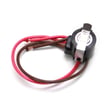
| Frost buildup, warming freezer | Defrost system issue | Refrigerator defrost bi-metal WPW10225581 |
| No ice or weak water flow | Water supply or valve problem | Refrigerator inlet valve W10408179 |
A refrigerator that runs too long or cannot move air efficiently puts extra load on the compressor and cooling system. Fixing airflow, defrost, and water issues early helps prevent bigger failures and keeps food temperatures stable.
Last updated: March 2026