Installation guide
 Owner’s manual



Where is the model number on a Whirlpool dryer?
On the Whirlpool WED7400XW0 27-inch electric dryer, the model number is on the model and serial tag located in the top right area of the door opening, near the door switch. Use that exact model number to match diagrams and order the correct parts.
How to find it quickly
- Open the dryer door fully and look along the inside front frame.
- Check the top right corner of the opening first.
- Look for a sticker or metal tag that lists MODEL and SERIAL.
- Write the model number exactly as shown (for example, WED7400XW0).
- Take a clear photo of the tag; it helps when ordering parts or checking wiring diagrams.
What to record from the tag
The tag usually includes more than just the model number. Recording all of it helps ensure a perfect match.
| What to capture | Example format | Why we use it |
|---|---|---|
| Model number | WED7400XW0 | Matches the correct parts list and diagrams |
| Serial number | Letters and numbers | Helps identify production series and revisions |
| Electrical ratings | Volts/amps | Confirms correct electrical setup for service |
Why it matters
Whirlpool dryers often share similar styling across multiple model families, but parts like the user interface, moisture sensor, or heating circuit components can vary by model. Using the exact model number prevents ordering the wrong component and saves time during troubleshooting.
Helpful next step
If you are using the model number to troubleshoot a no-heat or no-start issue, the wiring diagram and diagnostic steps in the WED7400XW0 owner’s manual are the fastest way to confirm what to test first.
Last updated: February 2026
What is the life expectancy of a Whirlpool dryer?
A Whirlpool electric dryer like model WED7400XW0 typically lasts 10 to 13 years. With consistent airflow maintenance (lint screen and venting) and avoiding chronic overloading, it commonly reaches the upper end of that range.
What affects dryer lifespan the most
- Vent restriction (long runs, crushed flex duct, clogged hood) increases heat and wear
- Lint buildup in the cabinet or blower housing stresses the motor and heater circuit
- Overloading accelerates belt, roller, and idler wear
- High heat use on every load can shorten heater and thermostat life
- Moisture sensor residue can cause longer run times and extra cycling
Maintenance that extends life (high impact)
We recommend these habits for WED7400XW0:
- Clean the lint screen every load; replace a damaged screen such as screen W10120998
- Check airflow and venting guidance in the WED7400XW0 owner’s manual
- Inspect and clean the vent duct and outside hood regularly
- Keep loads balanced; dry similar fabrics together to reduce cycle time
- If drying times suddenly increase, test safety and heat components before repeated use
Common wear items and what they usually mean
| Symptom | Most common wear area | Typical fix |
|---|---|---|
| Squealing, thumping | Drum support rollers, idler | Replace roller/idler parts (often as a kit) |
| Drum not turning | Belt, idler, motor | Replace belt or idler; verify motor operation |
| No heat or stops mid-cycle | Thermal fuse, heater circuit | Diagnose airflow first; then test components |
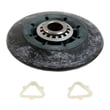
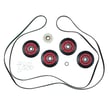
If you are already hearing noise or seeing poor tumbling, a bundled option like dryer repair kit 4392067 is a practical way to refresh the main drum-wear components at once.
Why it matters
A dryer can keep running past its typical life, but restricted airflow and worn drum support parts drive up heat, noise, and cycle time. Fixing those issues early helps protect major components like the drive motor and heating system.
Last updated: February 2026
How do I know if my Whirlpool dryer thermal fuse is blown?
On your Whirlpool WED7400XW0 electric dryer, a blown thermal fuse commonly shows up as a dryer that will not run at all, or a dryer that runs but has no heat. The sure way to know is a continuity test with a multimeter; a good fuse reads closed (near 0 ohms), and a blown fuse reads open.
Quick symptoms to look for
- Dryer will not start even with the door closed and Start pressed firmly
- Drum turns but there is no heat (clothes stay damp)
- Dryer stops mid-cycle and then will not restart
- You see an airflow warning behavior (often tied to vent restriction)
- You recently had poor drying performance or very hot cabinet temperatures
How we recommend testing the thermal fuse (continuity)
- Unplug the dryer (electric dryers use 240V power).
- Access the thermal fuse location (follow the disassembly steps in the WED7400XW0 installation guide).
- Pull the wires off the fuse terminals (note their positions).
- Set your multimeter to continuity or ohms.
- Test across the fuse terminals.
What the meter reading means
| Meter result | What it means | Next step |
|---|---|---|
| Beep or ~0 ohms | Fuse is good (closed circuit) | Check other heat or run components |
| No beep or OL/infinite | Fuse is blown (open circuit) | Replace the fuse and correct the airflow issue |
A thermal fuse is a one-time safety device; if it is blown, it must be replaced, not reset.
What usually causes the fuse to blow
Restricted airflow is the most common reason. We recommend checking these items before running the dryer again:
- Clean the lint screen and confirm it seats correctly
- Inspect the vent run to the wall for crushing or kinks
- Check the entire vent duct for lint buildup
- Confirm the exterior vent hood opens freely
- Avoid long vent runs and excessive elbows when possible
Why it matters
Replacing the fuse without fixing the airflow problem often leads to another blown fuse and continued no-heat or no-run symptoms. Good airflow also helps prevent long dry times and overheating.
Last updated: February 2026
What are the common problems with Whirlpool dryers?
Common Whirlpool dryer problems (including the Whirlpool WED7400XW0 27-inch electric dryer) are no-start conditions, no heat, long dry times from poor airflow, and drum or belt-related noise or no-tumble. Many issues trace back to power supply, door/start inputs, venting, or wear parts.
Most common symptoms and what they usually mean
- Dryer will not start: door not fully closed, Start not pressed long enough, or a power supply issue (electric dryers need 240V).
- Runs but no heat: home power issue (one leg of 240V missing), heating circuit problem, or a safety device opened.
- Long dry times: crushed or blocked venting; restricted airflow can also trigger vent-related diagnostics.
- No tumble or squealing/grinding: worn belt, idler, or drum support rollers.
- Stops mid-cycle or overheats: airflow restriction or a temperature-sensing/control issue.
Quick checks we recommend first (fast, no parts)
- Confirm the door is fully closed and press and hold Start/Pause for 2 to 5 seconds.
- Check the electrical supply: many homes have two fuses/breakers for an electric dryer; make sure both are on.
- Run a Timed Dry heated cycle (not Air Only) to confirm heat operation.
- Inspect the vent path for kinks, crushing, lint buildup, or a blocked exterior hood.
- Clean the lint screen and confirm strong airflow at the outside vent.
Common parts involved (when a repair is needed)
| Symptom | Common cause | Example part for WED7400XW0 |
|---|---|---|
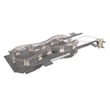
| No heat | Failed heater or heat safety device | Dryer heating element WP8544771 |
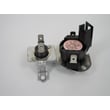
| Won’t run or stops | Overheat event opened a safety fuse (often airflow-related) | Dryer thermal fuse WP3390719 |
| Squeal, thump, no tumble | Belt, idler, or roller wear | Dryer repair kit 4392067 |
Why it matters
Airflow and correct 240-volt power are the foundation for proper drying. Fixing vent restrictions and power issues first prevents repeat failures of heat-related parts like a thermal fuse and helps cycles finish on time.
For model-specific operating and troubleshooting steps, use the WED7400XW0 owner’s manual.
Last updated: February 2026