Owner’s manual



What is the most common problem with LG dryers?
For the LG DLE0442W dryer, the most common customer complaints we see are clothes taking too long to dry (poor heating or poor airflow) and noisy operation (thumping, squealing, or rumbling). Airflow restrictions are often the root cause; worn drum support parts are a frequent noise source. See the DLE0442W owner’s manual for venting and maintenance basics.
- Long dry times / not drying well: clogged lint screen, restricted vent duct, crushed flex vent, blocked exterior hood
- No heat or weak heat: heating circuit problem (electric models), temperature sensing issue, or safety thermostat opening due to overheating
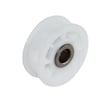
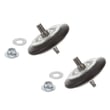
- Rumbling or thumping: worn drum support roller(s)
- Squealing: worn idler pulley or belt path wear
- Overheating / shutting down: airflow restriction, thermostat cycling abnormally
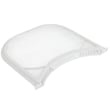
- Clean the lint screen before every load; wash it with a nylon brush periodically if residue builds up.
- Confirm strong airflow at the outside vent hood while the dryer runs.
- Keep the vent run short and use 4-inch rigid or flexible metal duct (not plastic or foil).
- Avoid overloading; bulky loads can fool sensor cycles.
| Symptom | Commonly involved part | Example part for this model |
|---|---|---|
| Rumbling/thumping noise | Drum support roller | Dryer drum support roller 4581EL2002L |
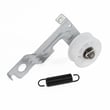
| Squealing noise | Idler pulley | Dryer idler pulley 4560EL3001A |
| No heat/poor heat (electric) | Heating element | Dryer heating element 5301EL1001J |
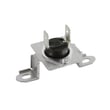
| Overheating/heat cycling issues | High-limit thermostat | Dryer high-limit thermostat 6931EL3003D |
Poor airflow can cause long dry times, overheating, and repeated thermostat trips. Catching vent restrictions early helps protect the heater housing, thermostats, and drum support system, and it keeps drying performance consistent.
Last updated: January 2026
How do I hard reset my LG dryer?
To hard reset your LG dryer model DLE0442W, we recommend disconnecting power for a few minutes, then restoring power and starting a new cycle. This clears many temporary control glitches; it does not fix an underlying heating, airflow, or sensor problem.
- Press Power to turn the dryer off.
- Unplug the dryer (or switch the dryer breaker off).
- Wait 3 to 5 minutes.
- Plug the dryer back in (or switch the breaker on).
- Press Power, select a cycle, then press Start/Pause.
For control-panel and cycle basics specific to this model, see the DLE0442W dryer manual.
A reset helps only if the control is confused. If the symptom comes right back, check these common causes:
- Child Lock is enabled (the control won’t respond normally).
- The door is not fully closed or the door switch is failing.
- The dryer is overheating due to restricted venting and shutting down for safety.
- A sensor input is out of range (moisture sensor or thermistor).
| Symptom after reset | Most likely area to check first | Example related part for DLE0442W |
|---|---|---|
| Won’t start at all | Door closure and door switch | Dryer door switch EBF61496102 |
| Runs but no heat | Heating circuit and safety thermostats | Dryer heating element 5301EL1001J |
| Stops mid-cycle or dries poorly | Airflow and temperature sensing | Dryer thermistor AGM30045804 |
A proper reset can save time when the electronic control just needs a clean power cycle. If the issue is airflow, heat, or a failed component, repeated resets can delay the real fix and lead to longer dry times or overheating.
Last updated: January 2026
Why does an LG dryer take so long to dry?
An LG DLE0442W dryer usually takes too long to dry because airflow is restricted (lint screen, exhaust duct, outside hood), the load is too large, or the Sensor Dry system is not reading moisture correctly. Start with airflow checks, then move to sensor and heat-related parts.
Restricted airflow makes drying times climb fast, even when the dryer heats.
- Clean the lint screen before every load; if you see residue, wash and scrub it with a nylon brush (per the DLE0442W dryer manual).
- Check the vent run for kinks, crushing, or long runs with too many elbows.
- Make sure you are using 4-inch rigid or flexible metal duct, not plastic or foil.
- Inspect the outside vent hood; the damper must open freely and not be blocked by lint.
- If drying performance suddenly got worse, have the full vent system cleaned.
| 90° elbows | Typical max rigid duct length | Typical max flexible duct length |
|---|---|---|
| 0 | 65 ft | 45 ft |
| 2 | 47 ft | 30 ft |
| 4 | 28 ft | 20 ft |
- Use Sensor Dry for mixed everyday loads; use Time Dry for bulky items (comforters, heavy towels).
- Do not overload; clothes need room to tumble.
- Sort by fabric weight; heavy items can keep lighter items damp.
If the vent is clear and loads are normal, a failing sensor or temperature control can cause long cycles or damp clothes.
- Clean the moisture sensor bars inside the drum (wax from dryer sheets can insulate them).
- If Sensor Dry ends early or runs unusually long, inspect the dryer moisture sensor 6500EL3001A and its wiring.
- If heat seems weak or cycles off too soon, a temperature-sensing part may be drifting; the dryer thermistor AGM30045804 is a common suspect.
Long dry times waste energy, overheat fabrics, and can trip safety thermostats. Restoring proper airflow and accurate moisture sensing helps the DLE0442W dry faster and more consistently.
Last updated: January 2026
How to test an LG dryer heating element?
To test the heating element in your LG DLE0442W dryer, we unplug the dryer, access the heater terminals, and use a multimeter on resistance (ohms). A good element typically shows continuity and a steady resistance reading; an open (OL) reading usually means the element is failed.
- Unplug the dryer (electric shock risk).
- Let the dryer cool completely.
- Turn off the breaker if you are unsure the outlet is dead.
- Avoid touching bare terminals; use insulated meter probes.
- If you smell burning or see melted wiring, stop and have the wiring repaired before running the dryer.
- Disconnect power.
- Remove the access panel needed to reach the heater housing (your manual shows the cabinet access and safety notes; see DLE0442W dryer manual).
- Take a photo of wire locations, then pull the wires off the heating element terminals.
- Set the multimeter to ohms (Ω).
- Measure across the two heating element terminals.
- Check for a short to ground: measure from each terminal to the metal heater housing.
| Meter result | What it usually indicates | What we do next |
|---|---|---|
| Steady resistance (not OL) across terminals | Element has continuity | Continue diagnosing thermostats, airflow, and power supply |
| OL / no continuity across terminals | Element is open (failed) | Replace the element: dryer heating element 5301EL1001J |
| Any continuity from terminal to metal housing | Element shorted to ground | Replace the element and inspect wiring/thermostats |
On LG electric dryers like DLE0442W, no-heat can also be caused by:
- Restricted venting or lint buildup (overheating can trip safety thermostats)
- A failed high-limit thermostat: dryer high-limit thermostat 6931EL3003D
- A failed blower thermostat: dryer blower thermostat 6931EL3002M
- A failed thermistor affecting heat control: dryer thermistor AGM30045804
- A power supply issue (dryer runs but has only 120V instead of full 240V)
A heating element can look intact but still be electrically open or shorted. Testing resistance and checking for a short to the heater housing helps us confirm whether the element is actually capable of producing heat before replacing parts.
Last updated: January 2026