Owner’s manual
 Error Codes



What does the number 23 signify?
On the GE PWE23KYNBFS bottom-mount refrigerator, the “23” is a model-series identifier used by GE to group similar refrigerator platforms and features; it is not a special code you need to set or interpret during normal operation. For day-to-day use, focus on the control settings and features shown in the owner's manual.
What “23” means on this refrigerator
In GE model numbers, the digits and letters help identify the product family, configuration, and feature set. In the manual for this platform, GE groups multiple related models together (including “PWE23” models), which is why you see “23” referenced in control-style and feature sections.
What it is (and is not)
- It is: part of the model family name (helps match the correct manual and parts).
- It is not: an error code, temperature code, or a setting you change.
- It is not: a capacity reading you can adjust from the control panel.
- It helps with: ordering the right replacement parts and using the correct control instructions.
Where you’ll notice it in real use
You may see “PWE23” referenced in documentation when GE describes control layouts and features for this model family.
| Where you see “23” | What it’s used for | What you should do |
|---|---|---|
| Model number label / paperwork | Identifies the exact refrigerator | Use it when looking up parts for PWE23KYNBFS |
| Manual sections (control styles, features) | Groups similar models together | Follow the steps for your control style |
| Parts lookup | Ensures correct fit | Match parts by model number, not by appearance |
Why it matters
Using the correct model identifier (including the “23”) prevents mismatched parts and wrong troubleshooting steps. For example, filter reset steps and control layouts can vary by model family.
Related parts customers commonly replace
If you are troubleshooting cooling or water quality issues on PWE23KYNBFS, these model-matched parts are commonly involved:
- Refrigerator temperature sensor WR55X10025 (temperature sensing and feedback)
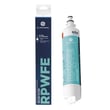
- GE refrigerator water filter RPWFE (water and ice filtration)
Last updated: February 2026
What is the advantage of a bottom mount fridge?
A bottom-mount refrigerator like the GE PWE23KYNBFS keeps the fresh-food section at eye and waist level, so you reach everyday items with less bending. The freezer stays below, which is convenient if you access refrigerated foods more often than frozen foods.
Key advantages you will notice day to day
- Easier access to fresh foods (less bending for milk, produce, leftovers)
- Better organization at eye level for frequently used items
- Freezer drawer can hold bulky frozen items and slides out for visibility
- Often pairs well with wide shelves and storage features in the fresh-food section
- Can feel more ergonomic for households that cook often
How it compares to other common layouts
| Layout | Fresh food access | Freezer access | Best for |
|---|---|---|---|
| Bottom-mount | Easiest | Requires bending | Most households that use the fridge most |
| Top-mount | Requires bending | Easiest | Heavy freezer users |
| Side-by-side | Moderate | Moderate | Narrow door swing spaces |
Why it matters
Most people open the refrigerator section far more than the freezer. With a bottom-mount design, the items you use most are positioned higher, which reduces strain and makes it faster to load, unload, and find food.
Helpful model-specific tip
For feature and storage details (shelves, bins, temperature-controlled drawer, and control settings) for the GE PWE23KYNBFS, use the owner's manual.
Last updated: February 2026
What is the most common problem with GE PWE23KYNBFS refrigerators?
The most common issues we see with the GE PWE23KYNBFS bottom-mount refrigerator are ice maker and water system complaints (slow or no ice, dripping or leaking at the dispenser, poor taste/odor) plus cooling complaints after a power outage or when airflow is restricted. The owner's manual troubleshooting section points first to filter, air-in-line, and control settings.
Most common symptoms (and what they usually mean)
- Ice maker not making ice or slow ice: ice maker turned off, temperature not stabilized yet, or water supply issue
- Water dripping from the dispenser: air trapped in the water line after filter changes or new install
- Water filter leaking: filter not fully locked in place or filter needs replacement
- Warm fresh food section: cooling system turned off in controls, door not sealing, or airflow problem
- Beeping: door alarm (door not fully closed or alarm needs snoozing)
Quick checks we recommend first
- Give temperatures time to stabilize: after first plug-in or an extended power outage, allow 24 hours for both compartments to reach the set temperatures.
- Confirm cooling is actually on: if the refrigerator is “not cooling,” the manual notes the cooling system may be turned off in the controls.
- Purge air from the dispenser line: if water drips after dispensing, dispense water for at least 5 minutes to clear air from the system.
- Check the water filter install: remove and reinstall the filter, making sure it locks in place; replace it if clogged or leaking.
Common causes and related parts for this model
| Problem area | What fails most often | Example part for PWE23KYNBFS |
|---|---|---|
| Temperature sensing | Thermistor out of range | Refrigerator temperature sensor WR55X10025 |
| Water quality/flow | Clogged filter | GE refrigerator water filter RPWFE |
| Defrost system | Frost buildup affecting airflow | Refrigerator defrost bi-metal thermostat WR50X10108 |
| Cooling airflow | Fan not moving air | Refrigerator evaporator fan motor and blade WR60X10352 |
Why it matters
Ice, water, and cooling symptoms often share the same root causes: restricted airflow, a clogged filter, or settings after a power interruption. Fixing the simple items first prevents unnecessary part replacement and helps the refrigerator recover to normal temperatures faster.
Last updated: February 2026