Owner’s manual
 Error Codes



How many cubic feet is a Kenmore freezer model 2539282010?
The exact cubic-foot capacity for Kenmore upright freezer model 2539282010 is not listed in the manual excerpts we have for this model. We use the freezer’s rated capacity to plan safe loading and freezing; see the rating label details and usage guidance in the 2539282010 owner's manual.
How to find the exact capacity for your 2539282010
Use these quick checks to get the correct cubic feet for your specific unit:
- Check the model and serial number plate inside the freezer (often on the upper left wall on upright models).
- Look for a rating label that lists capacity in cu. ft. (sometimes near the serial plate).
- Review the specifications section in the 2539282010 owner's manual.
- If you have the Energy Guide document for your unit, it often lists capacity and annual kWh.
Planning food load without the exact cubic feet
Even without the exact number, the manual gives a reliable rule for loading unfrozen food:
- Allow 4 hours for the freezer to cool down completely before loading unfrozen food.
- Freeze only about 3 lb of fresh food per cubic foot of freezer space at one time.
- Distribute packages evenly across shelves and baskets.
- Avoid turning the control colder just to freeze faster; adjust in small steps and allow time to stabilize.
Quick reference table
| What you’re doing | What we recommend | Why |
|---|---|---|
| First-time startup | Run empty for about 4 hours | Reaches safe storage temps |
| Adding unfrozen food | Use the 3 lb per cu. ft. rule | Prevents warm-up and slow freezing |
| Temp adjustments | Move 1 number at a time | Avoids over-correction |
Why it matters
Capacity affects how much unfrozen food you can add at once and how quickly temperatures recover after loading. Following the manual’s loading guidance helps protect food quality and reduces temperature swings.
Last updated: January 2026
Is there a reset button on a Kenmore upright freezer?
Kenmore upright freezers like model 2539282010 typically do not have a single dedicated “reset” button. Most issues that feel like a reset (warm temps, alarms, not running) are handled by checking power, confirming the temperature control setting inside the cabinet, and allowing proper cool-down time per the 2539282010 owner's manual.
What to try first (safe, quick checks)
- Make sure the freezer is plugged in firmly and the outlet has power.
- Check the Power On light (if your unit has it); it should glow when power is present.
- Confirm the temperature control knob inside the freezer is not set to OFF.
- After any change, allow several hours for temperatures to stabilize.
- If the freezer was just started or restarted, allow a full 4 hours to cool down completely.
If you are trying to “reset” a temperature alarm
Some versions include a Temp Alarm feature. If the alarm is sounding, you can silence it by pressing the TEMP ALARM OFF button (this stops the buzzer, but it does not repair the cause of warm temperature).
| Temp alarm behavior | What it usually means | What we recommend |
|---|---|---|
| Light out, no buzzer | Normal operation | No action needed |
| Blinking red, no buzzer | Initial install or extended power outage | Let it run and re-freeze; avoid loading unfrozen food right away |
| Blinking red, buzzer sounding | Warm temperature condition | Press TEMP ALARM OFF to silence; check door seal and airflow |
Common causes that mimic a “needs reset” problem
- Door not sealing (torn, warped, or loose gasket)
- Overloading with unfrozen food (exceeding typical “bulk load” limits)
- Frequent door openings or a door left ajar
- Dirty condenser area reducing heat removal
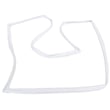
If you find the door is not sealing, replacing the gasket is a common fix; use the exact model match such as the freezer door gasket 5304507202.
Why it matters
A freezer can take hours to pull temperatures back down after a power interruption or heavy loading. Following the recommended cool-down period and using the alarm features correctly prevents food-safety issues and reduces unnecessary part replacement.
Last updated: January 2026
What are the most common issues with 2539282010?
The most common issues we see with the Kenmore 2539282010 upright freezer are warm temperatures, heavy frost buildup, door sealing problems, and unusual clicking or humming from the compressor area. Many of these problems trace back to airflow restrictions, a leaking door gasket, or a start device issue; use the owner's manual for model-specific checks.
Common symptoms and what they usually point to
- Freezer not cold enough: dirty condenser area, poor airflow, door not sealing, or a sealed-system/compressor problem
- Frost building up quickly: door left ajar, gasket leak, frequent openings, or high humidity
- Door hard to close or pops open: gasket not sealing, cabinet not level, or door stop issue
- Clicking from the back, then no cooling: start device problem (often the PTC starter) or compressor trouble
- Water or ice around the bottom: drain or hose routing issue
Quick checks we recommend first
- Confirm the temperature control is set correctly and allow 24 hours after changes.
- Make sure the freezer is level and the door closes on its own from a partially open position.
- Inspect the door seal for gaps, tears, or hardened sections; clean the gasket and mating surface.
- Improve airflow: do not block interior vents; keep space around the cabinet for ventilation.
- Listen at the compressor area: repeated clicking every few minutes often indicates a start issue.
Parts that commonly relate to these issues
| Symptom | Part to consider | What it affects |
|---|---|---|
| Frost, warm temps, door not sealing | Freezer door gasket 5304507202 | Prevents warm, moist air leaks that cause frost and temperature swings |
| Clicking, won’t start cooling | Ptc starter 5304493950 | Helps the compressor start and run properly |
| Poor heat release, long run times | Freezer condenser coil 5300123788 | Removes heat from the sealed system |
Why it matters
An upright freezer like the Kenmore 2539282010 depends on a tight door seal and good condenser airflow. Small issues (like a gasket leak) quickly turn into heavy frost, longer run times, and unstable temperatures.
Last updated: March 2026