Owner’s manual
 Error Codes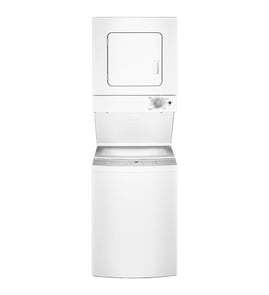


How many cubic feet is my Whirlpool duet washer?
Your Whirlpool LTE5243DQB thin-twin washer/dryer is not a Whirlpool Duet washer, and the washer capacity (cubic feet) is not listed in the available LTE5243DQB owner's manual excerpts. For most compact, stacked laundry center washers, capacity is typically about 1.5 to 2.5 cu. ft..
How to confirm the exact capacity for LTE5243DQB
We recommend using the model-specific literature first, then verifying by tub measurements if needed.
- Check the specifications section in the LTE5243DQB owner's manual.
- Look for a rating label on the unit (often inside the washer lid area or on the cabinet frame).
- If you find a “basket volume” or “tub volume” value, that is the capacity in cubic feet.
- If you only have dimensions, you can estimate volume, then convert to cubic feet.
- Use the full model number LTE5243DQB when comparing specs or ordering parts.
Typical capacity ranges (so you know what to expect)
These ranges help set expectations when you are comparing laundry loads or detergent amounts.
| Washer type | Typical washer capacity (cu. ft.) | Common use case |
|---|---|---|
| Compact stacked laundry center (thin-twin) | 1.5 to 2.5 | Apartments, small loads |
| Full-size top-load washer | 3.5 to 5.5 | Family loads |
| Front-load “Duet-style” washer | 4.0 to 5.0+ | Large loads, high efficiency |
Why it matters
Washer capacity affects how much you can load without going off-balance, how well clothes rinse, and how much detergent you should use. Overloading is a common cause of vibration and poor cleaning, especially in stacked laundry centers.
Last updated: February 2026
What is the most common problem with whirlpool washers?
For Whirlpool washers, the most common service issues are not draining and not spinning. On the Whirlpool LTE5243DQB thin-twin washer/dryer, these symptoms are often tied to load balance, lid position (the lid must be closed to spin), drain hose setup, or a worn drive/drain component; see the LTE5243DQB owner's manual for model-specific checks.
Quick checks we recommend first
- Make sure the lid is fully closed; this washer will not agitate or spin with the lid open.
- Redistribute the load; uneven loads can cause off-balance vibration and poor spin.
- Confirm the unit is level and the floor is solid; flexing floors increase vibration.
- Check the drain hose height; the top of the drain hose should be at least 39 in. above the floor.
- Make sure the drain hose is not sealed/taped into the standpipe; it needs an air gap.
- Inspect water inlet hoses for kinks or wear; replace inlet hoses every 5 years.
Common symptoms and the most likely causes
| Symptom | Most common causes | What to do next |
|---|---|---|
| Won’t spin | Lid open, unbalanced load, not level | Close lid, rebalance, level the unit |
| Won’t drain | Drain hose issue, pump problem | Verify hose setup; consider the pump |
| Noisy or vibrating | Floor flexing, unit not level, load not balanced | Add plywood under unit, level, rebalance |
| Cycle seems stuck (fills/drains) | Drain hose too low or sealed | Raise hose to 39 in.; ensure air gap |
Parts that commonly fix “won’t drain” or “won’t spin” complaints
If the basic setup checks look good, these are frequent repair parts for this style of Whirlpool washer:
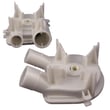
- Washer drain pump WP3363394 (drain problems, humming, slow or no drain)
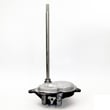
- Coupling 285753A (motor runs but washer does not agitate/spin)
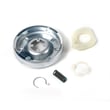
- Clutch 285785 (weak spin, burning smell, poor basket speed)
Why it matters
Drain and spin problems are often caused by installation and load conditions, not just failed parts. Correct drain hose height, a level cabinet, and balanced loads help the LTE5243DQB wash properly and reduce wear on the drive system.
Last updated: February 2026
What is the average lifespan of a whirlpool dryer?
Whirlpool dryers typically last 10 to 13 years on average. For the dryer in your Whirlpool LTE5243DQB thin-twin washer/dryer, regular lint removal, correct power supply, and avoiding overloads are the biggest factors that keep the motor, heater, and drum system running longer (see the LTE5243DQB owner's manual).
What affects dryer lifespan the most
A dryer’s life is usually shortened by heat restriction, electrical issues, and heavy mechanical wear.
- Clean the lint screen before every load; restricted airflow overheats components.
- Keep the vent path clear and as short as practical; crushed or long vents strain the heater.
- Avoid overloading; it wears drum support parts and the drive system faster.
- Use the right electrical supply; electric dryers need 240V and may use two fuses/breakers.
- Stop using the dryer if you smell burning or notice repeated shutdowns; address airflow or wiring issues.
Quick “average vs. extended life” guide
| Usage and care level | Typical outcome | What you’ll notice |
|---|---|---|
| Normal use, basic care | 10 to 13 years | Gradual longer dry times near end of life |
| Light use, excellent venting and cleaning | 14 to 17 years | Fewer heat and noise complaints |
| Heavy use, poor venting, frequent overloads | Under 10 years | Hot cabinet, burning smell, frequent no-heat/no-run issues |
Common wear items that can shorten life (and what they do)
If your LTE5243DQB starts squealing, thumping, or taking longer to dry, these are common suspects:
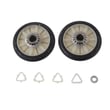
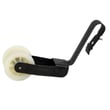
- Dryer idler pulley WP691366: keeps proper belt tension; worn pulleys can squeal and stress the motor.
- Dryer heating element wire kit 279457: helps restore safe, solid heater wiring connections after heat damage.
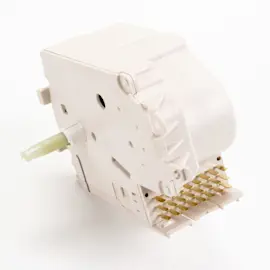
- Dryer timer WP3406720: controls cycle timing; failures can cause no-heat symptoms or odd cycle behavior.
Why it matters
A dryer that is forced to run hotter and longer (usually from lint buildup or vent restriction) ages faster and can also trip breakers or blow fuses. Keeping airflow and electrical supply correct protects the heating circuit, motor, and controls.
Last updated: February 2026
Is there a standard size for a stackable washer and dryer?
Most full-size stackable laundry units are built around a common footprint: about 27 inches wide, 77 to 80 inches tall, and 32 to 34 inches deep. For your Whirlpool LTE5243DQB thin-twin washer/dryer, plan for extra clearance behind and in front so the venting, hoses, and doors work correctly; see the LTE5243DQB owner's manual for installation clearances.
Typical “standard” dimensions and clearances
Even when the cabinet size is similar, the space you need is usually driven by hookups and airflow.
- Width: ~27 inches (most full-size stackable units)
- Height: ~77 to 80 inches (controls at the top)
- Depth: ~32 to 34 inches cabinet depth (often more with vent and hoses)
- Rear clearance: many installs need up to ~5 inches for venting and connections
- Front clearance: at least ~1 inch for airflow and door swing (more is better)
How to measure your space the right way
Measure the opening and then add “real-world” clearance for connections.
- Measure width, height, and depth of the alcove/closet.
- Add space for the dryer vent elbow and water hoses behind the unit.
- Confirm the dryer door and washer lid can fully open.
- If installed in a closet, confirm the door has top and bottom ventilation openings.
Quick planning table
| What you’re planning for | Typical target | Why it matters |
|---|---|---|
| Width | ~27 in | Fits most full-size stackable footprints |
| Height | ~77 to 80 in | Ensures controls are reachable |
| Depth (cabinet) | ~32 to 34 in | Prevents tight fit before hookups |
| Rear clearance | ~5 in (common) | Helps avoid crushed vent and kinked hoses |
Why it matters
Tight installations can restrict airflow and pinch venting, which increases dry times and lint buildup. The manual also recommends using the straightest vent path possible and sealing joints with clamps (not screws or duct tape) to reduce lint catching.
Last updated: February 2026