Owner’s manual
 Error Codes



How to remove bottom grille on GE refrigerator?
On the GE GFE26JSMAFSS bottom-mount refrigerator, the bottom grille (base grille) is typically held in place with screws and/or snap-in tabs. We remove it by taking out any visible fasteners first, then pulling the grille straight out to release the tabs, and lifting it away.
Steps to remove the bottom grille
- Unplug the refrigerator (or switch it off) for safety.
- Look along the top edge of the grille for screws.
- Remove the screws with a Phillips screwdriver.
- Grip the grille near both ends.
- Pull the grille straight toward you to release the retaining tabs.
- Lift the grille off and set it aside.
What to watch for
- Leveling legs: The manual notes the leveling legs are at the bottom front; avoid forcing the grille against them.
- Floor protection: Pull straight out; sliding sideways can scuff floors and stress plastic tabs.
- Water line and power cord: If you roll the refrigerator out for access, do not roll over the water supply line or power cord.
- Tab breakage: If it feels stuck, re-check for hidden screws before pulling harder.
Reinstalling the grille
Line the grille up with the slots, press it in until it seats, then reinstall the screws.
| Task | Tool | Tip |
|---|---|---|
| Remove grille screws | Phillips screwdriver | Keep screws in a cup so they do not get lost |
| Release grille tabs | Hands (two-handed pull) | Pull straight out, not up and out |
| Move refrigerator (if needed) | None | Raise leveling legs first, then pull straight out |
Why it matters
We remove the base grille to access the lower front area for cleaning, checking airflow, and safely moving the refrigerator for service. Removing it the right way prevents broken tabs, scratched flooring, and pinched water lines.
For model-specific diagrams and fastener locations, use the GFE26JSMAFSS owner's manual.
Last updated: February 2026
What is the most common problem with a GE refrigerator?
The most common GE refrigerator problem is a cooling complaint (warm fresh food section, warm freezer, or temperature swings). On the GE GFE26JSMAFSS, the most frequent root causes are airflow and heat-transfer issues such as dirty condenser coils, a failing evaporator fan, or a defrost problem that lets frost block airflow.
Most common symptoms we see
- Refrigerator section is warm but freezer seems OK
- Freezer is warm and ice production slows or stops
- Unit runs constantly or cycles too often
- Frost buildup on the freezer back wall
- Water dispenser flow is weak (often tied to filter restriction)
Quick checks that fix many “not cooling” calls
- Clean the condenser coils (dust buildup is a top cause of poor cooling and long run times).
- Confirm vents are not blocked by food packages in either compartment.
- Check door sealing: close a dollar bill in the gasket; it should resist being pulled out.
- Listen for the evaporator fan in the freezer; no fan noise often points to a fan or control issue.
- Replace the water filter on schedule to prevent dispenser and ice maker flow problems; see the GFE26JSMAFSS owner's manual.
Parts that commonly relate to these problems
If the basic checks do not help, these parts are often involved in GE cooling and ice complaints:
| Problem area | What you may notice | Example part for this model |
|---|---|---|
| Evaporator airflow | Warm fridge, weak airflow, unusual fan noise | Refrigerator evaporator fan motor WR60X32614 |
| Defrost control/sensing | Frost blanket on evaporator, warming over time | Refrigerator defrost bi-metal thermostat WR50X10069 |
| Temperature feedback | Temps swing, unit overcools or undercools | GE profile refrigerator temperature sensor WR55X10025 |
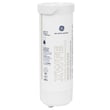
| Water/ice flow | Slow water, small cubes, no ice | GE refrigerator water filter XWFE |
Why it matters
Cooling problems usually start small (longer run times, minor temperature swings) and then turn into food-safety issues. Catching airflow restrictions early also helps protect major components like the compressor and control board.
Last updated: February 2026
What is the life expectancy of a GE Cafe refrigerator?
A GE Café refrigerator typically lasts 10 to 15 years with normal household use. For GE Café and GE Profile models, the sealed refrigerating system (including the compressor and related tubing) is covered longer than many other components, which supports long service life when the unit is maintained per the GFE26JSMAFSS owner's manual.
Typical lifespan and what affects it
Most refrigerators reach the 10 to 15 year range; higher-feature models (ice maker, dispenser, multiple fans and sensors) can need more maintenance over time.
Common factors that shorten life:
- Dirty condenser area causing higher compressor run time
- Warm kitchen temps or poor airflow around the cabinet
- Door gasket leaks leading to frost and long run cycles
- Ice maker and dispenser use (more moving parts, more water-related issues)
- Skipped filter changes causing low flow and valve strain
Maintenance checklist that helps you reach 10 to 15 years
Use these habits to reduce wear on the compressor, fans, and controls:
- Keep door seals clean and closing tightly
- Set stable temps (avoid frequent changes)
- Replace the water filter on schedule; use the correct filter type
- Clear ice buildup and keep vents inside the compartments unblocked
- Address unusual noises early (fan blade rubbing, buzzing, clicking)
Warranty coverage vs. expected lifespan (quick view)
| Item | Typical expectation | What it means for longevity |
|---|---|---|
| Full refrigerator | 10 to 15 years | Normal life expectancy with routine care |
| Sealed system (GE Café/Profile) | Longer coverage period | Compressor and sealed cooling parts are protected longer than many other parts |
| Wear items (filters, bins, lights) | Replaced as needed | Routine replacements keep performance steady |
Why it matters
A refrigerator that runs longer than it should (air leaks, restricted airflow, water flow problems) puts extra load on the sealed system and electronics. Staying ahead of airflow, sealing, and water filtration is the simplest way to protect cooling performance and extend service life.
Last updated: February 2026