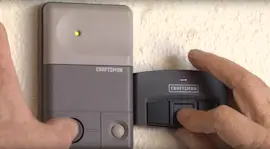
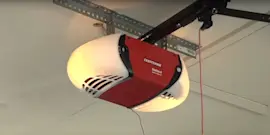
Owner’s manual
 Error Codes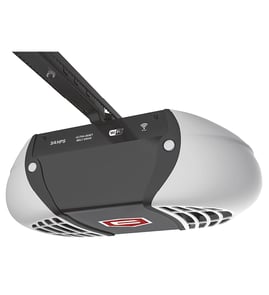

Why is my garage door opener not responding to the remote?
If your Craftsman 13953965SRT garage door opener is not responding to the remote, the most common causes are a dead remote battery, the opener being in “Lock” mode, or the remote needing to be reprogrammed to the opener’s Learn button. Use the owner's manual steps to restore remote operation safely.
- Replace the remote battery and try again.
- Make sure the wall control “Lock” feature is OFF (a flashing wall button often points to Lock mode).
- Confirm the opener has power (test the ceiling outlet with a lamp; check breaker or a wall switch-controlled outlet).
- Check the opener’s antenna: it should hang down and be unobstructed.
- If range is poor, note that metal doors, foil-backed insulation, or metal siding can reduce range.
Your opener can be programmed to a remote using the Learn button on the motor unit:
- Press and release the Learn button; the indicator light stays on for about 30 seconds.
- Within that time, press and hold the button on the remote you want to use.
- Release when the opener lights blink (or you hear clicks).
For a step-by-step walkthrough and any model-specific notes, follow the programming section in the owner's manual.
Use this table to narrow it down:
| What works? | Most likely cause | What we do next |
|---|---|---|
| Wall control works, remote does not | Lock feature on, dead battery, remote not programmed, antenna/range issue | Turn off Lock, replace battery, reprogram remote, check antenna |
| Neither wall control nor remote works | No power, tripped overload protector, door issue (frozen/obstructed), broken spring | Restore power, wait 15 minutes if overheated, clear obstruction, have door hardware serviced |
Remote issues are often simple, but they can also be a sign the opener is protecting you (for example, after repeated operation trips the motor overload protector). Restoring reliable remote control helps prevent unsafe “workarounds” and keeps normal safety features in place.
Related help: If your opener is showing diagnostic flashes or codes, use Craftsman error codes to match the symptom to the right fix.
Last updated: February 2026
How do I know what model my garage door opener is?
You can identify your Craftsman garage door opener model by finding the model label on the motor unit (the ceiling-mounted opener head). On Craftsman model 13953965SRT, the label is commonly located behind a light lens or on the side/back panel near the antenna.
Check these spots on the motor unit housing:
- Under the front light lens
- Under the left light lens (when you are facing the garage door)
- On the opposite side from the antenna (side or back panel)
- Near the learn button area or wiring terminals (often on the same panel)
Most Craftsman openers list key identifiers together. Look for:
- Model number (example: 139.53965SRT or 13953965SRT)
- Motor rating (your manual shows 1/2 HP for this model)
- Electrical rating and serial information
Use this checklist so you capture the right info the first time:
- Model number exactly as printed (include dots if shown)
- Any serial number on the same label
- Whether the opener is chain drive or belt drive
- Any blinking light pattern or diagnostic code (if the opener is acting up)
Once you have the model number, match it to the troubleshooting steps and programming instructions in the owner's manual. If you are seeing flashing lights or diagnostic behavior, our Craftsman error codes guide helps you narrow down common sensor, travel, and control issues.
| Location | What you do | Why it helps |
|---|---|---|
| Under a light lens | Pop the lens cover and look for a sticker | Labels are often protected from dust and scratches |
| Side/back panel near antenna | Look along the housing seam and rear panel | Many units place the ID near wiring and controls |
| Near learn button area | Check the panel where remotes are programmed | Model info is often grouped with programming info |
The exact model number ensures you use the correct programming steps for remotes/keyless entry, the right safety sensor alignment guidance, and the right repair procedures for your Craftsman garage door opener.
Last updated: February 2026
Is it cheaper to repair or replace a garage door opener?
For a Craftsman garage door opener like model 13953965SRT, it’s cheaper to repair when the problem is a simple adjustment or a small component issue (power, wiring, sensors, bulbs, remote programming). Replacement is the better value when the opener has repeated failures, major drive/motor problems, or repair costs start approaching the price of a new unit.
Repair is usually the better choice when:
- The opener has power issues you can trace to an outlet, breaker, or wall switch
- The door won’t close because the safety reversing sensors are blocked or misaligned
- The wall control works but the remote does not (often a lock setting, programming, or remote issue)
- The opener light won’t turn on (bulb replacement, 100W max)
- The motor overload trips after repeated cycles (waiting about 15 minutes restores operation)
Replace is usually the better choice when:
- The opener has frequent breakdowns or inconsistent operation
- The motor hums briefly and won’t run after basic checks
- Major internal wear is suspected (drive system, motor, logic board) and labor adds up
- You want newer convenience and safety features (for example, modern controls and connectivity)
Typical ranges vary by area, but this framework helps you decide:
| Option | Typical cost range | Best for |
|---|---|---|
| Repair/adjustment | $100 to $300 | Sensors, wiring, settings, minor electrical issues |
| Major repair | $300 to $500+ | Motor/drive-related problems where parts and labor stack up |
| Replace opener | $200 to $1,000+ | Older units, repeated failures, feature upgrades |
These are common, manual-backed checks that often prevent unnecessary replacement:
- Confirm the opener has power (test the outlet with a lamp; check breaker/fuse)
- Make sure all door locks are disabled
- Clear ice/snow or any obstruction under the door
- Inspect safety reversing sensors for alignment and obstructions
- If the door feels heavy or won’t stay balanced when operated manually, stop and have a trained door systems technician handle springs/cables (they are under extreme tension)
A garage door opener can look “bad” when the real issue is door balance, sensor alignment, or a tripped overload. Fixing those items first protects the motor and helps you avoid paying for a replacement you do not need.
For model-specific operating, programming, and troubleshooting steps, use the owner's manual.
Last updated: February 2026
How do I find my garage door opener type?
To find your garage door opener type for Craftsman model 13953965SRT, identify your garage door style (sectional or one-piece) and confirm key opener features like the safety reversing sensors and the learn button used for remote programming. The 13953965SRT owner's manual walks you through both identification and setup.
Use these checks to narrow it down fast:
- Door type: sectional door (multiple horizontal panels) or one-piece door
- Track style: one-piece doors may have a track or no track (installation steps differ)
- Safety reversing sensors: photo-eye sensors near the bottom of the door opening (aligned across the opening)
- Drive system (typical categories): chain drive, belt drive, or screw drive (look along the rail)
- Programming method: look for a LEARN button on the motor unit (used to add remotes)
Most identification comes from what you can see on the motor unit and rail:
| What you see | What it tells you | Why it matters |
|---|---|---|
| LEARN button on motor unit | Uses learn-mode programming for remotes/keypads | Confirms how you add or erase remotes |
| Rail with trolley and emergency release rope/handle | Standard trolley-style opener | Helps you match door arm and travel setup |
| Safety sensor “invisible light beam” across the opening | Safety reversing system is installed | Door should not close if the beam is blocked |
Your door type affects how the opener is positioned and adjusted. The manual’s planning section specifically calls out identifying the type and height of the garage door before installation and adjustment, because hardware and sensor mounting can change by door construction.
If you are identifying the opener because it is not working correctly:
- Check the diagnostic flashes or error patterns and compare them to Craftsman error codes
- Inspect and realign the safety sensors (they must face each other across the opening)
- If the door will not close, verify nothing blocks the sensor beam
- If remotes will not program, use the LEARN-button steps in the manual
Last updated: February 2026
What are the common problems with Craftsman 13953965SRT garage door openers?
Common problems on the Craftsman 13953965SRT garage door opener include no power or intermittent operation, remote or wall control issues, short remote range, the door reversing or not closing fully, and excessive noise or a humming motor. Our owner's manual troubleshooting section walks you through the most likely causes and checks.
- Opener does nothing (no response from wall control or remote): power issue, tripped breaker, locked door, frozen door, or motor overload protector tripped.
- Remote works but wall control does not: wall control wiring issue, faulty wall control, or a short in the bell wire.
- Remote range is very short: antenna not hanging down, interference from metal door or foil-backed insulation, or remote location in the vehicle.
- Door moves, then stops or reverses: travel or force settings need adjustment, or the door is binding or out of balance.
- Motor hums briefly but won’t run: door lock engaged, door is too heavy, or a spring/door balance problem.
- Lights act up (won’t turn on or off): bulb issue, light feature turned on, or incorrect bulb type.
- Confirm the ceiling outlet has power (test with a lamp).
- Make sure any manual door locks are disabled.
- Pull the emergency release and check door balance by hand; the door should stay at mid-travel when properly balanced.
- Inspect the opener antenna; it should extend straight down.
- Replace opener light bulbs with the correct type (100 W max).
| What you notice | Most likely cause | What to do next |
|---|---|---|
| No operation from wall control or remote | No power, overload protector tripped | Restore power; wait 15 minutes if overheated |
| Remote works, wall control doesn’t | Wall control or wiring issue | Check wall control light and wiring connections |
| Door reverses or won’t close | Force/travel setting or door resistance | Follow adjustment steps in the manual; check door for binding |
| Opener is loud near living space | Vibration transfer to framing | Add vibration isolation and verify mounting is solid |
Most “opener problems” are actually power, wiring, door balance, or adjustment issues. Fixing those first prevents repeated overload trips, nuisance reversing, and premature wear on the drive system.
Last updated: February 2026