Installation guide
 Owner’s manual
 Error Codes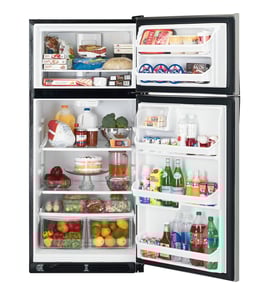


How many cubic feet is a Kenmore upright freezer model 25370819710?
Kenmore model 25370819710 is a top-mount refrigerator, not an upright freezer. The cubic-foot capacity for this specific refrigerator is listed in the product specifications section of the 25370819710 owner's manual; use that value to confirm the exact total capacity for your unit.
We recommend using the model-specific documentation because capacity can vary by sub-model and configuration.
- Open the 25370819710 owner's manual
- Look for a section labeled “Specifications”, “Product data”, or “Capacity”
- Record the total capacity (cu. ft.) and, if shown, the refrigerator and freezer compartment capacities
- If your model tag includes a color code (for example, 253.7081*), match it to your unit’s serial plate inside the fresh food compartment
| Feature | Top-mount refrigerator (25370819710) | Upright freezer |
|---|---|---|
| Main purpose | Fresh food + frozen storage | Frozen storage only |
| Door layout | Freezer on top, refrigerator below | Single tall freezer door |
| Typical capacity range | 14 to 22 cu. ft. | 14 to 21 cu. ft. |
Capacity affects food storage planning, energy use expectations, and whether accessories (like bins and shelves) match your interior layout. Confirming the correct appliance type also prevents ordering the wrong parts.
Last updated: January 2026
What are the most common issues with 25370819710?
The most common issues we see with the Kenmore 25370819710 top-mount refrigerator are warm temperatures (often tied to airflow or defrost problems), frost buildup in the freezer, water leaking, and ice maker troubles. Many of these symptoms trace back to a few serviceable parts and basic maintenance checks.
- Freezer cold but refrigerator warm: restricted airflow, evaporator fan issue, or frost-clogged evaporator
- Heavy frost on freezer back wall: defrost system problem (heater or defrost thermostat)
- No ice or slow ice production: ice maker issue or temperature too warm for ice making
- Water under the refrigerator: clogged/iced defrost drain or door left ajar causing excess frost melt
- Door not sealing, moisture or frost near the door: worn door gasket
- Clicking, humming, or not starting: start relay/capacitor or compressor circuit concerns
- Confirm controls are set to normal mid-range and allow 24 hours for changes.
- Make sure vents inside the refrigerator and freezer are not blocked by food packages.
- Check door closure: look for gaps, torn gasket areas, or items preventing a full seal.
- Listen for the evaporator fan when the freezer door switch is pressed (fan should run when cooling is called).
- Inspect for frost blanket on the freezer rear panel (a strong defrost clue).
| Symptom | Likely system | Example part on this model |
|---|---|---|
| Frost buildup, warming | Defrost | Refrigerator defrost heater 242044008 |
| Frost buildup, warming | Defrost sensing | Refrigerator defrost bi-metal thermostat 5303918634 |
| No ice | Ice maker | Refrigerator ice maker 241798231 |
| Poor door seal | Door sealing | Frigidaire refrigerator door gasket (white) 242193206 or frigidaire refrigerator door gasket (black) 242193212 |
Warm temperatures and frost buildup can quickly lead to food spoilage and extra compressor run time. Catching airflow, defrost, and door-seal problems early helps the refrigerator cool evenly and run efficiently.
For control settings, airflow locations, and diagnostic steps specific to Kenmore 25370819710, follow the owner's manual and use the installation guide for leveling and door alignment basics.
Last updated: March 2026
What is the average lifespan of a Kenmore refrigerator?
Most Kenmore refrigerators last 12 to 15 years. For your Kenmore 25370819710 top-mount refrigerator, regular maintenance (especially keeping the doors sealing tightly and the unit running efficiently) is what most often determines whether it reaches or exceeds that typical lifespan; see the 25370819710 owner's manual for model-specific care guidance.
These are the biggest factors we see that shorten or extend service life:
- Condenser coil cleanliness (dirty coils make the compressor run longer and hotter)
- Door gasket condition (air leaks force longer run times)
- Room temperature and ventilation around the cabinet
- How often doors are opened and how long they stay open
- Ice maker use (adds load and run time)
Use this routine to reduce wear on the cooling system:
- Vacuum and brush condenser coils on a regular schedule
- Keep door gaskets clean; wipe with mild soap and water, then dry
- Confirm doors close fully and shelves or bins are not preventing closure
- Keep the refrigerator level so doors self-close properly
- Set temperatures to normal targets (fresh food about 37°F, freezer about 0°F)
If you find a torn, hardened, or leaky seal, replacing the gasket is one of the most effective fixes; for example, this model has options like the refrigerator door gasket (white) 242193206.
| What you notice | Common cause | What to do first |
|---|---|---|
| Runs longer than it used to | Dirty coils, warm room, door not sealing | Clean coils; check gasket seal and door closure |
| Frost buildup in freezer | Door leak or defrost issue | Check gasket; inspect for heavy ice on rear panel |
| Temps swing more | Airflow blocked, controls bumped | Clear vents; verify settings |
A refrigerator that runs “too much or too long” wears the compressor faster and raises energy use. The manual’s troubleshooting guidance highlights door seal problems as a common reason for extended run time, so keeping gaskets clean and sealing well directly supports a longer lifespan.
Last updated: January 2026