Installation guide
 Owner’s manual
 Error Codes


What are the dimensions of a Kenmore 10653662300 Elite refrigerator?
The exact cabinet dimensions for the Kenmore 10653662300 are listed in the product specifications section of the owner's manual. If you need a quick planning estimate before measuring, most Kenmore 106 side-by-side refrigerators are approximately 33 to 36 inches wide, 66 to 70 inches tall, and 30 to 35 inches deep (without handles).
- Check the model and serial label inside the fresh food compartment to confirm the model is 10653662300.
- Use the dimensions from the owner's manual for the official width, height, and depth.
- Measure your unit anyway (older installs can vary):
- Width: outside edge to outside edge of the cabinet
- Height: floor to top of hinge cover (if present)
- Depth: back of cabinet to front edge of doors (and separately to the front of handles)
- If you are moving the refrigerator through a doorway, measure with doors closed and plan for hinge clearance.
Your manual calls for ventilation clearance and door-swing space. Use these minimums when planning the cutout:
- 1/2 inch on each side and at the top for airflow
- 2 inches minimum on the hinge side when next to a fixed wall (so doors can swing open)
- Extra space behind the unit if you have an ice maker and water line connections
| What you are planning for | What to measure/use | Typical note |
|---|---|---|
| Fit in the opening | Cabinet width and height | Use manual specs plus clearance |
| Door clearance | Door swing radius | Needs more room near walls |
| Walkway clearance | Depth with doors and handles | Handles often add the most |
Using the correct dimensions prevents airflow restriction (warm temps, longer run times) and avoids door-swing problems that can damage hinges, shelves, and gaskets over time.
Last updated: February 2026
Why is my Kenmore side by side ice maker not working?
If your Kenmore 10653662300 side-by-side refrigerator ice maker is not making ice, the most common causes are the ice maker being switched OFF, the water shutoff valve being closed, a clogged or misinstalled water filter, or a jam in the ejector area. Use the checks below to pinpoint the failure fast.
- Confirm the ice maker ON/OFF switch is set to ON (the switch is on the top right side of the freezer compartment).
- Make sure the freezer is cold and the unit has had time to produce ice (allow 24 hours for the first batch; up to 72 hours for full production after install).
- Verify the household water shutoff valve to the refrigerator is fully open.
- Check for a kinked water line behind the refrigerator.
- Look for an ice jam at the ejector area; clear it with a plastic utensil (never use anything sharp).
A restricted water supply can stop ice production even when everything else looks normal.
- If a filter is installed, reseat it and confirm it is not clogged.
- If the filter is old, replace it and discard the first three batches of ice afterward.
- Avoid feeding the ice maker with softened water when possible; it can lead to poor ice quality and component issues.
Helpful parts for water-related ice maker problems:
Use this as a quick benchmark after you correct the issue.
| Situation | Normal expectation |
|---|---|
| New install or recently powered on | First ice in about 24 hours |
| Fully cooled and running normally | About 70 to 120 cubes per 24 hours |
| Ice bin is full | Ice maker auto-stops via the sensor beam |
An ice maker that is OFF, starved for water, or blocked by a jam can look like a “bad ice maker,” but these checks often restore ice production without replacing major components. When parts are needed, addressing the filter and inlet valve first prevents repeat failures.
For switch location, shutoff behavior, cleaning the bin, and production timing, follow the steps in the owner's manual.
Last updated: February 2026
Where is the model number on a Kenmore side by side refrigerator?
On Kenmore side-by-side refrigerator model 10653662300, the model number is printed on the model and serial number label located on the inside wall of the refrigerator compartment. Use that label to record both the model and serial number for parts lookup and service records (see the owner's manual).
- Open the fresh food (refrigerator) door, not the freezer door
- Look along the inside walls of the refrigerator compartment
- Check near the crisper area and side walls at eye level
- Look for a label that lists model and serial information
- Write down the full model number exactly as shown: 10653662300
The label typically includes both identifiers. Use this quick guide:
| Item on label | What it’s used for | Example format |
|---|---|---|
| Model number | Matching parts to your exact refrigerator | 10653662300 |
| Serial number | Identifying production details for service records | Letters and numbers |
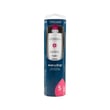
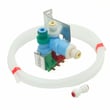
We use the model number to match the correct Kenmore parts diagrams and compatible replacement parts. Even small model-number differences can change which items fit, such as the refrigerator filter EDR5RXD1 or the refrigerator inlet valve W10408179.
- Copy the model number directly from the label (do not guess)
- If the label is hard to read, take a clear photo and zoom in
- Match the part by name and part ID when you shop (example: EDR5RXD1, W10408179)
Last updated: February 2026
What is the life expectancy of a Kenmore refrigerator freezer?
A Kenmore side-by-side refrigerator like model 10653662300 typically lasts 12 to 15 years. Keeping the condenser area clean, maintaining good airflow around the cabinet, and fixing door-seal or cooling issues quickly helps you reach (and often exceed) that normal lifespan; see the owner's manual.
Most refrigerator failures that shorten life come from heat buildup, airflow restrictions, or moisture and frost issues that go unaddressed.
- Ventilation: Keep space around the refrigerator so heat can escape.
- Cleaning: Follow the cleaning routine in the manual (interior and exterior).
- Door sealing: A leaking gasket forces longer run times and extra wear.
- Defrost performance: Frost buildup can strain the sealed system and fans.
- Power interruptions: Frequent outages or surges can stress controls.
Use this list to reduce compressor run time and prevent common wear items from causing bigger problems.
- Vacuum dust from the condenser area regularly.
- Keep door gaskets clean and ensure doors close fully.
- Set temperatures to normal targets (about 37°F fresh food, 0°F freezer).
- Replace the water filter on schedule if equipped.
- Avoid overpacking; leave room for air circulation.
| Item type | Examples on this model | Why it matters |
|---|---|---|
| Routine maintenance parts | Refrigerator filter EDR5RXD1 | Helps protect water flow and ice maker performance |
| Cooling/defrost parts | Refrigerator defrost bi-metal WPW10225581, refrigerator heater WP2323198 | Prevents frost buildup that can reduce cooling efficiency |
| Major sealed-system parts | Refrigerator compressor W10309994, evaporator | Higher cost; keeping the unit clean and well-ventilated reduces strain |
A refrigerator that runs hotter or longer than normal (from dirty coils, poor airflow, or a bad door seal) wears out key components faster. Staying on top of basic care is the simplest way to protect the compressor and cooling system.
Last updated: February 2026
What are the most common problems with Kenmore refrigerators?
The most common issues we see on Kenmore refrigerators like model 10653662300 are cooling problems, ice maker and water dispenser troubles, leaks, frost buildup, and door-seal air leaks. Many of these start with airflow restrictions, dirty condenser coils, or a clogged water filter; use the owner's manual troubleshooting section to narrow it down.
- Not cooling or weak cooling: dirty condenser coils, blocked vents, evaporator fan issue, or sealed-system problems
- Ice maker not making ice: low water supply, frozen fill tube, or ice maker component failure
- Water dispenser slow or dripping: air in the lines after a filter change, clogged filter, or water supply restriction
- Water leaks or puddles: loose/kinked water line, dispenser drip, or defrost drain issues
- Excess frost or moisture: frequent door openings, humid room air, or door gasket not sealing
- Noisy operation: fan blade rubbing ice, fan motor wear, or compressor/start components
- Confirm temperatures: set fresh food near 37°F and freezer near 0°F.
- Check door sealing: look for gaps, torn gasket, or doors not closing fully.
- Inspect airflow: make sure vents are not blocked by food packages.
- If water flow is weak: remove and reinstall the filter; if it is old, replace it.
- After filter replacement: flush the dispenser; dripping can be normal for 24 to 72 hours while air clears.
| Symptom | Most common fix | Example part for 10653662300 |
|---|---|---|
| Slow water flow | Replace clogged filter | Refrigerator filter EDR5RXD1 |
| No water to dispenser/ice maker | Test/replace inlet valve | Refrigerator inlet valve W10408179 |
| Leaks at filter area | Inspect housing and connections | Refrigerator water filter housing WP2186443 |
Cooling and water issues can cascade. A restricted filter or poor door seal can lead to temperature swings, frost, and extra compressor run time. Catching the simple causes first helps protect food and reduces wear on major components.
For model-specific operating tips (controls, cleaning, power interruptions, and troubleshooting), follow the owner's manual.
Last updated: February 2026