Owner’s manual
 Error Codes



How do you get the bottom shelf out of a Samsung refrigerator?
To remove the bottom shelf in your Samsung RF22KREDBSG refrigerator, we release the shelf from its side supports, then lift the shelf up and pull it out at an angle. This prevents cracking the glass and avoids bending the shelf frame. See the exact shelf removal notes in the RF22KREDBSG owner's manual.
- Remove all food and bins that block the shelf.
- Slide the shelf forward until it stops.
- Press the release tabs or locking clips on both sides at the same time (if your shelf uses them).
- While holding the releases, lift the front edge of the shelf up.
- Tilt the shelf slightly and pull it out of the refrigerator.
- Set the shelf on a flat surface for cleaning.
- Check for ice buildup or sticky spills at the rear supports; warm water on a cloth helps loosen residue.
- Make sure the shelf is fully slid forward before lifting.
- Look for a center support or stop bracket that must be cleared before the shelf can angle out.
- Do not force the glass; if it flexes, lower it and re-check the side clips.
| Do | Do not |
|---|---|
| Lift the front edge first | Pry under the glass with a tool |
| Press both side releases together | Twist the shelf frame to “pop” it free |
| Tilt and remove at an angle | Pull straight out if it is still locked |
Bottom shelves often sit on locking supports; lifting and tilting in the right order protects the glass, keeps the shelf rails aligned, and helps the shelf seat correctly when you reinstall it.
Last updated: February 2026
Do all Samsung refrigerators take the same water filter?
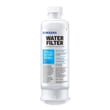
No. Samsung refrigerators do not all use the same water filter; the correct filter depends on your exact model and the filter housing style. For Samsung model RF22KREDBSG, use the filter type specified in the RF22KREDBSG owner's manual and match it to the correct replacement.
Use these quick checks before you buy:
- Confirm your full model number on the rating label (inside the fresh food section).
- Check the part number printed on the current filter.
- Match the filter shape (twist-in cartridge vs. other styles).
- Replace the filter on schedule (most households: about every 6 months).
- After installing, flush water through the dispenser to clear air and carbon fines.
For this model page, the listed compatible replacement is:
| Model | Part name | Part number | What it affects |
|---|---|---|---|
| RF22KREDBSG | Refrigerator water filter | DA29-00019A | Water taste/odor, flow, and ice quality |
If you are replacing the filter now, use refrigerator water filter DA29-00019A.
Using a non-matching filter commonly causes:
- Leaks at the filter head or housing
- Poor water flow at the dispenser
- Filter that will not lock in place
- Bypass of filtration (bad taste or odor)
- Ice maker fill problems due to restricted flow
The water filter is part of the sealed water path feeding the dispenser and ice maker. A correct fit maintains proper water pressure and prevents leaks, while the correct media improves taste and helps protect the water inlet valve and ice maker from sediment.
Last updated: February 2026
What's the lifespan of a bottom freezer fridge?
Most bottom-freezer refrigerators typically last 15 to 20 years with normal household use and basic maintenance. For your Samsung RF22KREDBSG, real-world lifespan depends most on compressor health, airflow (clean coils), and how well the doors seal; those factors drive repair frequency over time.
Bottom-mount (bottom-freezer) designs often run longer when they stay clean, level, and well-ventilated.
- Maintenance level: dirty condenser areas raise run time and wear
- Door seal condition: air leaks cause temperature swings and heavy compressor cycling
- Ice maker and dispenser use: more moving parts, more wear
- Water quality and filter changes: protects the water system and helps flow
- Room conditions: hot garages and tight cabinets shorten life
A fridge is usually near end-of-life when cooling becomes unreliable or sealed-system repairs become frequent.
| Symptom | Common cause | Typical fix type |
|---|---|---|
| Warm fresh food section | airflow/defrost issue | serviceable repair |
| Frost buildup behind rear panel | defrost problem | serviceable repair |
| No ice or slow ice | ice maker or water supply issue | serviceable repair |
| Runs constantly, poor cooling | dirty condenser, fan issue, low refrigerant | varies |
These steps reduce strain on the compressor and stabilize temperatures.
- Vacuum dust from the condenser area regularly (and keep vents clear)
- Keep doors closing tightly; clean and inspect gaskets
- Set stable temps (avoid frequent changes)
- Replace the water filter on schedule; use the correct filter for this model
- Fix small issues early (fan noise, frost, slow ice) before they cascade
If performance issues start showing up, these are common service items for this model family.
A bottom-freezer refrigerator that is kept clean and sealed properly runs fewer hours per day, holds temperature better, and avoids the long run times that accelerate compressor and fan wear. For model-specific care and settings, follow the owner's manual.
Last updated: February 2026
How to lower legs on Samsung fridge?
To lower the leveling legs on your Samsung RF22KREDBSG refrigerator, turn each front leveling leg clockwise (to the right) until the cabinet is stable and the doors sit even. Leveling prevents door gaps, ice buildup, and uneven cooling. See the exact leveling points in the RF22KREDBSG owner's manual.
- Open both fresh food doors so you can reach the front corners.
- Locate the front leveling legs (one at the left front, one at the right front).
- Turn the leg clockwise to lower that corner; turn counterclockwise to raise it.
- Adjust in small increments, alternating left and right.
- Recheck door alignment and that the refrigerator does not rock.
- The cabinet should not wobble when you push on the top corners.
- Doors should close on their own from a partially open position.
- Door tops should look even with each other.
- Gaskets should seal all the way around (no visible gaps).
- The unit should have a slight backward tilt so doors self-close.
A refrigerator that is not level can leave the doors slightly ajar, which drives temperature swings, moisture, frost, and extra compressor run time. Proper leveling also helps the ice maker and dispenser operate more consistently.
| Symptom | Most likely cause | What to do |
|---|---|---|
| One door sits higher | Uneven front legs | Lower the high side or raise the low side, then recheck |
| Doors won’t self-close | Not enough backward tilt | Lower both front legs slightly to tilt cabinet back |
| Door rubs or binds | Hinge alignment issue | Inspect hinges and mounting screws; correct alignment |
| Still not sealing | Gasket not seating | Warm and reshape gasket, clean sealing surfaces |
If the refrigerator is level but a door still sags or won’t align, a worn hinge can be the cause. For this model, common hinge-related replacements include the Samsung refrigerator door hinge, left DA61-08309A or a refrigerator door hinge DA97-12573A (match the location and side before ordering).
Last updated: February 2026