Installation guide
 Owner’s manual
 Error Codes


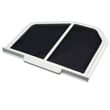


How do I tell what model my Kenmore dryer is?
Your Kenmore dryer’s model number is printed on the model and serial number label; on Kenmore model 11072992101, that label is located at the top inside the dryer door well. Once you have the full model number, you can match the correct parts, diagrams, and specifications.
Where to look for the model number label
Check these common Kenmore dryer label locations (start with the door opening):
- Top inside the dryer door well (most common on Kenmore 110-series dryers)
- Inside the door opening on the cabinet frame
- Rear panel of the dryer cabinet
- Behind the lower front access panel (on some designs)
- Near the lint screen housing (varies by design)
For a picture-based reference and the exact wording used on the label, use the 11072992101 owner's manual.
How to read the number (and why “110” matters)
Kenmore model numbers often start with a 3-digit prefix that helps identify the manufacturing source. For example, 110 is commonly associated with Whirlpool-built Kenmore dryers. The most important thing is to capture the entire model number exactly as shown.
| What to record | Example | Why it matters |
|---|---|---|
| Model number | 11072992101 | Ensures correct parts and fit |
| Serial number | (varies) | Helps match production run details |
| Purchase date | (your date) | Useful for service history |
Tips to avoid ordering the wrong parts
When you write down the model number, use these checks:
- Copy every digit in order; do not shorten it to “110” only
- Look for a separate serial number nearby and record it too
- If the label is worn, take a clear photo and zoom in
- Match the model number on your label to the one on your parts list before checkout
Why it matters
Kenmore dryers share many similar-looking parts across model families; the exact model number (like 11072992101) is what ensures you get the right items such as a door switch, thermal fuse, or gas valve coil kit.
Last updated: February 2026
How to replace a Kenmore dryer thermistor?
On Kenmore gas dryer model 11072992101, we replace the dryer thermistor by unplugging power, accessing the blower housing area, moving the wire connector to the new sensor, and reinstalling everything exactly as found. Use the 11072992101 owner's manual for safe access and reassembly details.
Safety first (before you open the cabinet)
- Unplug the dryer (or switch off the breaker) before removing any panels.
- Let the dryer cool completely.
- Shut off the gas supply valve if you will be working near the burner area.
- Avoid running the dryer with panels removed.
- If you smell gas at any point, stop and ventilate the area.
Steps to replace the thermistor
- Disconnect power and pull the dryer out enough to work safely.
- Remove the rear panel (common access point on many Kenmore 110-series designs).
- Locate the thermistor on or near the blower housing/exhaust duct (it is typically a small sensor with a 2-wire connector).
- Take a quick photo of wire routing and mounting position.
- Disconnect the wire harness from the thermistor.
- Remove the mounting screw(s) and take out the old thermistor.
- Install the new thermistor and reconnect the wire harness.
- Reinstall the rear panel, restore power (and gas if shut off), then run a timed heat cycle to confirm normal drying.
Parts and symptoms guide
| What you notice | Most likely area | What to check next |
|---|---|---|
| Dryer runs but heat is erratic | Temperature sensing | Thermistor connection, lint buildup in venting |
| Dryer shuts off too soon | Airflow or sensing | Lint screen, exhaust duct restrictions |
| Long dry times | Airflow | Blower wheel, crushed/kinked vent |
Related parts that often get checked at the same time
- Dryer thermistor WP8577274 (the sensor you are replacing)
- Lint screen and exhaust duct for restrictions
- Blower wheel for damage or looseness
- Thermal protection devices if the dryer overheated previously
Why it matters
The thermistor helps the dryer regulate temperature. When it drifts out of range or has a poor connection, the dryer can overheat, underheat, or end cycles early, which leads to long dry times and inconsistent results.
Last updated: February 2026
What are common problems with Kenmore dryers?
Common problems on the Kenmore 11072992101 gas dryer include no heat, long dry times, the drum not turning, and unusual noises. Most issues trace back to airflow restrictions (lint and venting), a blown safety fuse, or normal wear on drum support and drive components; use the 11072992101 owner's manual troubleshooting section to narrow it down.
Most common symptoms and what usually causes them
- No heat: gas supply valve closed, failed igniter, failed gas valve coils, or a safety device opened
- Long drying times: clogged lint screen, crushed or restricted vent, dirty exhaust ducting
- Drum not turning: worn rollers, idler pulley problems, or a failing drive motor
- Loud thumping/squealing: worn drum support rollers, idler pulley, or blower wheel issues
- Won’t start: door not fully closed, failed door switch, or power supply problem
Quick checks we recommend first (fast, no parts)
- Clean the lint screen; wash it with hot water and a nylon brush if you see residue buildup.
- Confirm the dryer is getting proper power and the door closes firmly.
- Verify the gas shutoff valve on the supply line is fully open.
- Inspect venting: use clamps to seal joints, avoid screws into the duct, and use heavy rigid metal venting.
- Make sure the dryer is level; an uneven floor can affect sensor-cycle performance.
Parts that commonly fix these problems on this model
| Symptom | Likely part to check | What it affects |
|---|---|---|
| Won’t start | Dryer door switch WP3406107 | Confirms door is closed so the motor can run |
| No heat (intermittent) | Dryer valve coil kit 279834 | Opens gas valve during ignition |
| No heat (safety open) | Dryer thermal fuse WP3390719 | Shuts heat down if overheating occurs |
| Squeal/thump | Support kit WPW10314173 | Drum support rollers for smooth tumbling |
| Squeal/no tumble | Dryer idler pulley 279640 | Keeps belt tension so the drum turns |
Why it matters
Airflow problems are the most common root cause behind “no heat” complaints and long dry times. Proper venting and a clean lint screen help the dryer heat correctly, dry faster, and reduce repeat failures of fuses and thermostats.
Last updated: February 2026