Error Codes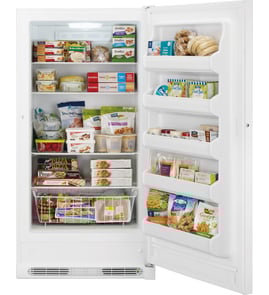






How long does a Kenmore upright freezer last?
A Kenmore upright freezer like model 1068262510 typically lasts 10 to 15 years with normal household use. Keeping the door sealing tightly, the condenser area clean, and the temperature steady helps you reach the upper end of that range.
Typical lifespan and what affects it
Most upright freezers fail early because they run too hot, run too often, or build heavy frost. These factors have the biggest impact:
- Room temperature and ventilation around the cabinet
- Door gasket condition and how often the door is opened
- Frost buildup (manual-defrost units) and airflow restrictions
- Power quality (outages, frequent breaker trips)
- Cleaning and general maintenance
Quick checks that help your freezer last longer
These are simple, high-impact habits for Kenmore upright freezers:
- Keep the freezer reasonably full (but do not block vents); it stabilizes temperature.
- Set temperature to about 0°F for food safety and efficient run time.
- Clean dust from the condenser area periodically (unplug first).
- Make sure the door closes easily and stays closed.
- Defrost when frost gets thick enough to reduce airflow (common trigger is about 1/4 inch).
Parts that commonly influence longevity
If the freezer is warming, running constantly, or sweating around the door, these parts are often involved:
| Symptom | Common cause | Example part for this model |
|---|---|---|
| Frost or moisture around door | Worn or leaking door seal | Door gasket 2188436A |
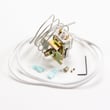
| Temperature swings or warm cabinet | Temperature control issues | Thermostat 4389248 |
Why it matters
A freezer that seals well and cycles normally puts less stress on the compressor and sealed system. That reduces run time, lowers energy use, and helps your Kenmore 1068262510 reach its expected 10 to 15 year service life.
Last updated: February 2026
What does the green light on my freezer mean?
On the Kenmore 1068262510 upright freezer, the green light typically indicates the freezer has power and the refrigeration system is running normally. The compressor cycles on and off as needed, so the light can stay on even when you do not hear the compressor.
What the green light usually tells you
- Power is present at the freezer and the control is energized.
- Normal operation: the compressor runs only when the temperature rises above the set point.
- Compressor cycling is expected: quiet periods do not mean the freezer is off.
- Door openings and warm food loads can make the compressor run longer.
Quick checks if you are unsure it is cooling
- Confirm the temperature control is set to a normal mid-range setting.
- Listen for the evaporator fan (inside) and feel for airflow.
- Check for heavy frost on the back wall (a sign of an airflow or defrost issue).
- Make sure the door seals tightly all the way around.
Door seal check (fast test)
- Close the door on a dollar bill.
- You should feel steady resistance when pulling it out.
- If it slips easily in multiple spots, the gasket may be leaking.
| Symptom | What it often means | What to do next |
|---|---|---|
| Green light on, freezer warm | Airflow issue, dirty condenser, or control problem | Check vents, clean coils, verify settings |
| Green light on, heavy frost buildup | Defrost system or door leak | Inspect gasket and frost pattern |
| Green light off, freezer dead | No power or failed control | Check outlet, breaker, cord |
Why it matters
That green indicator is a quick “status” signal, but cooling performance depends on airflow, a tight door seal, and the temperature control cycling the compressor correctly. If the freezer is not holding temperature and the control is suspect, the thermostat 4389248 is the model-matched temperature control part to check.
Last updated: February 2026
How many cubic feet is my upright freezer?
Your Kenmore upright freezer model 1068262510 has a specific cubic-foot capacity set by its cabinet size, but capacity is not listed in the information provided here. Most upright freezers fall into common size ranges (compact through large), so you can estimate capacity by measuring the exterior and matching it to typical dimensions.
Quick way to estimate cubic feet
- Measure the freezer’s width, height, and depth (in inches). Measure the cabinet, not the handle.
- Convert to cubic feet:
- (W × H × D) ÷ 1,728 = cubic feet
- Compare your result to typical upright-freezer size groups below.
Typical upright freezer size ranges
- Compact: 3 to 5 cu ft (about 20 to 24 in W, 31 to 37 in H, 20 to 25 in D)
- Small: 5 to 9 cu ft (about 21 to 25 in W, 55 to 60 in H, 22 to 26 in D)
- Medium: 10 to 16 cu ft (about 23 to 31 in W, 60 to 73 in H, 27 to 30 in D)
- Large: 17+ cu ft (about 27 to 34 in W, 64 to 76 in H, 29 to 30 in D)
Measurement tips that improve accuracy
- Measure depth without the door handle; handles can add 1 to 3 inches.
- If the freezer is in a tight space, measure at the widest point (hinge side can stick out).
- Interior “usable” space is always less than exterior volume because of insulation and the evaporator area.
Size guide table (fast comparison)
| Size group | Capacity (cu ft) | Common use case |
|---|---|---|
| Compact | 3 to 5 | Apartment, overflow storage |
| Small | 5 to 9 | Small family, garage backup |
| Medium | 10 to 16 | Family freezer, bulk shopping |
| Large | 17+ | Hunting, large households, bulk storage |
Why it matters
Knowing the cubic-foot capacity helps you plan food storage, choose baskets/shelves, and confirm fit before replacing door seals or adjusting the door. If you’re troubleshooting warm temps or frost, a poor door seal can make any size freezer struggle; the door gasket 2188436A is a common wear item on upright freezers.
Last updated: February 2026
Is there a reset button on a Kenmore upright freezer?
Kenmore upright freezers like model 1068262510 typically do not have a dedicated “reset” button. Most resets are done by power-cycling the freezer (unplugging briefly, then restoring power) or by using the temperature control interface if your unit has electronic controls.
How to reset your Kenmore 1068262510 (safe, common methods)
- Power reset: Unplug the freezer (or switch off the breaker) for 2 to 5 minutes, then restore power.
- Control reset (if you have Up/Down temp buttons): Press and hold Temp Up and Temp Down together for about 5 seconds (some versions use a similar key combo).
- Wait for stabilization: After any reset, allow 12 to 24 hours for temperatures to fully stabilize.
- Confirm airflow: Make sure packages are not blocking vents; poor airflow can look like a “needs reset” problem.
- Check the door seal: A leaking gasket can cause warm temps and long run times.
If it still will not cool: quick checks that usually find the cause
If a reset does not help, the issue is usually a control, airflow, or sealed-system symptom rather than a “stuck” freezer.
- Thermostat/control issue: If the freezer runs nonstop or not at all, the temperature control can be the culprit; see thermostat 4389248.
- Door gasket leak: Frost buildup, sweating, or warm temps can point to a poor seal; see door gasket 2188436A.
- Heavy frost on the back wall: Often indicates a defrost problem (heater, defrost thermostat, or timer/control depending on design).
- Condenser area blocked (if accessible): Dust and restricted airflow can reduce cooling.
What “reset” can and cannot fix (at a glance)
| Symptom | Reset might help? | More likely fix |
|---|---|---|
| Control panel acting odd after outage | Yes | Power reset, then recheck settings |
| Warm temps but no unusual frost | Sometimes | Airflow, door seal, thermostat |
| Thick frost/ice buildup | No | Diagnose defrost system |
| Clicking, short cycling, no cooling | No | Compressor start/relay or sealed-system service |
Why it matters
A reset clears minor control glitches after a power interruption, but it will not correct mechanical problems like a failing thermostat, a leaking door gasket, or a defrost failure. Using the right “reset” method helps you avoid unnecessary parts replacement.
Last updated: February 2026
Where is the model number on a Kenmore upright freezer?
On a Kenmore upright freezer like model 1068262510, the model number is printed on a rating label inside the cabinet or on the exterior cabinet edges. The most common spots are just inside the door opening, on an interior side wall, or behind the lower front kick plate.
Most common places to check
Look for a paper or metal tag that lists the model and serial numbers.
- Inside the freezer on a side wall (often near the front)
- Along the door opening frame (hinge side or latch side)
- On the ceiling area inside the cabinet (common on some uprights)
- Behind the lower front kick plate or toe grille
- On the back of the cabinet near the bottom
Quick steps to find it fast
- Open the door and scan the door frame first (eye level down to the bottom)
- Check the upper interior walls and ceiling next
- Remove the kick plate if your unit has one (usually it pulls off or is held by a couple screws)
- Use a flashlight; labels are often low-contrast or partially covered by frost
What the label looks like
| What you’ll see | Why it helps |
|---|---|
| Model number (example: 1068262510) | Ensures you get the correct Kenmore upright freezer parts |
| Serial number | Helps identify production run details for some part variations |
| Electrical ratings (V/Hz/A) | Useful when diagnosing power or control issues |
Why it matters
We use the model number to match the correct parts diagrams and compatible replacement parts (for example, a temperature control thermostat or door gasket). If you order by a partial number, you can end up with a part that does not fit or perform correctly.
If you need help confirming the number format, use our guide: how to find your appliance model number (and what it means for parts).
Last updated: February 2026