Installation guide
 Owner’s manual
 Error Codes


How to hard reset a Kenmore dishwasher?
For the Kenmore dishwasher model 66517383N710, the most reliable “hard reset” is a control reset: press CANCEL/DRAIN twice to reset the control, then reselect your cycle and press START/RESUME. This matches the reset procedure in the 66517383N710 owner's manual.
Quick reset steps (control reset)
- Open the door slightly to pause the cycle; wait for spraying to stop.
- Press CANCEL/DRAIN once, then press CANCEL/DRAIN a second time (this resets the control).
- Close the door within 3 seconds so the dishwasher can drain if needed.
- Select your new cycle and options.
- Press START/RESUME to restart.
If the buttons won’t respond
A “reset” sometimes fails because the controls are locked.
- Press and hold HEATED DRY for 3 seconds to toggle Control Lock off.
- Try the CANCEL/DRAIN twice reset again.
- If the dishwasher is mid-cycle, always wait for spraying to stop before opening the door fully.
What to expect after you reset
| What you do | What the dishwasher does | Typical time |
|---|---|---|
| Press CANCEL/DRAIN once | Cancel/Drain light turns on | Immediate |
| Close door after cancel | Drains water (if water is in the bottom) | Up to about 2 minutes |
| Press START/RESUME | Starts the selected cycle | Immediate |
Why it matters
Resetting the control clears a stuck cycle or option selection and safely forces a drain when water is left in the tub. That prevents standing water, odor, and poor wash results.
Last updated: January 2026
Where is the filter on a Kenmore quiet guard dishwasher?
On the Kenmore 66517383N710 dishwasher, the removable filters are located at the bottom center of the tub, under the lower rack. Pull out the lower rack to access the filter area, then twist and lift the upper filter assembly out of the lower filter.
Where to look (quick location guide)
- Open the door and slide the lower rack out.
- Look at the bottom center of the dishwasher tub.
- You will see the filter assembly sitting in a circular opening.
- The filter is not up on the door or along the side walls; it sits down in the sump area.
How the filter comes out (typical steps)
We follow the same basic removal method described in the 66517383N710 owner's manual.
- Rotate the upper filter assembly to unlock it (turn until it releases).
- Lift the upper filter assembly straight up and out.
- Lift out the lower filter (it sits under locating tabs).
- Rinse filters under running water; use a soft brush for stuck-on soil or hard-water deposits.
- Reinstall by seating the lower filter under the locating tabs, inserting the upper filter, then rotating clockwise until it drops and locks.
What you should see (parts and orientation)
| Filter piece | Where it sits | What it does |
|---|---|---|
| Upper filter assembly | Twists into the circular opening | Catches larger debris and helps protect the pump |
| Lower filter | Flat piece under locating tabs | Screens finer soil and supports the upper filter |
Why it matters
A clogged or incorrectly seated filter can reduce wash performance, leave grit on dishes, and contribute to draining or circulation issues. Keeping the filter clean helps your Kenmore dishwasher maintain strong spray and consistent cleaning.
Last updated: January 2026
What is the service code f4e1 on a Kenmore Elite dishwasher?
On a Kenmore dishwasher like model 66517383N710, the F4E1 service code points to a wash motor or circulation problem (the dishwasher is not moving water through the spray arms correctly). Clearing the code after the repair is part of restoring normal operation; follow the reset steps in the 66517383N710 user manual.
What you’ll usually notice with F4E1
- Dishes come out dirty because water is not circulating well
- Little to no spray action from the spray arms
- The cycle may stop mid-cycle or drain unexpectedly
- You may hear unusual humming or a motor that struggles to run
What to check first (before replacing parts)
We recommend these quick checks because they can mimic a motor fault:
- Confirm the door is fully closed and latched
- Verify the water supply valve is turned on
- Start a cycle and check for water in the bottom of the tub after a couple minutes (the installation guide’s “check operation” method)
- Clean the filter area and remove debris that can restrict flow
- Inspect the spray arm for clogs and free rotation
If the dishwasher is not operating at all, the 66517383N710 installation guide also calls out basics like a tripped breaker or blown fuse, door latch, and correct cycle selection.
Parts commonly involved when F4E1 is a wash/circulation issue
If the checks above don’t restore circulation, these are the most common repair paths:
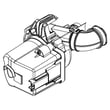
- Wash motor / sump and motor assembly: sump and motor assembly W11025157
- Circulation restrictions: clogged filter, blocked sump, or a damaged hose
- Heating-related performance issues (less common for F4E1, but can affect wash results): element assembly W10518394
Quick part-to-symptom guide
| Symptom during wash | Most likely area | Example part on this model |
|---|---|---|
| No spray, motor hums | Wash motor not pumping | W11025157 |
| Weak spray, intermittent | Restriction in filter/sump | WPW10463906 (filter) |
| Poor cleaning plus cool water | Heating performance | W10518394 |
Why it matters
F4E1 is important because the dishwasher can fill and drain normally but still fail to clean if the wash motor cannot circulate water. Fixing the circulation problem protects the pump system and restores proper spray-arm pressure.
Last updated: January 2026
What are common problems with Kenmore dishwashers?
Common problems on Kenmore dishwasher model 66517383N710 include not starting, poor cleaning, draining issues, and door or rack problems. Many symptoms trace back to loading, water temperature (target 120°F), filters, or a worn pump, valve, or heating circuit; our 66517383N710 use and care guide walks through the most likely checks.
Most common symptoms (and what they usually mean)
- Won’t start or stops mid-cycle: door not fully latched, Start/Resume light blinking, Sleep Mode active, or a tripped breaker.
- Dishes come out cloudy or spotted: hard water, not enough rinse aid, or incorrect detergent amount.
- Not draining: kinked drain hose, clogged filter area, or a failing drain pump.
- Poor wash performance: clogged spray arm holes, dirty filter, or circulation issue.
- Burning smell: plastic contacting the heater, debris on the heater, or a motor/pump strain.
- Door or rack issues: misaligned door, worn hinges, or broken rack stops/rollers.
Quick checks we recommend first
- Confirm the door closes and latches; if the Start/Resume light is blinking, close the door and press Start/Resume.
- Verify hot water supply; incoming water should be about 120°F (49°C).
- Check loading so large items do not block the wash system at the back or prevent the door from latching.
- Clean the filter area and inspect the spray arm for clogs.
- If it won’t drain, inspect the drain path for kinks or restrictions.
Parts that commonly solve these problems
| Symptom | Part to inspect | What it affects |
|---|---|---|
| Not draining | Dishwasher drain pump W10876537 | Pumps water out during drain |
| Not filling or fills slowly | Dishwasher water inlet valve W11175771 | Controls water entering the tub |
| Poor cleaning | Dishwasher spray arm WPW10491331 | Water distribution and spray pressure |
| Not drying or heating issues | Element assembly W10518394 | Water heating and drying performance |
Why it matters
Catching the root cause early prevents repeat wash failures, reduces odor and residue buildup, and helps protect the tub, racks, and motor from extra strain.
Last updated: January 2026