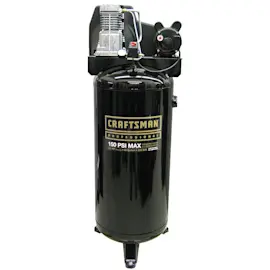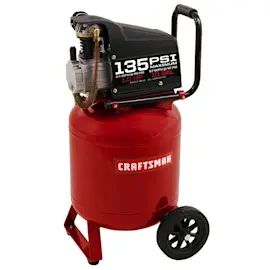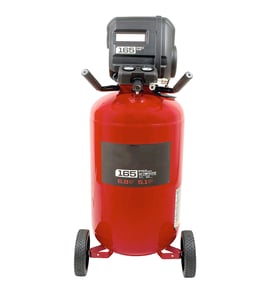

How to find air compressor model number?
The model number for your Craftsman air compressor is printed on the unit’s identification label (often a metal or foil placard). On model 10217501, check the tank, frame, or motor/pump shroud for a stamped or printed model number and serial number.
Check these common label locations first:
- Air tank: along the side of the tank, near the drain valve area
- Frame/base rail: near the wheels or rubber feet
- Motor/pump shroud: on the plastic cover or nearby metal bracket
- Rear panel (if equipped): near the power cord entry
- Handle area: on the upright frame tube
For ordering parts and matching diagrams, we use the exact identifiers from the label.
| Label item | What it’s used for | Tip |
|---|---|---|
| Model number | Matches the correct parts list | Copy it exactly, including dashes/spaces |
| Serial number | Helps identify production run | Take a photo for accuracy |
| Voltage/amps | Confirms electrical requirements | Useful when troubleshooting start issues |
| Max PSI | Confirms pressure rating | Do not exceed this rating |
Use these practical options to identify the unit:
- Look for the model number stamped into a metal tag riveted to the tank or frame
- Check for a second label under the handle or behind a shroud
- Search your purchase paperwork for the model number
- If you can’t find it, match by visible features (tank style, regulator layout, pressure switch style) and use the DIY guides to narrow the system you’re working on
The correct model number ensures you get the right Craftsman 10217501 air compressor parts and diagrams; small design changes between similar compressors can affect items like the pressure switch, regulator, check valve, and gauges.
For more help identifying issues once you have the model number, use our DIY troubleshooting: air compressor common questions.
Last updated: February 2026
How to tell if an air compressor pressure switch is bad?
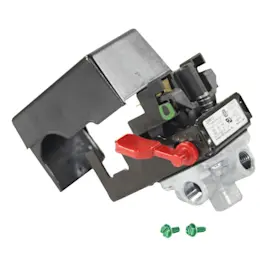
A bad pressure switch on a Craftsman 10217501 air compressor shows up as incorrect cut-in or cut-out behavior: the motor will not start, will not shut off, or will short-cycle. You may also hear constant hissing at the unloader line and see the tank pressure stall well below normal.
- Compressor will not start even with power available
- Compressor runs but never shuts off (or shuts off too early)
- Rapid on/off cycling (short cycling)
- Air leaking continuously from the unloader valve area after the motor stops
- Burnt smell, buzzing, or chattering from the switch housing
- Tank pressure will not build even though the pump is running
- Confirm the symptom: Note whether the problem is “won’t start,” “won’t stop,” or “short-cycles.”
- Listen at shutdown: When the motor stops, a brief hiss is normal; hissing that continues points to a pressure switch or check valve issue.
- Watch the gauges: If tank pressure rises normally but the motor does not shut off, the switch is not opening at cut-out.
- Try a reset and cool-down: If it restarts only after cooling, the switch contacts may be pitted or the motor may be overloading.
| What you observe | Most likely cause | What to check next |
|---|---|---|
| Won’t start with low tank pressure | Switch not closing (bad contacts) or power issue | Cord/outlet, switch terminals, motor overload |
| Runs past normal shutoff | Switch not opening at cut-out | Pressure switch mechanism, sensing line blockage |
| Constant leak at unloader after stop | Switch unloader not sealing or check valve leaking | Unloader line, tank check valve |
| Short cycling | Switch setpoint problem or air leak | Regulator setting, leaks, switch function |
The pressure switch controls motor on/off based on tank pressure. When it fails, the compressor can overrun, short-cycle, or refuse to start, which accelerates wear on the motor, check valve, and pump.
Use our step-by-step guide: how to replace an air compressor pressure switch.
Last updated: February 2026
Is a 20 gallon air compressor big enough for air tools?
Yes. A 20-gallon air compressor is big enough for many common air tools in a home garage, and it can work well with your Craftsman 10217501 for intermittent use. The key is matching the compressor’s delivered airflow (SCFM at 90 PSI) to the tool’s SCFM demand.
A larger tank mainly gives you a bigger “reserve” so the tool can run longer before the motor has to catch up.
- Helps with short bursts (impact wrench, brad nailer, stapler)
- Helps smooth pressure swings for light spraying and blow-off
- Does not increase the pump’s SCFM output
- High-demand tools can outrun the pump even with a big tank
- Longer run times can mean more heat and moisture in the air
Use this as a practical starting point; always compare your tool’s SCFM rating to the compressor’s SCFM at 90 PSI.
| Tool type | Typical air demand | 20-gallon compressor fit | What you’ll notice |
|---|---|---|---|
| Nailers/staplers | Low | Great | Fast recovery, steady use |
| Impact wrench (auto lug nuts) | Medium | Usually good | May cycle often on stubborn fasteners |
| Blow gun/inflation | Low to medium | Great | Consistent performance |
| HVLP touch-up spraying | Medium | Often OK | May need pauses to recover |
| Die grinder/DA sander | High (continuous) | Often not ideal | Pressure drop, frequent waiting |
- Find the tool’s SCFM requirement (often listed at 90 PSI)
- Compare it to the compressor’s SCFM at 90 PSI (not just tank size)
- If tool SCFM is higher, plan on short bursts and recovery time
- Use the shortest, largest-diameter hose you can (to reduce pressure drop)
- Set the regulator so the tool gets its required PSI, not “max PSI”
If the tool needs more SCFM than the compressor can deliver, the tank empties faster than it refills. That causes pressure drop, weaker tool performance, and longer wait times between bursts.
For common “won’t keep up” situations, we use the troubleshooting steps in air compressor won't build tank pressure.
Last updated: February 2026
What is the most common cause of air compressor failure?
The most common cause of air compressor failure (including on the Craftsman 10217501) is poor maintenance that leads to heat and wear: dirty intake filtration, restricted cooling airflow, moisture contamination, and running the unit hard for long periods. Over time, that combination damages valves, seals, bearings, and the pump.
- Overheating from blocked cooling fins, poor ventilation, or long duty cycles
- Dirty or clogged intake filter that makes the pump work harder and run hotter
- Moisture left in the tank that accelerates internal corrosion and causes leaks
- Air leaks at fittings, regulator, drain valve, or hose connections that force constant cycling
- Electrical/control issues such as a failing pressure switch, capacitor, or loose wiring
- Unplug the compressor and let it cool.
- Inspect and clean cooling areas (shroud, fins, vents) so air can flow freely.
- Drain the tank after use to remove water (especially in humid garages).
- Listen for hissing and soap-test fittings to find small leaks.
- Watch the gauges: slow fill or low max pressure points to pump/valve sealing problems.
| What you notice | Most likely cause | What to do first |
|---|---|---|
| Won’t start | Power supply issue, pressure switch, motor/capacitor | Verify outlet, reset, then test switch |
| Runs but won’t build pressure | Leaks, worn reed valves, bad check valve | Check for leaks, then inspect valves |
| Starts then trips breaker | Overheating, tight pump, motor issue | Improve airflow, check pump drag |
| Pressure won’t adjust | Regulator problem, gauge issue | Inspect regulator and gauge behavior |
Heat and contamination are the fastest ways to shorten pump life. A compressor that runs hot or cycles constantly wears internal components quickly, and moisture left in the tank creates rust that leads to chronic leaks and unsafe performance.
- Air compressor won't start
- Air compressor won't build tank pressure
- Air compressor air leaks
- How to rebuild an air compressor pump
Last updated: February 2026