Owner’s manual
 Error Codes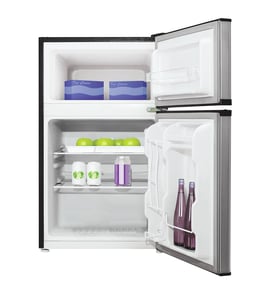




How do I know what model Kenmore refrigerator I have?
Your Kenmore refrigerator’s model number is printed on the rating label inside the refrigerator cabinet. For Kenmore model 18393972, the manual specifically notes the model and serial number are on a label in the refrigerator; match that label to the number you use when ordering parts.
Check these common spots on compact refrigerators like Kenmore 18393972:
- Inside the fresh food compartment on a side wall
- On the ceiling of the refrigerator compartment
- Behind or under a crisper drawer (if equipped)
- Near the door opening, around the cabinet frame
- On the back exterior panel (less common on compact units)
If you still do not see it, use the location guidance in the owner's manual.
Record both numbers exactly as shown on the label:
- Model number (used to match parts and diagrams)
- Serial number (helps identify production details)
- Date of purchase (useful for your records)
Kenmore model numbers are the fastest way to ensure a part fits your exact refrigerator configuration. Even small design changes can affect fit for items like a temperature control knob, door shelf, or hinge parts.
| Item | What it identifies | Used for |
|---|---|---|
| Model number | The refrigerator design and parts list | Ordering correct replacement parts |
| Serial number | The specific unit | Service history and unit identification |
Once you have the model number, use it exactly as printed (including all digits). For this page, that is 18393972.
Last updated: February 2026
What is the average lifespan of a Kenmore 18393972 Elite refrigerator?
A Kenmore compact refrigerator like model 18393972 typically lasts 10 to 15 years. You can push lifespan toward the high end by keeping airflow clear, maintaining good door gasket sealing, and defrosting the freezer section when frost reaches about 1/4 inch (see the owner's manual).
Most refrigerators fall into a predictable range; the biggest drivers are heat load, door sealing, and how hard the compressor has to work.
- 10 to 15 years is the normal lifespan range for modern refrigerators
- Frequent door openings and warm, humid rooms make the unit run more often
- Poor door sealing (gasket not seating) increases run time and wear
- Heavy frost buildup reduces cooling efficiency and stresses the system
- Regular cleaning and correct temperature settings reduce cycling
These steps match how compact, manual-defrost units are designed to operate.
- Defrost the freezer section when frost reaches 1/4 inch thickness
- During defrost, use the drip tray and empty it as it fills
- Keep the door closing fully; remove bin or container blockages
- Level the refrigerator and re-align the door if it does not shut properly
- Unplug before cleaning; use a mild baking soda and warm water solution for interior cleaning
| Item | Best practice | Why it helps |
|---|---|---|
| Frost level | Defrost at ~1/4 inch | Restores airflow and efficiency |
| Door seal | Check gasket seating | Prevents warm air leaks |
| Temperature control | Avoid “too cold” settings | Reduces over-cycling and freezing |
| Placement | Allow proper air circulation | Lowers compressor heat load |
A refrigerator that runs too frequently, struggles to close, or has heavy frost buildup uses more energy and puts extra wear on the sealed system (compressor and refrigerant loop). Staying ahead of frost and door-seal issues is the simplest way to protect the most expensive components.
Last updated: February 2026
What are the main 5 parts of a refrigerator?
The five main parts that make a refrigerator cool are the compressor, condenser coil, metering device (capillary tube or expansion valve), evaporator coil, and thermostat/temperature control. Together, these parts move refrigerant and remove heat so your Kenmore 18393972 compact refrigerator can maintain a safe food temperature (see the owner's manual).
- Compressor: pumps refrigerant through the sealed system.
- Condenser coil: releases heat to the room air.
- Metering device (capillary tube/expansion valve): drops refrigerant pressure so it can get cold.
- Evaporator coil: absorbs heat from inside the cabinet.
- Thermostat/temperature control: senses temperature and cycles cooling on and off.
These are not part of the sealed refrigeration cycle, but they matter for everyday performance:
- Door gasket: keeps warm air out and prevents frost and sweating.
- Evaporator access cover/door: protects the evaporator area and helps direct airflow (example: Kenmore refrigerator evaporator access door RF-2300-250).
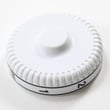
- Temperature control knob: the user control you turn to adjust cooling (example: Kenmore refrigerator temperature control knob RF-4000-35).
- Drain/water tray: catches defrost moisture so it can evaporate (example: Kenmore refrigerator water tray RF-7600-122).
| Part | Main job | Common symptom if it fails |
|---|---|---|
| Compressor | Moves refrigerant | Not cooling at all, clicking/humming |
| Condenser coil | Dumps heat | Warm cabinet, runs constantly |
| Metering device | Controls refrigerant flow | Poor cooling, frosting patterns |
| Evaporator coil | Absorbs heat inside | Warm fridge, heavy frost/ice |
| Thermostat/control | Regulates temperature | Too warm or too cold, short cycling |
When you know the “big 5,” troubleshooting gets faster. For example, a broken control knob is a simple fix, but sealed-system issues (compressor, coils, metering device) typically require specialized service. Our owner's manual also covers safe use, temperature adjustment, and basic care.
Last updated: February 2026
Can you still get parts for Kenmore refrigerators?
Yes. We still offer replacement parts for Kenmore refrigerators, including model 18393972; you can match parts by model number and then choose the exact component you need (for example, a temperature control knob, door shelf, or hinge assembly). For diagrams and part identification, use the owner's manual.
- Confirm the model number on the rating label is 18393972.
- Compare the part name and part number to what you’re replacing.
- Use the exploded-view diagrams in the owner's manual to verify location and fit.
- If the issue is physical damage (broken shelf, loose door), inspect mounting points and screws before ordering.
- If the issue is cooling-related, check basic setup first (door closing, temperature setting, airflow).
These are examples of parts available for Kenmore compact refrigerator 18393972:
| What you’re fixing | Part you may need | Example from our parts list |
|---|---|---|
| Temperature won’t stay set or knob is missing/cracked | Temperature control knob | Refrigerator temperature control knob RF-4000-35 |
| Door won’t close smoothly or sags | Hinge components | Refrigerator hinge assembly RF-0250-06 |
| Broken or missing storage on the door | Door shelf/bin | Refrigerator door shelf RF-6350-142 |
| Water collecting under the unit | Evaporation/drip tray | Refrigerator water tray RF-7600-122 |
Using the correct Kenmore parts for model 18393972 helps the door seal properly, keeps temperatures stable, and prevents issues like moisture buildup, odors, and frequent running. The manual also notes basic checks such as confirming the door fully closes and adjusting the temperature control as needed.
Last updated: February 2026
How many cubic feet is my Kenmore Coldspot refrigerator model 18393972?
Your Kenmore compact refrigerator model 18393972 has a capacity of 3.9 cubic feet. You can also confirm the capacity and other specifications by checking the product information in the 18393972 owner's manual.
Use these quick checks to match the rating to your exact unit:
- Look for the model and serial label inside the fresh food compartment.
- Compare the model number on the label to 18393972.
- Check the specifications section in the 18393972 owner's manual.
- If you are shopping parts, match by model number first, not by marketing names like “Coldspot.”
“Coldspot” is often used for larger Kenmore refrigerators, but model 18393972 is a compact unit. Here is a practical comparison:
| Refrigerator style | Typical capacity | Where you see it |
|---|---|---|
| Compact refrigerator (18393972) | 3 to 5 cu. ft. | Office, dorm, garage |
| Full-size side-by-side | 20 to 28 cu. ft. | Main kitchen refrigerator |
Knowing the correct cubic feet helps you set expectations for storage space, cooling recovery after door openings, and proper placement clearances so the refrigerator runs efficiently.
Last updated: February 2026