 Installation guide
 Owner’s manual




How to remove the filter and spinner on GE dishwasher?
On the GE GDF520PSD0SS dishwasher, we remove the filter by pulling out the bottom rack, twisting the large round (ultra-fine) filter to unlock it, then lifting it out; the spray arm (spinner) comes off after the filters are out and any retaining pieces are released per the GDF520PSD0SS owner’s manual.
Filter removal steps (ultra-fine and fine filters)
- Turn the dishwasher off and let it cool if it just ran.
- Pull the bottom rack out to access the sump area.
- Twist the large round ultra-fine filter counterclockwise to unlock, then lift it out.
- Twist the two retaining posts at the back of the tub to release the fine filter (mesh plate), then lift it out.
- Rinse filters with warm, soapy water; use a soft sponge or soft brush for stuck-on soil.
- Reinstall in reverse order; twist the ultra-fine filter to lock and secure both retaining posts.
Removing the spray arm (spinner)
On this GE design, the lower spray arm sits above the filter area; once the filters are removed, you can access the spray arm hub and any locking tab or fastener.
- Remove the bottom rack.
- Remove the filters first (steps above).
- Release the spray arm from its hub (twist-off or lift-off depending on the hub style).
- Rinse spray arm holes under running water; clear debris with a toothpick if needed.
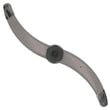
If your lower spray arm is cracked, warped, or the jets are clogged beyond cleaning, replacement is often the fastest fix; use the exact model-matched part dishwasher spray arm, lower WD22X33499.
Cleaning do’s and don’ts (to avoid damage)
| Item | Use | Avoid |
|---|---|---|
| Filters | Warm soapy water, soft sponge | Scouring pads, stiff brushes |
| Spray arm | Rinse, gentle hole cleaning | Forcing the hub, overtightening |
| Reassembly | Twist to lock, confirm seated | Running a cycle with filters loose |
Why it matters
A clogged filter or spray arm reduces water flow, which can cause gritty dishes and poor wash performance. GE recommends inspecting and cleaning the filters periodically (about every other month, depending on usage).
Last updated: February 2026
Is GE profile considered high end?
Yes. GE Profile is generally considered GE’s higher-end mainstream line, positioned above standard GE models with more premium features and finishes; it is a step below GE’s luxury-tier lines. For your GE dishwasher model GDF520PSD0SS, “Profile” mainly signals upgraded options, not a different repair approach.
How GE Profile typically compares
GE uses multiple product lines; “high end” usually means more features, quieter operation, and more advanced controls.
- Standard GE: core features, value-focused
- GE Profile: upgraded features and design, more tech-forward options
- Luxury lines: highest-end styling and feature sets (varies by brand family)
| Line | Typical positioning | What you notice most |
|---|---|---|
| Standard GE | entry to mid-range | fewer cycles and options |
| GE Profile | mid to high-end mainstream | more options, upgraded look |
| Luxury tier | premium | top styling, specialty features |
What this means for parts and service on GDF520PSD0SS
For repairs, the most important thing is matching parts to the exact model number (GDF520PSD0SS) and following GE’s service and safety guidance.
- Use the model-specific procedures in the GDF520PSD0SS owner’s manual
- Follow mounting, leveling, and connection requirements in the GDF520PSD0SS installation guide
- Keep your model and serial number handy when scheduling service
- Use OEM-matched parts when replacing functional components
Common “premium feature” parts customers ask about
If performance issues show up (poor cleaning, not drying, leaks), these model-matched parts are common checkpoints:
- Dishwasher heater element WD05X30818 (drying and water heating)
- Dishwasher spray arm, lower WD22X33499 (wash coverage)
- Dishwasher coarse filter WD22X10093 (soil capture and circulation)
Why it matters
Knowing the line helps set expectations: GE Profile usually adds convenience and performance features, but correct diagnosis and model-matched parts are what actually restore cleaning, draining, and drying performance.
Last updated: February 2026
Is it worth repairing a GE dishwasher?
Yes, repairing a GE dishwasher like model GDF520PSD0SS is worth it when the problem is a single, fixable failure (drain, heat, latch, or wash performance) and the total repair cost stays well below the cost of replacement. Most dishwashers typically last about 10 years, so age and repair history should drive the decision.
Quick decision checklist
- Under ~10 years old and otherwise in good condition
- One clear symptom (won’t drain, won’t heat, won’t start, leaks) instead of multiple issues
- Repair cost is under ~50% of a comparable new dishwasher
- No repeated breakdowns in the last 12 to 24 months
- You can confirm basics first (power, loading, detergent, filters) using the GDF520PSD0SS owner’s manual
Common repairs that are usually worth it
These are frequent, “single-part” fixes on many GE dishwashers and often restore normal operation:
- Not draining: check the dishwasher drain hose WD24X10062 for kinks or clogs; a drain pump may also be involved
- Not drying or water not heating: a failed heater such as the dishwasher heater element WD05X30818
- Won’t start or won’t latch: a door latch issue such as the GE dishwasher door latch lock WD21X10490
- Poor cleaning: clogged filters, blocked spray arms, or a damaged spray arm (for example, the lower spray arm)
Repair vs replace: simple comparison
| Situation | Repair makes sense | Replace makes sense |
|---|---|---|
| Age | Under ~10 years | Over ~10 years |
| Cost | Under ~50% of new | Over ~50% of new |
| Problem pattern | One-time failure | Recurring or multiple failures |
| Condition | Tub, racks, door are solid | Rusted racks, leaks, heavy wear |
Why it matters
A dishwasher that is still structurally sound (tub, door, racks) can often be brought back to reliable performance with a targeted part replacement. On the other hand, repeated electrical/control issues or multiple leaks can turn into ongoing downtime and higher total cost.
What we recommend before spending on parts
- Clean and inspect the filters (reduced wash performance or gritty dishes often points here)
- Verify the dishwasher is getting power (including any wall switch control)
- Run a normal cycle after correcting loading and detergent use
- If you see an error, use the GE electronic dishwasher error codes guide to narrow the failure
Last updated: February 2026
What is the average lifespan of a GE dishwasher?
A GE dishwasher typically lasts 10 to 12 years with normal household use. For your GE GDF520PSD0SS, consistent cleaning, correct detergent use, and keeping water flow and seals in good shape are the biggest factors that help it reach (or exceed) that average; see the GDF520PSD0SS owner’s manual for care and cleaning guidance.
Typical lifespan ranges (what to expect)
Most dishwashers fall into a predictable range based on use and maintenance:
- Typical average: 10 to 12 years
- Common overall range: 8 to 15 years
- Shorter lifespan drivers: heavy daily loads, hard water scale, poor draining, frequent overheating
- Longer lifespan drivers: regular filter cleaning, good loading habits, prompt leak fixes
| Usage pattern | What we usually see | Practical takeaway |
|---|---|---|
| Light (few loads/week) | Often closer to 12 to 15 years | Maintenance matters more than hours run |
| Normal (most households) | Around 10 to 12 years | Keep filters and spray arms clear |
| Heavy (multiple loads/day) | Often 8 to 10 years | Expect more wear on pump, heater, seals |
Maintenance that extends life on the GDF520PSD0SS
These steps reduce strain on the wash system and help prevent leaks:
- Clean the filter area regularly; remove debris before it reaches the pump.
- Keep spray arm holes clear; a clogged arm reduces cleaning and overworks the motor (the lower arm is a common wear item like the dishwasher spray arm, lower WD22X33499).
- Use dishwasher detergent and rinse aid as recommended for automatic dishwashers.
- Scrape off hard soils (bones, toothpicks, seeds) instead of pre-rinsing everything.
- Address leaks quickly; a worn door or tub seal can shorten the life of internal components.
Why it matters
Once a dishwasher gets near the 10 to 12 year mark, small issues (poor cleaning, not draining, not drying, door not latching) can cascade into bigger repairs. Staying ahead of clogs, scale, and leaks helps protect high-cost parts like the control board, heater, and drain pump.
Last updated: February 2026
What is the most common problem with a GE dishwasher?
On the GE GDF520PSD0SS dishwasher, the most common problems we see are poor cleaning from clogged filters or spray arms, draining trouble from a blocked drain path, and “won’t start” symptoms tied to the door not latching. Regular filter cleaning and basic checks prevent many calls.
Most common issues (and what to check first)
- Not cleaning well: Clean the filters and check for blocked spray arm holes.
- Not draining: Look for a kinked hose, a clogged air gap (if installed), or debris in the sump area.
- Won’t start or stops mid-cycle: Make sure the door is fully closed and latched; the manual notes the Start light can flash if the door was opened or the cycle was interrupted.
- Leaks at the door: Inspect the door seal for gaps, tears, or food buildup.
- Not drying: Confirm rinse aid use and proper detergent; low rinse aid can reduce drying performance.
Quick troubleshooting steps for GDF520PSD0SS
- Turn off power at the breaker for 1 minute, then restore power.
- Remove the bottom rack and clean the filter assembly as shown in the GDF520PSD0SS owner’s manual.
- Spin the spray arms by hand; they should rotate freely and not be packed with debris.
- If you have an air gap, clean it (it can clog and cause drain issues).
- Run a short cycle empty after cleaning to confirm water circulation and draining.
Parts that commonly solve these symptoms
| Symptom | Common cause | Part to consider |
|---|---|---|
| Gritty dishes, weak wash | Clogged filter or restricted spray | Dishwasher coarse filter WD22X10093 or dishwasher spray arm, lower WD22X33499 |
| Won’t start, beeps, stops | Door not fully latching | Door latch assembly (inspect latch and strike alignment) |
| Standing water | Drain restriction or pump issue | Drain path cleaning; drain pump diagnosis |
Why it matters
A partially clogged filter or spray arm reduces water pressure at the dishes, which can look like a “bad dishwasher” even when the motor and control are fine. Cleaning the filters every other month (or sooner with heavy use) helps keep cycles consistent.
Last updated: February 2026
Where do I find the model number on a GE dishwasher?
On your GE dishwasher model GDF520PSD0SS, the model number is printed on the rating label on the tub wall just inside the door. Open the door fully and look along the inside tub frame (commonly on the left-hand side). See the GDF520PSD0SS owner's manual for the exact label location diagram.
Quick steps to locate the rating label
- Open the dishwasher door and keep it fully open.
- Look at the tub wall just inside the door opening.
- Check the left-hand tub wall first; then scan the right side if needed.
- Find the label that lists both Model # and Serial #.
- Write the numbers down exactly as shown (including letters and any dashes).
What the model number helps you do
The model number is the key to matching the correct GE dishwasher parts and instructions for your exact configuration.
- Confirms the correct parts list for GDF520PSD0SS
- Helps identify finish and panel type (for example, models ending in SS are stainless steel)
- Speeds up troubleshooting and service calls
Model number vs. serial number
| Item | What it identifies | When you need it |
|---|---|---|
| Model number | The dishwasher design and parts fit | Ordering parts, manuals, diagrams |
| Serial number | The specific unit’s production info | Service history, warranty, support |
Why it matters
Even within the same GE dishwasher series, small design changes can affect fit. Using the exact model number from the tub label helps us match the right components the first time.
Last updated: February 2026





