
Why is 31.6 on a miter saw?
The 31.6° mark on your Craftsman 113234601 compound miter saw is a built-in shortcut for making common compound cuts for crown molding. It pairs with a typical 33.9° bevel setting so you can cut standard crown molding corners accurately without doing angle math every time.
Most miter saws include 31.6° because it is one of the standard settings for cutting crown molding when you use the compound miter method (miter plus bevel).
- It helps create tight 45° corner joints for many crown installations.
- It is commonly paired with a 33.9° bevel.
- It is intended for typical crown molding “spring angles” (commonly 38° or 52°).
- It reduces trial-and-error when you are cutting inside and outside corners.
These are the most common “starting point” settings people use for crown molding with the compound method.
| Crown position | Miter setting | Bevel setting |
|---|---|---|
| Inside corner (left side) | 31.6° | 33.9° |
| Inside corner (right side) | 31.6° | 33.9° |
| Outside corner (left side) | 31.6° | 33.9° |
| Outside corner (right side) | 31.6° | 33.9° |
Even with the 31.6° detent, crown molding varies by profile and spring angle, and walls are rarely perfectly square. We use these steps to dial it in fast:
- Cut two short test pieces first (scrap crown is ideal).
- Keep the crown oriented consistently (mark “ceiling” and “wall” edges).
- Confirm the bevel direction before cutting (left-tilt vs right-tilt matters).
- Sneak up on the fit if corners are out of square (small miter tweaks are normal).
- Use a stop block for repeat cuts once the fit is perfect.
Crown molding cuts are easy to get wrong because you are joining two angles at once. The 31.6° mark is there to speed up setup and improve accuracy, especially when you are making multiple matching cuts.
If you need to look up parts or diagrams for your Craftsman 113234601 miter saw, start with the model parts list, or search by model number on Sears PartsDirect.
Last updated: February 2026
What should you never cut with a miter saw?
You should never use a Craftsman 113234601 compound miter saw to cut materials or setups that can bind, shatter, or pull into the blade. Avoid rip cuts, ferrous metals, masonry, and any small or unstable workpiece that puts your hands close to the blade path.
- Ferrous metals (steel, iron): they can grab the blade and throw the workpiece.
- Masonry (brick, concrete, tile): abrasive dust and the wrong blade type create a high-risk cut.
- Loose knots, badly split, or severely warped wood: it can shift mid-cut and pinch the blade.
- Anything thicker or wider than the saw’s rated capacity: overloading increases binding and kickback.
- Rip cuts (cutting with the grain): a miter saw is built for crosscuts and angled cuts, not ripping.
- Freehand cutting (no fence support): always keep the work against the fence and table.
- Cutting very small pieces without a safe hold-down: if you cannot clamp it, do not cut it.
- Reaching across the blade line: keep hands out of the “no-hands zone” in front of and beside the blade.
- Use a table saw or circular saw with a guide for rip cuts.
- Use the correct blade for the material you are cutting (wood blade for wood only).
- Clamp the workpiece whenever it is short, narrow, or prone to twisting.
- Let the blade reach full speed; then lower smoothly and wait for the blade to stop before lifting.
| Task | Use a miter saw? | Better option |
|---|---|---|
| Crosscut 2x lumber | Yes | Miter saw with sharp wood blade |
| Rip a board | No | Table saw or circular saw + straightedge |
| Cut steel angle | No | Metal-cutting saw or abrasive chop saw |
| Cut brick/tile | No | Masonry saw or angle grinder with masonry wheel |
Most miter saw injuries and tool damage come from binding, kickback, and unstable workpieces. Staying within the saw’s intended use protects the guard, blade, fence alignment, and most importantly, your hands.
For parts and diagrams for your Craftsman 113234601, start with the model parts list or search by model on Sears PartsDirect.
Last updated: February 2026
What are the parts of a miter saw?
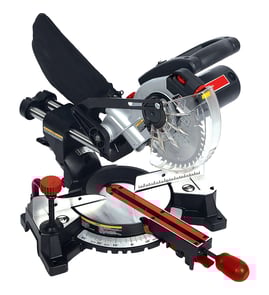
A compound miter saw like the Craftsman 113234601 is built around a motor-driven blade that pivots down to cut, plus angle-setting controls that let us set miter (left-right) and bevel (tilt) for accurate crosscuts. You can look up diagrams and replacement components by model on Sears PartsDirect.
- Blade and arbor: The blade mounts to the arbor (spindle) and is clamped by an arbor bolt and washers.
- Blade guard (upper and lower): Covers the blade; the lower guard retracts as we lower the handle.
- Motor and drive: The electric motor spins the blade (direct drive or belt/gear drive depending on design).
- Handle and trigger switch: The handle houses the power switch/trigger and often a safety lock.
- Miter table and miter scale: The rotating base with a degree scale for left-right angle cuts.
- Miter lock and detent plate: Locks the table at an angle; detents help “click” into common angles.
- Fence: The vertical back support that keeps the workpiece square to the blade.
- Bevel pivot, bevel scale, and bevel lock: Lets us tilt the saw head for bevel cuts.
| Part | What it adjusts/does | Why you use it |
|---|---|---|
| Miter lock + scale | Left-right angle | Picture frames, trim corners |
| Bevel lock + scale | Blade tilt | Crown molding, compound cuts |
| Fence | Workpiece alignment | Straighter, safer cuts |
| Guard system | Blade coverage | Reduces accidental contact |
Knowing the names of the miter scale, bevel lock, fence, and guard parts makes troubleshooting and ordering faster, especially when we are diagnosing issues like inaccurate angles, a sticking guard, or a switch that will not power on.
- Unplug the saw before inspecting anything near the blade or switch.
- Read the scales at eye level to avoid angle-setting errors.
- If cuts are not square, check fence alignment and miter detents first.
- If the saw will not start, focus on the trigger switch, cord, and internal wiring.
- Match parts by model number 113234601 to avoid fit issues.
Last updated: February 2026
Which Mitre saw is the most accurate?
The most accurate miter saw is the one that holds its settings and can be tuned precisely; in practice, premium sliding compound miter saws with rigid fences, minimal head play, and repeatable detents deliver the best accuracy. For your Craftsman 113234601 compound miter saw, careful calibration and a sharp blade typically make a bigger difference than brand alone.
Accuracy usually comes down to repeatability and squareness, not just a published spec.
- Miter detents that land exactly on common angles (0°, 15°, 22.5°, 31.6°, 45°)
- Fence straightness and a tight fence-to-table relationship
- Low deflection in the arm/rails (especially on sliding models)
- Minimal arbor and pivot play (no side-to-side wiggle at the blade)
- A quality blade matched to the material (fine-tooth for trim, ATB/Hi-ATB for clean crosscuts)
These steps are what we use to make cuts “dead-on” for trim and furniture work.
- Unplug the saw; clean pitch and dust from the table, fence, and detent plate
- Verify the fence is straight; tighten fence fasteners evenly
- Set and confirm 0° miter and 0° bevel with a reliable square
- Make a test cut, then “flip test” the board to check for out-of-square
- Replace or sharpen the blade if you see burning, wandering, or tear-out
- Use consistent clamping and support; long stock needs stable infeed/outfeed
| Feature | What to look for | Why it helps |
|---|---|---|
| Fence system | Tall, rigid, adjustable | Keeps work square and repeatable |
| Miter detents | Positive, tight, adjustable stops | Reduces angle drift |
| Slide/arm rigidity | Low play under hand pressure | Prevents “walking” cuts |
| Blade quality | Premium carbide, correct tooth count | Cleaner, straighter kerf |
Even a high-end saw cuts inaccurately if the fence is out of square or the blade is dull. Once your Craftsman 113234601 is tuned, you get tighter miters, cleaner joints, and less rework on casing, baseboard, and picture frames.
If you need replacement components (for example, fence hardware, detent parts, switches, or guards), start with the parts list for model 113234601; you can also search by model number on Sears PartsDirect.
Last updated: February 2026
Can you cut a 4x4 with a 12 inch miter saw?
Yes; a 12-inch miter saw commonly cuts a 4x4 (actual about 3-1/2 in. x 3-1/2 in.) at 90 degrees in one pass, and if your saw does not have enough vertical clearance you can still make the cut accurately using a flip-cut. For Craftsman model 113234601, confirm clearance with a test cut and proper clamping.
Blade diameter helps, but the saw’s head and guard geometry determine the maximum cut height.
- Vertical clearance at 90 degrees: the key measurement for a 4x4
- Sliding vs. non-sliding: mainly affects crosscut width; height is still the limiter
- Fence and blade guard shape: can reduce usable height even with a large blade
- Miter or bevel angle: capacity drops quickly at 45 degrees miter or bevel
- Work support and clamping: prevents the post from rolling or lifting into the blade
A flip-cut is the standard method when the saw cannot fully clear the thickness.
- Mark the cut line on all four faces of the 4x4.
- Clamp the workpiece firmly against the fence and down to the table.
- Make the first cut as deep as the saw allows without forcing it.
- Rotate the 4x4 180 degrees (keep the same reference face against the fence) and cut to meet the kerf.
- If needed, rotate 90 degrees and repeat to finish cleanly.
| Cut setup | Likelihood of one-pass cut on a 4x4 | Notes |
|---|---|---|
| 90 degrees straight cut | Common | Best-case clearance |
| 45 degrees miter | Less common | Height and fence geometry limit cut |
| Bevel cut | Least common | Head tilt and guard reduce clearance |
Trying to “muscle through” a too-tall cut can pinch the blade, shift the workpiece, and increase kickback risk. A controlled flip-cut protects accuracy, the blade, and the saw.
If you need diagrams or replacement parts for Craftsman 113234601, search by model number on Sears PartsDirect.
Last updated: February 2026