Owner’s manual



How to reset error codes on Whirlpool dishwasher?
On the Whirlpool WDTA50SAKZ0 dishwasher, you typically clear an error condition by canceling the cycle and then restarting after correcting the cause (such as water supply or draining issues). For code meanings and the exact button behavior for your control panel, follow the steps in the WDTA50SAKZ0 owner's manual.
- Press Cancel once to stop the cycle and silence an alarm tone (if sounding).
- Wait about 30 seconds with no buttons pressed so the control returns to an Off state.
- Restore the condition that triggered the code (water on, door fully latched, drain path clear).
- Press Start/Resume to run again.
- If the same code returns immediately, address the related system (fill, drain, or motor) before retrying.
Some codes are “fix the condition and resume,” while others stop operation and require service.
| What you see | What it usually means | What to do first |
|---|---|---|
| H2O | No water detected | Confirm supply valve is ON; confirm fill hose is connected; press Start/Resume |
| F1E1 | Fill valve operation problem | Turn off water (if possible); press Cancel to silence; service is typically needed |
| F8E4 | Overfill condition | Turn off water (if possible); press Cancel to silence; service is typically needed |
If you are troubleshooting a “no fill” or “no water” situation on WDTA50SAKZ0, these model-matched parts are often involved:
- Fill valve assembly W11434044 (controls water entering the dishwasher)
- Water inlet W11535094 (water inlet component used in the fill path)
- Check the inlet screen for debris and confirm household water pressure is steady.
Resetting without fixing the cause usually brings the error right back. Correcting the underlying issue first helps protect the control, prevents overfilling, and gets the wash cycle running normally again.
Last updated: February 2026
What does F4 mean on a Whirlpool dishwasher?
On a Whirlpool dishwasher, an “F” code is a fault code; on model WDTA50SAKZ0, the manual’s drain-related fault is F9E1 (dishwasher will not drain), not “F4”. If you’re seeing “F4” on the display or as a blink pattern, treat it as a drain problem first and follow the drain checks below, then clear the alarm with Cancel.
- Press Cancel once to stop the cycle and silence the alarm tone.
- Wait 1 to 2 minutes to see if the unit runs a drain sequence.
- Check the sink/disposal for a backup; clear any clog.
- Confirm the drain hose is not kinked, crushed, or pinched behind the dishwasher.
- If connected to a garbage disposal, make sure the disposal inlet plug was knocked out.
Drain issues on WDTA50SAKZ0 usually come down to a restriction or a failed drain component.
- Clogged drain hose or air gap (if equipped)
- Clogged disposal or sink drain
- Blockage in the sump area
- Drain pump problem
| Symptom | What to inspect | Example model-matched part |
|---|---|---|
| Hums but won’t drain | Drain hose routing, clogs | Hose-drain,e W11414944 |
| Intermittent draining | Loose connection, clamp | Clamp WP596669 |
| No drain action at all | Pump electrical or pump failure | Pump assembly W11460963 |
Different Whirlpool-built dishwashers and some look-alike control panels use different code formats (displayed codes vs. blink patterns). For WDTA50SAKZ0, we use the fault code chart in the WDTA50SAKZ0 owner's manual to match the symptom to the correct code and fix.
If the dishwasher repeatedly ends the cycle with a drain fault after you clear clogs and confirm the hose and disposal connection are correct, the issue is typically in the pump circuit or control logic.
For more code help and reset steps, use Whirlpool dishwasher error codes and how to reset a Whirlpool dishwasher.
Last updated: February 2026
Can I replace dishwasher parts myself?
Yes, for Whirlpool dishwasher model WDTA50SAKZ0, many common parts are DIY-friendly to replace if you shut off power and water first and follow the step-by-step procedure in the WDTA50SAKZ0 owner’s manual. For wiring or leak-related repairs, careful setup and testing for leaks are essential.
These repairs are typically straightforward with basic hand tools and careful handling:
- Door sealing parts such as the dishwasher door seal W11664713
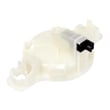
- Door closing parts such as the latch assembly (includes switch) W11412299
- Drain path items such as the hose-drain,e W11414944
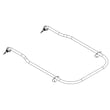
- Wash performance items such as the dishwasher spray arm, lower W11579565
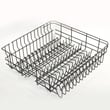
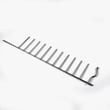
- Rack hardware such as the dishwasher dishrack, lower W10728159
These involve plumbing connections, electrical connections, or both. If you are comfortable working safely, you can do them; otherwise, a technician is the faster option.
- Water supply components such as the fill valve assembly W11434044 or water inlet W11535094
- Control and wiring components such as the ACU (electronic control)
- Motor and sump-related repairs (circulation and sealing)
We recommend these steps before any WDTA50SAKZ0 repair:
- Turn off the circuit breaker (dishwashers must be grounded; avoid shock risk)
- Shut off the dishwasher water supply valve
- Protect hands from sharp edges; avoid damaging the door seal
- If the hot water system has not been used for 2 weeks or more, run hot water at faucets for several minutes before starting the dishwasher (reduces hydrogen gas risk)
- After reassembly, run a short cycle and check underneath for leaks
| Repair type | Typical DIY difficulty | Common risk |
|---|---|---|
| Door seal, latch, racks | Easy | Door leaks if mis-seated |
| Drain hose, clamps | Medium | Leaks, poor draining |
| Fill valve or inlet | Medium | Leaks at fittings |
| Control or wiring | Advanced | Shock risk, miswiring |
A correct DIY repair can restore cleaning and prevent leaks, but a small installation mistake (pinched gasket, loose hose fitting, or misrouted wiring) can cause water damage or a no-start condition. The WDTA50SAKZ0 owner’s manual also includes key safety warnings and installation-cycle checks that help you confirm the repair is solid.
Last updated: February 2026
Why is my Whirlpool dishwasher leaking at the bottom of the door?
On a Whirlpool WDTA50SAKZ0 dishwasher, leaking at the bottom of the door is usually caused by a door seal that is dirty, damaged, or not sealing evenly because the dishwasher is not level and plumb. Start by cleaning the sealing surfaces, then confirm the unit is level and the door latches firmly.
- Wipe the inner door edge and the tub lip where the seal contacts; remove grease, detergent film, and debris.
- Check the door closes smoothly and fully; do not force it against racks or tall items.
- Confirm the door is closing tightly and latched.
- Verify the dishwasher is level and plumb so water does not push toward one corner of the door.
- Inspect the lower spray arm for cracks or blockage that can create a strong spray toward the door.
The WDTA50SAKZ0 installation instructions call for checking plumb and adjusting the leveling legs so the legs are firmly against the floor and the dishwasher is centered in the opening. If the unit is tilted forward or twisted, the door seal can gap at the bottom corners.
Use these targets while you adjust:
| What to check | What “good” looks like | What it prevents |
|---|---|---|
| Front-to-back level | Door closes without rubbing; unit is centered | Water pooling at the bottom edge |
| Side-to-side plumb | Racks do not roll out on their own | Uneven seal compression |
| Door latch engagement | Latch clicks and holds consistently | Leaks from a partially latched door |
Follow the leveling and door-latch checks in the WDTA50SAKZ0 owner’s manual.
If cleaning and leveling do not stop the leak, the sealing parts are the next most common fix.
- Dishwasher door seal W11664713: seals the door to the tub; replace if torn, hardened, or permanently deformed.
- Gasket-tub,d W11483553: helps seal the tub and door interface; replace if nicked or flattened.
- Latch assembly (includes switch) W11412299: a weak latch can let the door sit slightly open under wash pressure.
A small door leak can quickly lead to water under the dishwasher, swelling of nearby cabinetry, and repeated cycle interruptions. Fixing the seal and leveling early prevents bigger repairs later.
Last updated: February 2026