Owner’s manual
 Error Codes


Where is the model number on a Kenmore side by side refrigerator?
On Kenmore side-by-side refrigerator model 25353722300, the model number is printed on the serial plate located inside the refrigerator (fresh food) compartment. Check the label on an interior wall near the top or along the side, then record the model and serial for parts and service reference.
- Open the fresh food (refrigerator) door, not the freezer door
- Look on the inside cabinet walls (left or right side)
- Check near the upper front area of the compartment
- Use a flashlight; the print can be small
- Write down both the model number and serial number exactly as shown
The serial plate usually lists both identifiers you need for correct part matching.
| Label item | What it’s used for | Example for this unit |
|---|---|---|
| Model number | Ensures you get the correct Kenmore parts diagram and compatible parts | 25353722300 |
| Serial number | Helps identify production details for service and some part variations | Varies by unit |
We use the model number to match the correct parts for your exact Kenmore refrigerator configuration (ice maker, water filter setup, door style, and internal components). Even small model differences can change which gasket, valve, or ice maker parts fit.
- Save it in your phone notes
- Write it on the first page of your 25353722300 owner’s manual
- Use the exact characters shown (no spaces added or removed)
Last updated: February 2026
How many cubic feet is my Kenmore refrigerator by model number?
Your Kenmore refrigerator model 25353722300 has its exact cubic-foot capacity listed on the unit’s serial/rating plate inside the fresh food compartment and in the specifications section of the owner's manual. That is the most accurate way to match capacity to your exact configuration.
Use these checks in order; they work even if the refrigerator has been moved or parts have been replaced:
- Check the serial/rating plate inside the refrigerator compartment (it lists model and serial; specs are often referenced from this data).
- Look in the specifications section of the owner's manual for capacity (listed as total and sometimes split between refrigerator and freezer).
- If the manual lists multiple versions, match by model and serial from the plate to pick the correct spec table.
- If you are measuring for space planning, use the cabinet dimensions in the manual rather than capacity.
Cubic feet is the interior storage volume. On side-by-side refrigerators like the Kenmore 25353722300, the published capacity can differ slightly depending on how the manufacturer counts usable space (shelves, bins, and ice maker components can affect usable room).
| Spec you’re looking for | What it tells you | Best use |
|---|---|---|
| Total cubic feet | Overall interior volume | Comparing refrigerator sizes |
| Refrigerator section volume | Fresh food space | Grocery storage planning |
| Freezer section volume | Frozen storage space | Bulk frozen storage planning |
| Exterior dimensions | Physical size of the cabinet | Fit in your kitchen opening |
Knowing the correct cubic-foot capacity helps you compare models accurately, plan food storage, and confirm you are looking at the right specifications for your exact Kenmore side-by-side refrigerator.
Last updated: February 2026
How to tell if a Kenmore refrigerator compressor is bad?
If your Kenmore 25353722300 side-by-side refrigerator is warm and the compressor will not start, repeatedly clicks, or runs constantly without cooling, the compressor or its start components are failing. First rule out power, control settings, and airflow issues using the checks in the owner's manual.
- Refrigerator and freezer temperatures rise even though the unit seems to be “running.”
- You hear a repeated click every few minutes (start attempt, then shutdown).
- The compressor is very hot to the touch after trying to run (use caution).
- The condenser area is warm but there is little or no cooling inside.
- The refrigerator runs too much or too long and never stabilizes.
These items commonly mimic a “bad compressor” and are faster to confirm.
- Verify power and settings: Make sure the unit is plugged in, the breaker is not tripped, and the freezer control is not set to OFF (often shown as “0”).
- Allow for defrost: A defrost cycle is normal and can pause cooling for about 30 minutes.
- Clean condenser coils: Dirty coils can cause long run times and poor cooling.
- Check door sealing: A torn or loose gasket can cause constant running and warm temps; inspect the door seal and consider replacing the refrigerator gasket 241786014 if it is cracked or not sealing.
- Confirm airflow: If the evaporator fan is not moving air, cooling will suffer even with a good compressor; inspect the fan blade and motor.
A compressor diagnosis is electrical and mechanical; these are the standard confirmations.
| Test or observation | What it indicates | Typical next step |
|---|---|---|
| Repeated clicking at the compressor | Start device overload tripping or compressor locked | Test start components, then compressor |
| High amp draw at startup | Compressor struggling or locked rotor | Replace compressor kit if confirmed |
| Windings continuity and insulation checks | Internal motor damage | Replace compressor |
| No cooling with correct airflow and clean coils | Sealed system or compressor issue | Sealed system service |
A compressor is part of the sealed refrigeration system; misdiagnosing it can lead to unnecessary parts replacement. Doing the basic power, control, gasket, and airflow checks first helps you pinpoint whether the issue is truly the compressor or a simpler fix.
Last updated: February 2026
What causes a side-by-side refrigerator to stop cooling?
A Kenmore 25353722300 side-by-side refrigerator usually stops cooling because power is interrupted, the temperature controls are set to OFF, airflow is blocked, or the cooling system cannot shed heat due to a dirty condenser. Start with the simplest checks, then move to fan and defrost-related causes.
- Make sure the plug is fully seated and the outlet has power.
- Check the house fuse or circuit breaker.
- Confirm the freezer control is not set to "O" (OFF).
- Allow time after a power loss or unplugging; full cool-down typically takes 8 to 12 hours.
- Make sure food packages are not blocking cold air vents.
- Verify doors close tightly and are not being held open by bins or containers.
| What’s happening | What you’ll notice | What to do next |
|---|---|---|
| Control set to OFF or too warm | Compressor may not run; temps rise | Reset controls; allow 24 hours to stabilize |
| Defrost cycle in progress | Cooling pauses for about 30 minutes | Wait; this is normal periodically |
| Dirty condenser | Runs too long; weak cooling, warm cabinet sides | Clean condenser coils and recheck temps |
| Door seal leak or door not level | Frost, moisture, warm spots, long run times | Inspect/clean gasket; level unit |
| Evaporator fan issue | Freezer cold but fresh food warm, or no airflow | Check fan blade/motor for obstruction or failure |
If basic checks do not restore cooling, these model-compatible parts are often involved:
- Evaporator motor 5303918549 (moves cold air through the compartments)
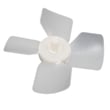
- Refrigerator evaporator fan blade 5308000010 (damaged blades reduce airflow)
- Refrigerator defrost bi-metal thermostat 5303918214 (defrost system protection and control)
- Refrigerator temperature control thermostat 240383703 (temperature regulation)
A refrigerator that is not cooling can be a simple control or airflow issue, but it can also be a heat-removal or defrost problem. Checking controls, door sealing, and condenser cleanliness first prevents unnecessary part replacement and helps protect food safety.
For model-specific control settings, cleaning guidance, and troubleshooting tables, follow the steps in the owner's manual.
Last updated: February 2026
What are the most common problems with Kenmore refrigerators?
The most common problems we see on Kenmore refrigerators like model 25353722300 are poor cooling, water leaks, ice maker or dispenser issues, and unusual noises. These usually trace back to airflow restrictions (dirty condenser coils or a failed evaporator fan), defrost problems, or worn door seals.
- Not cooling or warm temperatures: dirty condenser coils, evaporator fan not running, frost buildup from a defrost issue
- Runs too long: doors opened often, door not sealing, condenser coils dirty (the manual calls out dirty gaskets and a dirty condenser as common causes)
- Water leaking or puddles: clogged defrost drain, loose water line, cracked reservoir, leaking inlet valve
- Ice maker not making ice: low water pressure, frozen fill tube, clogged filter, inlet valve problem, ice clumps jamming the bin
- Noisy operation: fan blade rubbing ice, worn fan motor, items vibrating on shelves
- Confirm the controls are not set to OFF and the unit has power.
- Clean the condenser coils and make sure airflow around the cabinet is open.
- Check door gaskets for gaps, tears, or dirt; clean and reseat the seal.
- Look for frost buildup on the freezer back panel (often points to a defrost or airflow problem).
- If the ice dispenser jams, remove the bin and shake to loosen cubes (avoid sharp tools).
| Problem area | What fails most often | Example part for this model |
|---|---|---|
| Weak cooling, warm fridge | Evaporator fan motor | Evaporator motor 5303918549 |
| Poor airflow noise | Fan blade damage | Refrigerator evaporator fan blade 5308000010 |
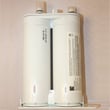
| Water dispenser slow, bad taste | Clogged water filter | Genuine Kenmore refrigerator water filter WF2CB |
| No ice or no water fill | Water inlet valve leaking or not opening | Refrigerator water inlet valve assembly 242252702 |
| Frost, moisture, long run times | Door gasket not sealing | Refrigerator gasket 241786014 |
Cooling, ice production, and leak complaints usually share the same root causes: airflow, sealing, and water supply. Fixing those first prevents food spoilage, reduces compressor run time, and helps avoid repeat ice maker and dispenser problems.
For model-specific operating tips (including defrost-cycle behavior and water filter change intervals), use the owner's manual.
Last updated: February 2026