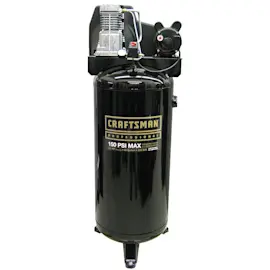
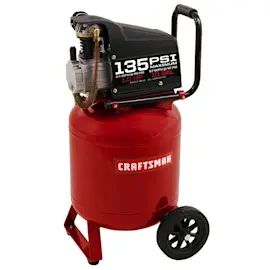
Owner’s manual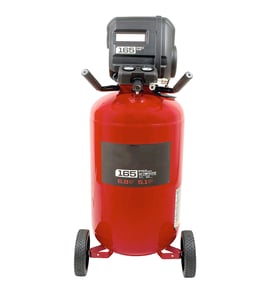

How to read compressor model numbers?
On a Craftsman air compressor like model 919176210, the model number identifies the compressor family, while the code number, manufacturer number (ASME code tanks), and motor nameplate numbers identify the exact tank and motor components. We use these numbers to match the correct parts and service information in the owner's manual.
Where to find the key numbers on model 919176210
You will typically find the identification numbers in these locations:
- Model number: on the label on the front of the air tank saddle
- Code number: on the label on the side of the air tank
- Manufacturer number (ASME code compressors only): on the metal data plate welded to the side of the tank (painted the same color as the tank)
- Motor manufacturer name: on the motor label
- Motor manufacturer number: also on the motor label
How to “read” the numbers (what each one tells you)
For Craftsman model 919176210, these numbers serve different purposes:
| Number you see | What it identifies | When you need it |
|---|---|---|
| Model number (919176210) | The compressor model | Looking up diagrams, general parts, and specs |
| Code number | Production code for the unit | Matching correct revisions or production runs |
| Manufacturer number (ASME) | The tank’s ASME identification | Tank-related service and verification |
| Motor nameplate info | The exact motor build | Motor electrical issues, wiring, or motor replacement research |
Why it matters when ordering parts or troubleshooting
Using the right identifier prevents mismatched parts and wrong electrical guidance. For example, the manual notes that 919176210 (1 HP) uses a dual-voltage motor (110-120V or 220-240V), and the correct wiring instructions are typically printed inside the motor cover or on the motor nameplate.
Tips we use to avoid mix-ups
- Write down the model number and code number before you start a repair
- If the issue is electrical, record the full motor nameplate data
- If your tank is ASME-coded, copy the data plate information exactly
- Keep the numbers with your maintenance notes for future reference
For parts lookup by model number, start with the model parts list, or search by model at Sears PartsDirect.
Last updated: February 2026
Is a 20 gallon air compressor big enough for air tools?
Yes; a 20-gallon air compressor is big enough for many common air tools when you use them intermittently, but it is not the right choice for continuous, high-air-demand tools. With your Craftsman 919176210 air compressor, the key is matching the tool’s SCFM requirement to what the compressor can deliver and how long you need to run it (see the owner's manual).
What a 20-gallon compressor handles well
A 20-gallon tank gives you a useful air reserve for short bursts, so it works best for tools that cycle on and off.
- Brad/finish nailers and staplers
- Tire inflation and blow guns
- Caulking and grease guns
- Air ratchets and some impact wrenches (short bursts with recovery time)
- Light-duty air brushing
When 20 gallons is usually not enough
Tank size helps, but SCFM is what determines whether the compressor can keep up.
- DA sanders and other continuous sanding tools
- HVLP or conventional paint spraying for large areas
- Sandblasting
- Die grinders used continuously
- Any tool that makes the motor run nearly nonstop to maintain pressure
Quick way to size it: SCFM and duty cycle
Your tool’s label/manual lists an SCFM rating at a given pressure (often 90 PSIG). If the tool’s SCFM is higher than the compressor’s output, the tank pressure will drop and the pump will run constantly.
| Tool type | Air demand pattern | 20-gallon fit? |
|---|---|---|
| Nailers, inflators | Short bursts | Good |
| Impact wrench | Bursts with pauses | Often OK |
| Sander, sprayer, blaster | Continuous | Usually too small |
Why it matters
Running an undersized compressor for a high-CFM tool causes pressure drop, inconsistent tool performance, and excessive run time. That extra heat and workload can shorten service life, so we recommend sizing for the tool’s SCFM first, then using tank size as a buffer.
For repair help if performance is poor (hard starting, low pressure, leaks), use our DIY guides like air compressor won't build tank pressure. For replacement parts and diagrams for model 919176210, start with the parts list for this model, or search by model number on Sears PartsDirect.
Last updated: February 2026
What is the average lifespan of an air compressor?
Most homeowner and light-duty air compressors average 5 to 10 years of service life; with consistent maintenance and reasonable run time, many reach the upper end of that range. For your Craftsman 919176210 air compressor, following the maintenance and oil guidance in the owner's manual is the most direct way to extend pump and motor life.
Typical lifespan by compressor type
Air compressor life depends heavily on duty cycle, heat, and how clean and dry the air system stays.
| Compressor type | Typical lifespan | Common use |
|---|---|---|
| Oil-free, direct-drive (DIY) | 5 to 10 years | Nailers, inflators, light shop work |
| Oil-lubricated, belt-drive (shop) | 10 to 15 years | Larger tools, longer run times |
| Industrial rotary screw | 10 to 20 years | Continuous production environments |
What shortens lifespan fastest
These are the most common “life reducers” we see on air compressors like the Craftsman 919176210:
- Water left in the tank (internal corrosion and contaminated air)
- Running hot (poor ventilation, clogged intake filter)
- Wrong oil or low oil on oil-lubricated pumps (accelerated wear)
- Air leaks that force long run times (pump and motor stress)
- Frequent hard starts (pressure switch, check valve, or unloader issues)
Maintenance habits that add years
The manual for this model calls out key tasks such as replacing the air intake filter, checking the safety valve, checking and changing oil, and draining water from the tank.
- Drain the tank after use; moisture is normal and must be removed
- Keep the air intake filter clean so the pump can breathe
- Use the correct compressor oil and keep the level correct (the manual notes the crankcase fill is about 16 fl oz)
- Store with the tank empty and cord and hose protected
- Fix leaks promptly so the unit reaches cut-out pressure quickly
Why it matters
A compressor usually “wears out” from excess run time and heat. Simple steps like draining the tank and keeping the intake filter clean reduce corrosion and lower the duty cycle, which protects the pump, pressure switch, and motor.
If you need to look up maintenance intervals or identify components (pressure switch, safety valve, regulator, drain valve), use the diagrams and parts list in the owner's manual. For broader model-based part searching, use Sears PartsDirect.
Last updated: February 2026
What does 4.0 SCFM at 90 PSI mean?
“4.0 SCFM at 90 PSI” means your Craftsman air compressor model 919176210 can deliver 4.0 standard cubic feet of air per minute while maintaining 90 PSI at the outlet. It is a real-world airflow rating you use to match the compressor to air tools that run around 90 PSI.
How to use SCFM at 90 PSI when choosing tools
Most pneumatic tools list an air requirement in SCFM at a specific PSI (often 90 PSI). Your compressor needs to meet or exceed that number for steady operation.
- Match the tool’s required SCFM at 90 PSI to the compressor’s rating
- If the tool needs more SCFM than the compressor provides, the tool will run weak or the compressor will run constantly
- Short-burst tools (brad nailers, staplers) can work with lower SCFM than continuous-run tools
- Continuous tools (DA sanders, grinders, paint sprayers) usually need higher SCFM
- Hose size, fittings, and leaks can reduce usable airflow
SCFM vs PSI (what each number tells you)
The manual defines SCFM as a unit of air delivery and PSIG/PSI as a unit of pressure. Use both numbers together to understand performance. See the definitions section in the owner's manual.
| Spec | What it measures | What you’ll notice if it’s too low |
|---|---|---|
| SCFM | Air volume (flow) | Tool slows down, pressure drops while running |
| PSI (PSIG) | Air pressure (force) | Tool may not actuate properly or lacks power |
Why “standard” matters
“Standard” in SCFM means the airflow is corrected to a consistent baseline so you can compare compressors more fairly. That is why SCFM is more useful than raw CFM when you are shopping or comparing performance.
Quick buying and lookup tip
For parts and diagrams for model 919176210, start with the model parts list, or search by model number on Sears PartsDirect.
Last updated: February 2026
What is the most common cause of air compressor failure?
Poor maintenance is the most common cause of air compressor failure because it leads to overheating and rapid wear. For the Craftsman 919176210 air compressor, the manual highlights restricted air intake filtration, incorrect oil level (including overfilling), and poor ventilation as key contributors; see the 919176210 owner's manual.
What usually fails first when maintenance is skipped
These problems show up early because they increase heat, friction, and run time:
- Restricted or dirty air intake filter (low output, longer run times)
- Oil issues: low oil, old oil, or overfilled crankcase (knocking, overheating, wear)
- Poor cooling airflow or dirty cooling fins (hot running, shutdowns)
- Air leaks at fittings, hose, or valves (won’t hold pressure, runs constantly)
- Unloader or check valve issues (hard starting, overload trips)
Quick prevention checklist
We recommend this routine for shop-style compressors like model 919176210:
- Check crankcase oil level before each use; keep it near the fill hole level
- Change oil about every 100 operating hours (per the manual)
- Replace the air intake filter when dirty, oily, or paint-covered
- Keep the unit in a dry, clean, cool, well-ventilated area
- Check for leaks with soapy water; tighten fittings without overtightening
Symptoms-to-cause guide
| What you notice | Common cause | First thing to check |
|---|---|---|
| Slow fill, low air delivery | Restricted intake | Air intake filter and airflow path |
| Knocking, hot pump | Oil level/condition | Oil level, oil change interval |
| Runs too long, won’t hold | Air leak | Fittings, hose, safety valve |
| Motor won’t restart easily | Unloader/check valve | Unloader hiss at shutoff, check valve |
Why it matters
Most “failures” start as small efficiency problems (dirty filter, minor leaks, oil level). Fixing them early prevents long run times and overheating, which is what typically turns maintenance into a pump or motor repair.
For step-by-step troubleshooting by symptom, use air compressor won't start. For diagrams and to order replacement parts by model number, search Sears PartsDirect.
Last updated: February 2026