Owner’s manual
 Error Codes


How many cubic feet is the Kenmore Elite?
Kenmore Elite is a product line, not one specific refrigerator size; cubic feet depends on the exact model number. For your Kenmore side-by-side refrigerator model 10659124801, the most accurate capacity listing is in the 10659124801 owner's manual.
How to find the cubic feet for your exact Kenmore Elite model
If you are asking about a different Kenmore Elite refrigerator (for example, a French door model), use the model number from the rating label and match it to the correct manual.
- Look for the model number on the rating label (commonly inside the fresh food compartment on a side wall).
- Use that exact model number to pull the correct manual and specs.
- If you have a side-by-side, confirm you are not mixing it up with a French door “Elite” model.
- If you only know the marketing name (like “Kenmore Elite”), use the model number to avoid ordering the wrong parts.
Typical capacity ranges (helpful for a quick reality check)
Most full-size refrigerators fall into these general ranges; your exact number can vary by cabinet width and configuration.
| Refrigerator style | Typical capacity range |
|---|---|
| Top freezer | 14 to 22 cu. ft. |
| Side-by-side | 20 to 28 cu. ft. |
| French door | 22 to 30+ cu. ft. |
Why it matters
Cubic feet affects how much food you can store, but it also impacts fit and airflow needs. When you are planning a replacement, measuring the opening and confirming the spec in the manual prevents clearance problems and helps you compare like-for-like models.
Last updated: February 2026
How wide is a Kenmore side by side refrigerator?
Most Kenmore side-by-side refrigerators are about 32 to 36 inches wide; your Kenmore model 10659124801 is in that typical range. For the exact cabinet width and required clearance for door swing, we recommend checking the dimensions section in the 10659124801 owner's manual.
Typical widths you will see
Side-by-side refrigerator widths vary mainly by capacity and whether the unit is standard-depth or counter-depth.
- 32 to 33 inches: narrower side-by-side models
- 35 to 36 inches: most common full-size side-by-side models
- 36+ inches: larger-capacity or premium configurations
Clearance you should plan for (important)
Even if the cabinet width fits, you still need space for airflow and for the doors to open.
- Allow about 1/2 inch of space on each side and at the top for ventilation
- If the refrigerator sits next to a fixed wall, plan for about 2 inches minimum on the wall side so the door can swing open
- If you have an ice maker, leave extra space behind for the water line connection
Quick planning table
| What you are measuring | What to include | Why it matters |
|---|---|---|
| Cabinet width | Refrigerator body only | Confirms it fits the opening |
| “Fits in opening” width | Cabinet width + side clearance | Prevents overheating and noise |
| Door swing space | Extra room near walls/cabinets | Lets bins and drawers pull out |
How to measure width correctly
- Measure the widest point of the cabinet (not the doors)
- Measure again across the doors/handles if you are checking hallway clearance
- Compare your measurements to the dimensions listed in the 10659124801 owner's manual
Why it matters
A refrigerator that is too tight in the opening can run hotter, cool poorly, and make service tasks (like leveling, cleaning the condenser area, or connecting the water line) much harder.
Last updated: February 2026
What is the ER if code on a Kenmore Elite?
On Kenmore model 10659124801, the ER IF (or Er IF) code points to an ice fan problem in the freezer area. That fan pushes cold air through the door air ducts to keep the ice maker and ice bin cold; when it is not moving air correctly, the refrigerator reports ER IF.
What to check first (quick, safe steps)
- Power reset: unplug the refrigerator for 2 minutes, then restore power.
- Make sure the freezer door closes fully and seals tightly.
- Check for frost or ice buildup around the ice maker area and door chute.
- Confirm vents and air passages are not blocked by food packages.
- If you recently replaced the water filter, flush the water system as described in the owner's manual.
Common causes of ER IF
| Likely cause | What you may notice | Typical fix |
|---|---|---|
| Ice fan not running or running slow | Warm/soft ice, slow ice production | Clear ice obstruction; replace failed fan components as needed |
| Frost buildup restricting airflow | Frost near vents, noisy fan, intermittent cooling | Defrost and correct the underlying defrost/airflow issue |
| Door or dispenser air path issue | Ice clumping near door, poor airflow to ice box | Inspect door chute area; repair dispenser door if it is not sealing |
| Control or wiring issue | Code returns quickly after reset | Inspect connections; replace failed control if diagnosed |
Parts that are often involved
If the ice maker is not producing ice normally after you clear any ice blockage and reset power, these model-matched parts are commonly checked during diagnosis:
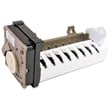
- Refrigerator ice maker WPW10190965 (ice production and harvest)
- Refrigerator ice dispenser door WP2180353 (helps keep warm air out of the ice chute)
Why it matters
The ice fan is what keeps the ice compartment cold. When airflow drops, ice can melt and refreeze into clumps, the ice maker can slow down, and the freezer may struggle to maintain stable temperatures.
Last updated: February 2026