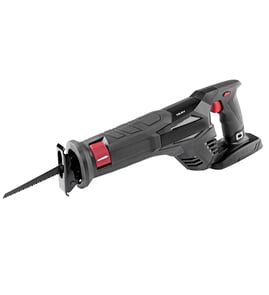

What is a reciprocating saw good for cutting?
A Makita JR3000V reciprocating saw is best for fast, aggressive cutting where precision is not the priority, especially demolition and rough-in work. With the right blade, it cuts wood (including nails), metal, plastic, and pruning limbs.
- Wood and framing lumber: use a wood or demolition blade (coarse teeth)
- Wood with nails: use a demolition blade rated for nail-embedded wood
- Metal pipe, conduit, angle iron: use a metal-cutting blade (fine teeth)
- PVC/ABS and other plastics: use a fine-tooth blade to reduce chipping
- Tree limbs and pruning: use a pruning blade (aggressive, wide tooth pattern)
Reciprocating saws shine when you need reach, speed, and the ability to cut in awkward positions.
| Job type | Reciprocating saw fit | Why |
|---|---|---|
| Demolition (studs, drywall, nails) | Excellent | Fast rough cuts, tolerant of mixed materials |
| Flush cuts near surfaces | Good | Flexible blades can cut close to a wall or floor |
| Tight, detailed cutouts | Poor | Large stroke and vibration reduce precision |
| Straight finish carpentry cuts | Fair | Works, but leaves a rougher edge than a circular saw |
- Match TPI (teeth per inch) to material: lower TPI for wood, higher TPI for metal
- Let the saw do the work; forcing it bends blades and increases vibration
- Keep the shoe firmly against the work to reduce chatter and improve control
- Start slow to establish the kerf, then increase speed once the blade is tracking
- Use the shortest blade that still reaches through the material for better stability
Using the correct blade and technique on your JR3000V improves cut speed, reduces blade breakage, and helps protect key wear components like the blade clamp, shoe, and motor.
For more DIY help with electrical troubleshooting tools used in power tool repair, see how to use a multimeter to test electrical parts video.
Last updated: February 2026
How do reciprocating saws work?
A reciprocating saw like the Makita JR3000V works by using an electric motor to drive a mechanism that moves the blade rapidly back and forth (reciprocates). That push-pull stroke lets the teeth bite and clear material quickly, which is why these saws are popular for demolition, pruning, and rough cutting.
The motor’s rotation is converted into linear blade motion through a crank and linkage (or similar drive). As the blade strokes:
- The forward stroke does most of the cutting
- The return stroke clears chips and resets the teeth
- The shoe (front foot) braces against the work to reduce vibration and improve control
- The blade clamp holds the blade so the stroke transfers power efficiently
Reciprocating saws are designed for fast material removal, not fine finish work. They excel when you need reach and flexibility.
| Task | Typical blade choice | What to expect |
|---|---|---|
| Wood demolition | Coarse wood blade | Fast cuts, rough edge |
| Metal pipe/conduit | Fine-tooth metal blade | Slower cut, cleaner control |
| Pruning limbs | Pruning blade | Fast, can grab if unsupported |
| Mixed materials | Bi-metal “demo” blade | Versatile, moderate speed |
- Match the blade tooth count to the material (fewer teeth for wood, more for metal).
- Keep the shoe pressed firmly to the workpiece to limit chatter.
- Let the saw do the work; forcing it overheats blades and stresses the drive.
- Support the workpiece to prevent pinching and kickback.
- Unplug the saw before changing blades or inspecting the clamp.
Understanding the back-and-forth stroke helps you choose the right blade, control vibration, and avoid bending blades or damaging the blade clamp and drive components during tough cuts.
Related help: are diy appliance repairs safe
Last updated: February 2026
How to change Makita Recip saw blade?
To change the blade on a Makita JR3000V reciprocating saw, unplug the tool (or remove the battery if applicable), open the blade clamp/lock at the nose, slide the old blade out, then insert the new blade fully and release the lock so it clamps securely.
- Disconnect power before touching the blade or clamp
- Wear gloves; used blades are sharp and can have burrs
- Let the blade cool if you were cutting metal
- Keep fingers away from the clamp slot while locking
- Tug-test the blade after installing to confirm it is locked
- Power off and disconnect: Unplug the corded saw.
- Open the blade clamp: At the front (nose) of the saw, rotate or actuate the blade lock/clamp mechanism to the open position.
- Remove the old blade: Pull the blade straight out.
- Install the new blade: Push the new reciprocating saw blade into the clamp until it bottoms out.
- Lock it in: Release the clamp so it returns to the locked position.
- Verify: Pull on the blade firmly; it should not slide out.
- Debris in the clamp (sawdust, metal chips)
- Clamp not fully rotated to the open position before insertion
- Blade not inserted all the way
- Worn clamp parts (common on heavily used power tool parts)
| Symptom | Most common cause | What to do |
|---|---|---|
| Blade falls out | Not fully seated or not fully locked | Reinsert, then lock and tug-test |
| Clamp feels stuck | Packed debris or light corrosion | Clean the nose area; cycle clamp open/closed |
| Blade hard to remove | Clamp not fully opened | Open clamp fully, then pull straight out |
A properly locked blade keeps the JR3000V cutting straight and reduces vibration. It also prevents the blade from ejecting during a stroke, which protects the shoe, clamp, and user.
For help locating the correct model identification before ordering parts, use how to find your appliance model number (and what it means for parts).
Last updated: February 2026
Is there a difference between a reciprocating saw and a JR3000V?
A reciprocating saw is the tool category; Makita JR3000V is a specific reciprocating saw model within that category. So there is a difference in wording: one is the generic tool type, and the other is your exact model.
- Reciprocating saw: A general type of power tool that cuts with a push-pull (back-and-forth) blade motion.
- JR3000V: A specific Makita reciprocating saw model number used to identify the exact tool when selecting parts and diagrams.
- “Sawzall”: A common nickname people use for reciprocating saws; it is a brand name that gets used generically.
Even when two tools are both “reciprocating saws,” internal components can differ (switch style, brush holder design, gear case parts, cord set, etc.). Using the exact model number helps match the correct parts breakdown.
- Use JR3000V when searching parts diagrams
- Match parts by diagram location and description, not just by appearance
- Confirm the type number or revision if your tool has one on the ID label
- Replace worn items in pairs when applicable (for example, carbon brushes)
| Term you see | What it refers to | Best time to use it |
|---|---|---|
| Reciprocating saw | Tool category | Comparing tool types and features |
| Makita JR3000V | Specific model | Finding exact replacement parts |
| Sawzall | Common nickname | Casual conversation (not for parts lookup) |
Using the correct wording prevents ordering the wrong power tool parts. “Reciprocating saw” tells us what the tool is; “JR3000V” tells us which exact Makita version you have so the parts list matches your saw.
For model identification tips before ordering, use how to find your appliance model number (and what it means for parts).
Last updated: February 2026
Are Makita reciprocating saws good?
Yes. Makita reciprocating saws are widely considered good tools because they deliver strong cutting power, solid durability, and consistent performance for common demolition and remodeling tasks. For the Makita JR3000V reciprocating saw, overall satisfaction typically comes down to using the right blade and keeping the tool maintained.
A good reciprocating saw balances power, control, and reliability across different materials.
Common strengths customers look for:
- Strong motor performance for wood, metal, and mixed-material cuts
- Comfortable handling and manageable vibration for longer jobs
- Quick, secure blade changes (less downtime)
- Durable shoe and blade clamp for demolition work
- Easy access to serviceable wear items (cord, brushes, switch)
Most “this saw is great” experiences come from matching the blade and technique to the job.
Best-practice checklist:
- Use a wood demolition blade for nail-embedded lumber; use a bi-metal blade for metal
- Let the saw do the work; forcing the cut increases heat and wear
- Keep the shoe firmly against the workpiece to reduce vibration and blade breakage
- Replace dull blades early; a fresh blade cuts faster and runs cooler
- Inspect the cord and strain relief regularly if you use the saw on job sites
| Material | Blade type | Teeth per inch (typical) | Notes |
|---|---|---|---|
| Wood (clean) | Wood-cutting | 4 to 8 TPI | Fast cuts, rougher finish |
| Wood with nails | Demolition bi-metal | 6 to 10 TPI | Better durability |
| Metal pipe/angle | Bi-metal metal-cutting | 14 to 24 TPI | Slower, cleaner cuts |
| Thick metal | Heavy-duty bi-metal/carbide | 8 to 14 TPI | Use steady pressure |
Reciprocating saw performance is heavily blade-dependent. The right blade and a stable cutting stance reduce vibration, improve cut speed, and help the motor, blade clamp, and shoe last longer.
For more help identifying the exact model number details you need when shopping for parts, use how to find your appliance model number (and what it means for parts).
Last updated: February 2026