Installation guide
 Owner’s manual
 Error Codes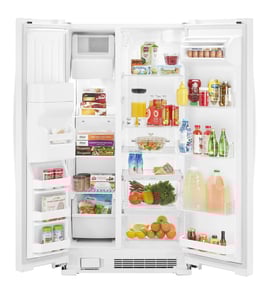

Is side by side better than a French door?
A side-by-side like the Frigidaire FRS6R5ESBS is better when you want easy freezer access, more door storage, and a narrower door swing; a French door is better when you want wider fresh-food shelves and easier access to large platters. The best choice depends on how you use refrigerator vs. freezer space.
Quick comparison
| Feature | Side-by-side (FRS6R5ESBS style) | French door |
|---|---|---|
| Fresh-food shelf width | Narrower | Wider |
| Freezer access | Eye-level, easy | Lower drawer |
| Door storage | Typically strong | Good, varies |
| Door swing clearance | Often needs less | Often needs more |
| Best for | Frozen foods, tight aisles | Fresh foods, party trays |
When a side-by-side is the better pick
- You use the freezer daily and want items at eye level.
- Your kitchen has tight walkways; narrower doors can be easier to open.
- You like lots of bins on both doors for condiments and drinks.
- You rely on ice and water in the door and want quick access.
When a French door is the better pick
- You store wide items (pizza boxes, sheet pans, platters) in the fresh-food section.
- You want more flexible fresh-food organization (wide shelves and drawers).
- You prefer a bottom freezer drawer for bulk frozen storage.
Fit and airflow considerations (often overlooked)
Even if you love a layout, the refrigerator has to fit and ventilate correctly. For this Frigidaire side-by-side, the installation guidance calls for clearance around the cabinet (including 3/8 inch at the sides and top, and 1 inch at the back) and proper leveling to help the doors seal. Check the exact requirements and door-opening details in the FRS6R5ESBS installation guide.
Why it matters
Choosing the right style reduces food waste and frustration. If you buy a layout that does not match your habits (fresh-food heavy vs. freezer heavy), you end up overstuffing shelves, blocking vents, and fighting temperature swings.
Last updated: February 2026
What does EF mean on a Frigidaire refrigerator?
On a Frigidaire FRS6R5ESBS refrigerator, EF (often shown as SY EF) points to a problem in the evaporator fan circuit. The evaporator fan is what pushes cold air through the refrigerator and freezer, so when it fails you can get warm temperatures or poor airflow.
What you’ll notice when EF/SY EF is active
- Refrigerator section warming up even though the freezer seems cold
- Weak or no airflow from the vents
- Unusual fan noise, or no fan sound at all
- Frost buildup on the freezer back panel (common when airflow is restricted)
- Temperature swings and longer run times
Quick checks we recommend first
- Power reset: Unplug the refrigerator for 5 minutes, then plug it back in.
- Check for blocked airflow: Make sure packages are not blocking freezer vents.
- Listen for the evaporator fan: You normally hear air moving in operation.
- Inspect for heavy frost: A frosted-over evaporator area can stop the fan from moving air.
- Confirm door closure: A door left ajar can lead to frost and airflow problems.
For model-specific component locations and access steps, use the owner's manual.
Parts that commonly relate to an EF/SY EF condition
If the fan is not moving air, the issue is often the fan blade, the fan motor, wiring, or a defrost-related problem that caused ice buildup.
| Symptom | Most likely area | Example part on this model page |
|---|---|---|
| Fan runs but airflow is weak | Fan blade slipping, ice obstruction | Refrigerator evaporator fan blade 5308000010 |
| Heavy frost, fan hitting ice | Defrost system issue | Refrigerator defrost bi-metal thermostat 5303918214 |
| No ice maker fill sound, water issues too | Water system (separate from EF, but often noticed together) | Refrigerator water inlet valve assembly 242252702 |
Why this matters
The evaporator fan is the “air mover” for the cooling system. When the EF/SY EF condition is present, cold air does not circulate correctly, so food temperatures can rise and the refrigerator may run longer than normal.
Last updated: February 2026
Why is my Frigidaire side by side beeping?
On the Frigidaire FRS6R5ESBS, beeping is usually an alarm: 5 beeps means a door has been left open for 5 minutes or more, and 3 beeps means the refrigerator detected a power loss or low-voltage condition. These alerts repeat about once per minute until the issue is corrected; see the owner's manual.
What the beep pattern means
| Beep pattern | Most common cause | What to do first |
|---|---|---|
| 5 beeps (repeats) | Door ajar for 5+ minutes | Close doors fully; check for obstructions |
| 3 beeps (repeats) | Power loss or low voltage | Confirm outlet power; reset if needed |
Quick checks we recommend
- Make sure both doors close completely and nothing is preventing closure (bins, tall items, ice bucket).
- Inspect the door gaskets for gaps, tears, or areas not sealing; warm the gasket with a hair dryer on low and reshape if it is warped.
- Clean the gasket and mating surface with mild soap and water; sticky residue can keep the seal from seating.
- If you recently moved the refrigerator or cleaned behind it, confirm the power cord is fully seated in the outlet.
- If the beeping started after a brief outage, allow the refrigerator to run and stabilize temperatures.
Parts that can help if a door is not sealing
A poor seal can trigger repeated door-ajar alarms and cause temperature swings.
- If the fresh food door gasket is damaged, match it to your model: Frigidaire refrigerator door gasket (black) 241786013
- If the freezer door gasket is damaged, match it to your model: Frigidaire refrigerator freezer door gasket, black 241786014
Why it matters
These alarms protect food safety and help prevent excessive compressor run time. A door that is slightly open or a weak gasket can also lead to frost buildup, warm temperatures, and higher energy use.
Last updated: February 2026
Why is my Frigidaire side by side freezer frosting up?
Freezer frost in a Frigidaire FRS6R5ESBS is almost always caused by warm, humid air leaking in through a door that is slightly open or not sealing tightly. Start by checking door alignment and the door gasket seal, then reduce door openings and clear any blocked air vents; see the installation guide for the door-seal and leveling checks.
Most common causes to check first
- Freezer door not fully closing because a bin, shelf, or food package is sticking out
- Door gasket is dirty, warped, torn, or not sealing to the cabinet on all sides
- Door is opened too often or held open too long (humidity turns into frost)
- Items inside are blocking freezer air vents, reducing airflow and causing cold spots
- High humidity conditions combined with frequent door openings
Quick fix checklist (10 minutes)
- Inspect the gasket all the way around; wipe it and the cabinet sealing surface with warm, mild soapy water, then dry.
- Close the door on a thin sheet of paper in several spots; you should feel steady resistance when pulling it out.
- Make sure the refrigerator is level and slightly tilted back so the doors self-close.
- Rearrange food so nothing touches the door liner and vents stay clear.
- If frost is heavy, move food to a cooler and do a full manual defrost (unplug, doors open) until all ice is gone, then restart.
What “normal” vs “not normal” looks like
| Frost pattern | What it usually means | What to do |
|---|---|---|
| Light frost after humid days or lots of openings | Normal moisture intrusion | Reduce openings; confirm door seal |
| Thick frost on walls/shelves | Door leak or door slightly open | Check gasket, leveling, obstructions |
| Frost returns quickly after defrost | Ongoing air leak or airflow issue | Recheck gasket and vent blockage |
Parts that commonly solve frost problems
If the gasket is worn, cracked, or won’t seal after cleaning and leveling, replacement is the long-term fix.
- Frigidaire refrigerator freezer door gasket, black 241786014
- Frigidaire refrigerator door gasket (black) 241786013
Why it matters
Frost buildup reduces airflow and forces longer run times, which can lead to warmer temperatures, freezer burn, and higher energy use. A tight door seal and proper leveling prevent humid air from entering and turning into frost.
Last updated: February 2026