
Does my Campbell Hausfeld compressor need oil?
Yes, many Campbell Hausfeld air compressors use an oil-lubricated pump and need the crankcase filled to the correct level before use; some models are oil-free and do not take oil. For the Campbell Hausfeld WL611700, confirm which pump type you have by checking the pump housing for an oil fill cap and sight glass or dipstick.
How to tell if WL611700 is oil-lubricated or oil-free
Use these quick checks on the compressor pump:
- Oil fill cap or breather cap present on the crankcase: oil-lubricated
- Sight glass (round window) or dipstick: oil-lubricated
- “Oil-free” label on the shroud or pump: oil-free
- No crankcase, no fill point, sealed plastic shroud: typically oil-free
- Oil drain plug at the bottom of the crankcase: oil-lubricated
If it takes oil: what to use (and what to avoid)
For an oil-lubricated compressor pump, we use non-detergent compressor oil (commonly SAE 30 for warm conditions). Avoid automotive motor oils with detergent additives because they can contribute to deposits and shorten valve and pump life.
Quick oil guidance table
| Pump type | Needs oil? | What we use | What we avoid |
|---|---|---|---|
| Oil-lubricated | Yes | Non-detergent compressor oil (often SAE 30) | Detergent motor oil, mixed/unknown oils |
| Oil-free | No | No oil added | Adding oil to the pump |
Basic oil check and fill steps
- Unplug the compressor and let it cool.
- Set it on a level surface.
- Check the sight glass or dipstick (if equipped).
- Add oil slowly to reach the marked level; do not overfill.
- Reinstall the cap tightly and wipe any spills.
Why it matters
Correct lubrication reduces heat and wear on the pump, helps the reed valves seal properly, and extends the service life of your Campbell Hausfeld WL611700 air compressor.
For general DIY safety and repair readiness, we recommend reviewing are diy appliance repairs safe.
Last updated: February 2026
What can cause a compressor not to start?
On the Campbell Hausfeld WL611700 air compressor, a no-start problem is usually caused by a power supply issue, a motor start problem (capacitor or centrifugal switch), a pressure switch/unloader issue, or a pump that is mechanically stuck. We start by confirming power and unloading tank pressure, then isolate the motor and switch.
Quick checks first (fastest wins)
- Verify the outlet has power and the breaker is not tripped.
- Unplug the compressor; wait 2 minutes; plug back in and try again.
- Drain the tank to 0 PSI and try starting (a stuck unloader can prevent restart under pressure).
- Check the extension cord: avoid long or undersized cords; plug directly into a wall outlet.
- Reset any overload protector on the motor (if equipped).
Common causes and what they look like
| Symptom | Most likely cause | What to do next |
|---|---|---|
| No sound at all | No power, bad cord, bad switch | Confirm outlet power; inspect cord and ON/OFF switch wiring |
| Hums, then trips breaker | Bad start capacitor, low voltage, seized pump | Try direct outlet; remove belt/cover (if applicable) and check if pump turns |
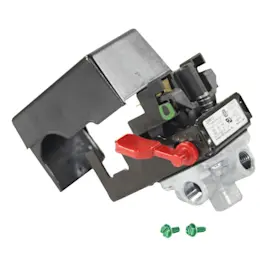
| Starts only with empty tank | Pressure switch or unloader valve issue | Drain tank; listen for a short “hiss” at shutoff; inspect unloader line |
| Clicks repeatedly | Pressure switch contacts, loose wiring | Inspect connections; check for heat damage at terminals |
Safe DIY troubleshooting steps
- Unplug power before removing any covers.
- Bleed tank pressure fully; trapped pressure can make diagnosis misleading.
- Inspect for obvious issues: burnt smell, melted terminals, loose spade connectors.
- Spin the pump/flywheel by hand (if accessible); it should turn smoothly.
- If you have a meter, test for voltage at the pressure switch and continuity through the switch when ON.
For electrical testing basics, we use the steps in how to use a multimeter to test electrical parts video.
Why it matters
Repeated start attempts with low voltage or a stuck pump can overheat the motor, damage the start components, and trip breakers. A quick power and pressure-unload check prevents unnecessary part replacement and helps you pinpoint whether the issue is electrical, pressure-control related, or mechanical.
Last updated: February 2026
Where is the reset button on an air compressor?
On the Campbell Hausfeld WL611700 air compressor, the reset is typically the motor’s thermal overload reset; it’s usually a small red or black button on or near the motor housing, often close to the pressure switch area or power cord entry. Press it firmly after the motor cools.
Where to look on the WL611700
Check these common reset locations used on many Campbell Hausfeld-style portable compressors:
- On the motor end bell (the back of the motor housing)
- Near the pressure switch cover (where the on/off lever and wiring are)
- On a small overload protector mounted to the motor, sometimes under a rubber cap
- Near where the power cord enters the motor or switch box
- Behind a handle shroud or small plastic guard near the pump and motor assembly
Safe reset steps (quick checklist)
Use this sequence to avoid repeat trips and protect the motor:
- Turn the compressor switch OFF and unplug it
- Let the motor cool for 15 to 30 minutes
- Pull the tank pressure down to 0 to 10 PSI using the tank drain (easier restart)
- Press the reset button once (do not hold it in)
- Plug in and switch ON; listen for a normal start and watch the pressure build
If you do not see a reset button
Some compressors do not have an external reset; the overload is internal and resets automatically after cooling. If WL611700 still will not start after cooling, the issue is usually in one of these areas:
| Symptom | Most common cause | What to check first |
|---|---|---|
| Hums but will not start | Bad start capacitor or tight pump | Spin the flywheel by hand (unplugged), then check capacitor wiring |
| Trips breaker quickly | Extension cord/low voltage | Plug directly into a dedicated outlet |
| Starts only with empty tank | Unloader valve issue | Listen for a short air “psst” when it shuts off |
| Runs but builds pressure slowly | Air leak or reed valve issue | Check fittings, hose, and tank drain for leaks |
For electrical checks like verifying power at the switch or testing a capacitor, use our how to use a multimeter to test electrical parts video.
Why it matters
The reset protects the motor from overheating and overcurrent. If it trips repeatedly, the compressor is telling you there’s a load, airflow, voltage, or starting-component problem that needs correction before the motor is damaged.
Last updated: February 2026