Installation guide
 Owner’s manual
 Error Codes




Why does my Kenmore washer keep getting unbalanced?
Your Kenmore washer model 11025132410 usually gets unbalanced when the load is packed unevenly, the washer is not level, or the tub suspension is worn and can’t control basket movement during spin. Start with loading and leveling checks, then inspect the suspension components.
- Load items in loose heaps evenly around the washplate, not in one pile.
- Avoid washing single heavy items (one blanket, one bath mat). Add a few towels to balance.
- Use Bulky/Bedding for oversized or non-absorbent items.
- Do not add extra water; this low-water design relies on load sensing.
- Make sure all four feet are firmly on the floor and the washer does not rock.
For the model-specific loading guidance and cycle tips, follow the instructions in the 11025132410 use & care manual.
If the cabinet is even slightly out of level, the basket can swing and trigger repeated rebalancing.
| What you notice | Likely cause | What to do |
|---|---|---|
| Washer “walks” or bangs early in spin | Feet not set, floor flexing | Re-level, tighten feet, add a firm base if needed |
| Unbalance happens mostly with bulky loads | Load distribution/cycle choice | Redistribute, use Bulky/Bedding |
| Unbalance happens on most loads | Suspension wear | Inspect suspension components |
Leveling steps and floor requirements are covered in the 11025132410 installation instructions.
If you’ve confirmed proper loading and leveling but the tub still swings excessively, the suspension system may be weak. On this model, a common repair is replacing the suspension rod kit (damper assembly): damper assembly W11130362.
- Basket leans to one side when empty
- Tub bounces easily when you push down and release
- Frequent “rebalancing” pauses and repeated spin attempts
An unbalanced washer can shorten the life of the drive system and increase wear on the basket support and cabinet. Fixing the root cause helps protect the gear case, belt drive, and overall wash performance.
Last updated: January 2026
What is the life expectancy of a Kenmore washer?
Kenmore washer life expectancy is not specified as a fixed number of years for model 11025132410 in the manufacturer information we have for this model. In real-world use, how long it lasts depends most on installation, load habits, detergent choice (HE), and routine maintenance; our goal is to help you maximize service life.
The documentation for this model focuses on correct use and maintenance practices that help prevent common wear issues.
- This washer is designed for HE (High Efficiency) detergent
- It uses automatic load size sensing (low-water washplate system)
- It includes a Clean Washer cycle intended to be run every 30 washes
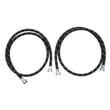
- It recommends replacing inlet hoses after 5 years to reduce hose-failure risk
For the exact procedures and cycle details, use the 11025132410 use & care manual.
These are the most common patterns we see that lead to earlier repairs on top-load HE washers like this Kenmore:
- Overloading or tightly packing items (extra strain on drive and suspension)
- Chronic out-of-balance loads (more vibration and component wear)
- Using non-HE detergent or too much detergent (oversudsing, poor rinsing, residue)
- Skipping tub cleaning and leaving the lid closed between uses (odor and buildup)
- Ignoring small leaks or slow draining (can lead to bigger failures)
| Task | How often | Why it helps |
|---|---|---|
| Run Clean Washer cycle | Every 30 washes | Reduces residue and odor-causing buildup |
| Leave lid open between loads | Ongoing | Helps the tub dry out |
| Inspect inlet hoses | Periodically | Catches bulges, cracks, or leaks early |
| Replace inlet hoses | About every 5 years | Reduces risk of hose failure |
Washers usually fail early from preventable stress (overloading, vibration) or buildup-related problems (oversudsing, odors). Following the model’s HE detergent and cleaning guidance helps reduce those risks and can delay major repairs.
Last updated: January 2026
How to hard reset kenmore washer?
For Kenmore washer model 11025132410, there isn’t a separate “hard reset” button sequence. The most reliable reset is to cancel the current cycle (which drains the tub) and then power-cycle the washer to clear a temporary control issue.
This uses the control’s cancel-and-drain function.
- Press and hold START/PAUSE/UNLOCK LID for 3 seconds
- The cycle cancels and the washer drains
- If the washer was spinning, wait for the basket to stop before the lid unlocks
If the control seems unresponsive, a power reset often helps.
- Turn the washer off
- Unplug the power cord (or switch off the dedicated breaker)
- Wait 1 minute
- Restore power, select a cycle, and press START/PAUSE/UNLOCK LID
On this model, the lid must be closed for the washer to run.
- Make sure the lid is fully closed
- If the washer is spinning, allow time for it to stop before attempting to unlock
- If the lid remains locked after canceling and draining, power-cycle the washer and try again
| What you’re trying to do | What to press/do | What should happen |
|---|---|---|
| Stop and drain a cycle | Hold START/PAUSE/UNLOCK LID 3 seconds | Cycle cancels; water drains |
| Pause and unlock lid | Press START/PAUSE/UNLOCK LID once | Lid unlocks after basket stops |
| Clear a control glitch | Unplug 1 minute, then restore power | Control restarts |
Canceling and draining prevents water from sitting in the tub and clears many “stuck cycle” situations. If the problem keeps returning, it usually points to an ongoing control or lid-lock issue rather than a one-time glitch.
For the exact control-button behavior on this washer, see the 11025132410 use & care manual.
Last updated: January 2026