Owner’s manual
 Error Codes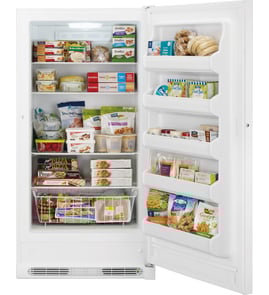




What is the life expectancy of an upright freezer?
Most upright freezers, including Kenmore model 25321042413, typically last 12 to 15 years, and 10 to 20 years is a normal overall range. Consistent maintenance (especially keeping airflow and door sealing in good shape) is what most often determines whether you land on the low or high end.
Typical lifespan ranges
These are practical expectations for an upright freezer in normal home use:
- 10 to 12 years: common when the freezer runs in a hot garage, is overpacked, or has poor airflow
- 12 to 15 years: typical for indoor use with basic upkeep
- 15 to 20 years: achievable with good ventilation, clean condenser area, and a tight door seal
| Usage and environment | What we typically see | Why |
|---|---|---|
| Climate-controlled room | 12 to 20 years | Lower heat load, steadier run times |
| Garage or warm utility area | 10 to 15 years | Higher ambient temps increase compressor run time |
| Heavy door openings | 10 to 15 years | More warm air and moisture entering the cabinet |
What extends the life of an upright freezer
Use these habits to reduce compressor strain and prevent frost and airflow problems:
- Keep the freezer level so the door closes and seals evenly
- Leave space around the cabinet for ventilation (do not box it in)
- Avoid overpacking; keep air paths open so cold air can circulate
- Keep the door seal clean and check for gaps or tearing
- Defrost and clean if you see heavy frost buildup that blocks airflow
For model-specific care and operating guidance, follow the 25321042413 owner’s manual.
Signs your freezer is nearing end-of-life
These symptoms often show up in the last few years of service:
- Runs almost constantly but temperatures drift warmer
- Loud clicking, repeated start attempts, or long recovery after door openings
- Heavy frost returning quickly after defrosting
- Warm cabinet edges or condensation around the door opening
Why it matters
A freezer that is struggling to maintain temperature typically uses more electricity and can shorten food storage time during door openings or power interruptions. Catching airflow and sealing issues early is the simplest way to protect the compressor and extend overall life.
Last updated: January 2026
Is it worth repairing a 17 year old freezer?
For a 17-year-old Kenmore upright freezer model 25321042413, it’s worth repairing when the problem is a low-cost, non-sealed-system fix (like a door seal or thermostat). If the estimate is close to the price of a replacement freezer, replacing usually makes more sense.
Quick decision checklist
- Repair if the freezer still holds temperature well and the issue is isolated (door not sealing, control issue, minor electrical).
- Repair if the total repair cost is roughly under 30–40% of a comparable new upright freezer.
- Replace if the problem involves the sealed system (compressor, evaporator, condenser) or repeated cooling failures.
- Replace if you see heavy internal rust, damaged liner, or chronic frost/ice that returns quickly after defrosting.
- Replace if you need multiple parts at once and labor is significant.
Common repairs on this model that can be “worth it”
These are typical, practical fixes that often restore performance without major cost:
- Replace a worn door gasket to stop warm air leaks (example part: gasket,white 5304506131).
- Replace a temperature control thermostat if temperatures swing or won’t regulate (example part: freezer temperature control thermostat 5304514707).
- Fix door closing issues that cause frost and warm spots (example part: refrigerator door closer 5304511026).
Cost and risk comparison
| Repair type | Typical outcome | Usually worth it at 17 years? |
|---|---|---|
| Door seal or door closing hardware | Better sealing, less frost, steadier temps | Yes |
| Temperature control parts | Restores proper cycling and temps | Yes |
| Sealed-system cooling parts (compressor/evaporator/condenser) | Can restore cooling but higher cost and labor | Often no |
Why it matters
A freezer that leaks air or can’t regulate temperature runs longer, builds frost faster, and can struggle to keep food safely frozen. A targeted repair can reduce energy waste and prevent food spoilage, but major cooling-system work often exceeds the value of an older unit.
What we recommend before you decide
- Check the troubleshooting and temperature setting guidance in the 25321042413 owner’s manual.
- Get a written estimate that separates parts vs. labor.
- Compare the estimate to the cost of a similar-capacity upright freezer and your expected remaining use.
Last updated: January 2026
How many cubic feet is a Kenmore model 25321042413 freezer?
The Kenmore 25321042413 upright freezer has a 20.5 cu. ft. capacity. For the full spec list (including electrical ratings and feature details), we recommend confirming the capacity line in the 25321042413 owner's manual.
How to verify the capacity on your unit
- Match the model tag inside the cabinet to 25321042413 (not just the 253 prefix)
- Check the “Specifications” section in the 25321042413 owner's manual
- If you are comparing to another freezer, use the published “total capacity” value (not shelf-by-shelf usable space)
- Keep airflow clear around shelves and vents; blocked airflow reduces usable storage and cooling performance
Capacity quick reference
| Spec | Value | What it helps with |
|---|---|---|
| Total capacity | 20.5 cu. ft. | Storage planning and comparing models |
| Freezer type | Upright | Shelf and door-bin organization |
Why it matters
Knowing the exact cubic feet helps you plan bulk storage, choose the right freezer location, and set realistic expectations for load size and recovery time after door openings.
Last updated: January 2026