 Owner’s manual
 Error Codes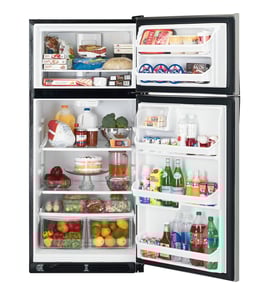




What are the disadvantages of a top mount fridge?
Top-mount refrigerators like the GE GTH17GBEFRWW typically trade convenience for simplicity: the freezer is at eye level, but you bend more to reach fresh-food items, and they often have fewer premium organization and dispenser features than many bottom-freezer designs.
Common disadvantages (what you notice day to day)
- More bending for fresh food: the refrigerator section sits lower, so produce drawers and lower shelves take more reaching.
- Less “grab-and-go” organization: many top-mounts have simpler bins and fewer adjustable storage options.
- Fewer built-in features: water and ice dispensers are less common on top-mount models.
- Door-swing clearance needs: you need enough space for doors to open fully; leveling helps doors close properly.
- Manual defrost-related symptoms can feel worse (on models without advanced defrost controls): frost or airflow issues can be more noticeable when vents get blocked.
Quick comparison: top mount vs bottom freezer
| Feature | Top mount (like GTH17GBEFRWW) | Bottom freezer |
|---|---|---|
| Fresh-food access | Lower, more bending | Higher, easier access |
| Freezer access | Higher, easier access | Lower, more bending |
| Storage/organization | Often simpler | Often more flexible |
| Dispensers | Less common | More common |
Setup details that reduce the downsides
Even with a top-mount design, correct placement and leveling make daily use easier.
- Leave typical installation clearance around the cabinet for airflow (sides, top, back)
- Set the front leveling legs so doors close easily when opened about halfway
- Avoid installing where room temperature drops below about 60°F (16°C)
- Keep door shelves from being overloaded so doors align and seal consistently
For model-specific guidance on clearances, leveling legs, and door handling, use the GTH17GBEFRWW owner's manual.
Why it matters
Most “top-mount complaints” are really about ergonomics and features. If you prioritize lower cost, simpler repairs, and a straightforward layout, a top-mount can be a great fit. If you want easier fresh-food access and more premium storage, a bottom-freezer style usually feels better.
Last updated: January 2026
What is the most common problem with a GE refrigerator?
Cooling problems are the most common issue we see with GE refrigerators, including the GE GTH17GBEFRWW. The usual causes are restricted airflow (dirty condenser coils), a weak fan, a defrost problem that lets frost block airflow, or a door gasket leak that lets warm air in.
Quick checks that fix many “not cold enough” complaints
- Confirm the temperature controls were not bumped warmer.
- Make sure vents inside the fresh food and freezer sections are not blocked by packages.
- Clean dust from the condenser coil area and confirm the condenser fan can move air.
- Check for heavy frost on the freezer back panel (often points to a defrost issue).
- Do the paper-strip test around the door; if it slips easily, the gasket may be leaking.
For model-specific operating and care guidance, follow the GTH17GBEFRWW owner's manual.
Common symptoms and the most likely causes
| Symptom | Most likely cause | What to do first |
|---|---|---|
| Fridge warm, freezer cold | Airflow problem from freezer to fridge | Clear vents, look for frost buildup |
| Both sections warm | Dirty coils, fan issue, sealed system problem | Clean coils, listen for fans |
| Frost/ice on freezer back wall | Defrost system not clearing frost | Defrost manually, then troubleshoot |
| Door won’t seal, moisture inside | Worn or warped gasket | Inspect and replace gasket if needed |
Parts that commonly relate to cooling complaints on this model
If basic cleaning and airflow checks do not help, these parts are commonly involved:
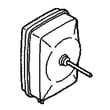
- Refrigerator evaporator fan motor WR60X31522 (moves cold air through the freezer and into the refrigerator section)
- Refrigerator defrost control board WR55X21623 (controls defrost timing to prevent frost blockage)
- Refrigerator door gasket (white) WR24X10229 (prevents warm air leaks that cause poor cooling and frost)
Why it matters
A refrigerator that cannot move air correctly or cannot defrost correctly often runs longer, warms food, and builds frost. Fixing airflow and sealing issues early also helps protect major components like the compressor.
Last updated: January 2026
How do I find the model number on my GTH17GBEFRWW?
On your GE GTH17GBEFRWW top-mount refrigerator, the model number is printed on the rating label inside the fresh food (refrigerator) compartment. Look on the upper left side wall; the label lists both the model and serial number.
Where to look (fast checklist)
- Open the fresh food door (not the freezer door)
- Check the upper left interior side wall
- Look for a white or silver rating label
- Find the line that starts with Model #
- Write down the Model # and Serial # exactly as shown
What the label helps you do
Having the correct model number lets us match the right diagrams, parts, and instructions for your exact refrigerator.
| You need | Where it’s used | Example of why it matters |
|---|---|---|
| Model number | Parts lookup and diagrams | Ensures the correct door gasket or shelf fits |
| Serial number | Date/production info | Helps identify the correct revision of a part |
Tips if you do not see the label right away
- Wipe the area with a damp cloth; labels can blend into the liner
- Use a flashlight and look along the cabinet wall near the front edge
- Check for a label that may be partially covered by a shelf support or bin
Why it matters
Even small model-number differences can change parts like the refrigerator door gasket, evaporator fan motor, or light switch, so using the exact model number prevents ordering the wrong replacement.
For a visual reference and more model-specific details, see the GTH17GBEFRWW owner’s manual.
Last updated: March 2026





