Installation guide
 Owner’s manual
 Error Codes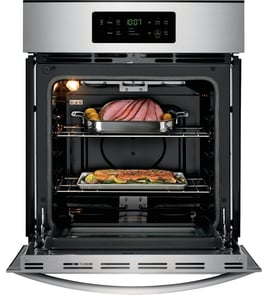


Does anyone make a 36 wall oven electric?
Yes. Several brands make 36-inch electric wall ovens; the key is matching the cabinet cutout, electrical supply (208/240V), and installation requirements to your kitchen. For your Kenmore Pro wall oven model 79041003601, use the cutout and wiring specs in the 79041003601 installation guide when comparing 36-inch replacements.
A “36-inch” wall oven can vary by cutout size, trim overlap, and depth, so we recommend confirming these items first:
- Cabinet cutout dimensions (width, height, depth)
- Electrical supply: 3-wire or 4-wire, single-phase 120/240V or 120/208V, 60 Hz
- Dedicated circuit with time-delay fuse or circuit breaker (neutral not fused)
- Breaker size based on the oven’s wattage rating (found on the serial plate)
- Support and anti-tip mounting: the oven must be secured with mounting brackets
Use the oven’s wattage rating to choose the recommended circuit size (typical guidance from the installation instructions):
| Supply voltage | Wattage range | Recommended circuit |
|---|---|---|
| 240V | Less than 4800W | 20A |
| 240V | 4800W to 7200W | 30A |
| 240V | 7200W to 9600W | 40A |
| 240V | 9600W and up | 50A |
| 208V | Less than 4100W | 20A |
| 208V | 4100W to 6200W | 30A |
| 208V | 6200W to 8300W | 40A |
| 208V | 8300W and up | 50A |
A 36-inch electric wall oven that does not match your cutout or circuit can require cabinet modifications, new wiring, or breaker changes. Using the correct installation specs helps you avoid fit issues and nuisance tripping, and it supports safe operation.
Last updated: February 2026
How many watts does a Kenmore oven use?
A Kenmore wall oven like model 79041003601 typically uses about 4,800 to 9,600 watts depending on which heating elements are running and whether it is wired for 240V or 208V. For the exact wattage of your unit, we use the rating shown on the serial plate and the electrical requirements in the 79041003601 installation guide.
We match the oven’s nameplate wattage to the correct circuit size.
- Check the serial plate for the oven’s wattage consumption
- Confirm whether your home supply is 240V or 208V
- Use the installation instructions to match wattage to breaker size
- Make sure the oven is on an individual, properly grounded branch circuit
- Use a time-delay fuse or circuit breaker (as specified)
These are the standard ranges used for this Kenmore Pro electric wall oven installation.
| Supply voltage | Appliance protection rating (watts) | Recommended circuit |
|---|---|---|
| 240V | Less than 4,800W | 20A |
| 240V | 4,800W to 7,200W | 30A |
| 240V | 7,200W to 9,600W | 40A |
| 240V | 9,600W and up | 50A |
| 208V | Less than 4,100W | 20A |
| 208V | 4,100W to 6,200W | 30A |
| 208V | 6,200W to 8,300W | 40A |
| 208V | 8,300W and up | 50A |
Wattage drives the breaker size, wire gauge, and safe operation of your wall oven. If the circuit is undersized, you can get nuisance tripping, slow preheat, or overheating at connections.
If you are asking about wattage because the oven is not heating correctly, these parts are common checks for this model:
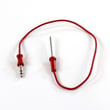
- Frigidaire range oven temperature sensor 316217002 (temperature feedback to the control)
- Frigidaire range oven control board 318601500 (manages bake and broil operation)
- Wall oven relay control board 316443915 (switches power to heating circuits)
Last updated: February 2026
Is it worth fixing an electric oven?
Yes; for a Kenmore Pro wall oven like model 79041003601, it’s worth fixing when the repair is a common wear item (like a bake element or temperature sensor) and the total repair cost stays well below the cost of replacing a built-in wall oven and paying for installation.
- The oven is under 10 years old or has been reliable overall.
- The problem is isolated (no heat, inaccurate temp, dead display) rather than multiple symptoms.
- You can confirm power and settings first (clock set after an outage, breaker on).
- The repair is a single part replacement (sensor, element, control board).
- You can do safe diagnostics with power off, or you can schedule a technician.
These are frequent fixes that usually restore normal baking without replacing the oven:
| Symptom | Likely cause | Example part for 79041003601 |
|---|---|---|
| Oven temperature is off, long preheat | Temperature sensor drifting | Frigidaire range oven temperature sensor 316217002 |
| No bake heat, uneven baking | Bake element failed | Oven element 318601604 |
| Dead or erratic controls | Control board issue | Wall oven display control board 316460300 |
Built-in wall ovens cost more to replace because removal, cabinet fit, and electrical hookup add time and expense. Our installation instructions also stress proper grounding, correct 120/240 or 120/208 VAC supply on a dedicated circuit, and shutting off power during line connections; those same factors make replacement more involved than a typical countertop appliance. Use the installation guide for electrical and cutout requirements.
- Reset after a power interruption: set the clock if the display is flashing.
- Verify the breaker is fully engaged (wall ovens often use a double-pole breaker).
- Confirm the oven is level (a tilted rack can mimic “bad baking”).
- If you suspect an electrical issue, shut off power and use the owner's manual for control setup and basic troubleshooting.
A targeted repair keeps a good Kenmore Pro wall oven in service, avoids cabinet modifications, and reduces the risk of installation-related issues that can come with a full replacement.
Last updated: February 2026
What are the parts of an electric oven?
An electric wall oven like the Kenmore Pro 79041003601 is built around heating, airflow, and control components: bake and broil elements create heat, a temperature sensor helps regulate it, and the electronic control manages cooking modes, timing, and display functions. See the 79041003601 owner's manual for your oven’s feature layout.
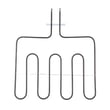
- Bake element (bottom heat source for baking and roasting)
- Broil element (top heat source for broiling)
- Oven temperature sensor (feeds temperature data to the control)
- Electronic oven control and display (sets modes, time, temperature)
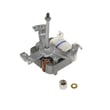
- Oven vent and blower/cooling fan (moves heat and protects electronics)
- Convection fan system (on convection models for even baking)
- Oven racks and rack supports (position cookware and improve airflow)
- Oven door and door seal (keeps heat in and stabilizes temperatures)
Your manual highlights several features and components commonly referenced during troubleshooting and parts replacement, including the broil element, oven vent, halogen lights, racks, and the oven control display. For installation-related components and electrical requirements, use the 79041003601 installation guide.
| What it does | Part you may replace | When it’s suspect |
|---|---|---|
| Senses oven temperature | Range oven temperature sensor 316217002 | Oven heats wrong, temp swings, error codes tied to sensor |
| Seals heat at the door | Oven seal 318053120 | Heat leaks, longer preheat, uneven baking |
| Provides bake heat | Oven element 318601604 | No bake heat, slow preheat, visible damage |
Knowing the major oven parts helps you troubleshoot faster. For example, temperature problems often point to the sensor or control, while weak heating usually points to a bake or broil element. Venting and the cooling fan are also critical because the blower can keep running after shutoff to cool internal components.
Last updated: February 2026