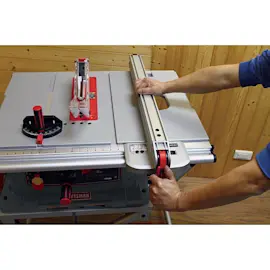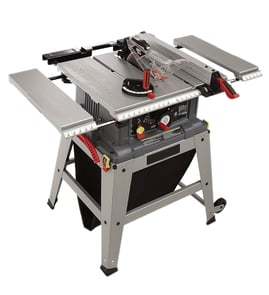

Can I add sawstop to any table saw?
No. You can’t add the SawStop brake system to a Craftsman 113298060 table saw (or most other saws) because that safety technology is built into SawStop saws as an integrated design, not as a universal add-on kit.
What you can do instead (practical safety upgrades)
We recommend focusing on proven table saw safety steps that work on the 113298060 without redesigning the saw:
- Use a riving knife or splitter and anti-kickback pawls if your saw setup supports them
- Install and use the blade guard whenever the cut allows it
- Use a push stick or push block for narrow rips
- Set blade height correctly (typically just above the workpiece)
- Keep the fence parallel to the blade to reduce binding and kickback
- Use a sharp, correct blade for the material (dull blades increase force and risk)
For safe operating practices and setup habits, follow our guide: how to use a table saw safely.
Why SawStop is not a retrofit
A SawStop-style system needs multiple engineered elements working together, including sensing electronics, a brake cartridge mechanism, and a saw structure designed to absorb the braking forces and control blade retraction. On a traditional saw like the Craftsman 113298060, those elements are not present, and adding them requires major mechanical and electrical redesign.
Quick comparison
| Option | Works on Craftsman 113298060? | What it changes |
|---|---|---|
| SawStop brake retrofit | No | Would require integrated sensing, brake, and structural redesign |
| Blade guard, splitter/riving knife, push tools | Yes | Improves control and reduces contact and kickback risk |
| Tune-up (alignment, clean/lube, sharp blade) | Yes | Improves cut quality and reduces binding and stalls |
Why it matters
Most serious table saw injuries come from two things: blade contact and kickback. Even without a brake system, correct guarding, alignment, and feeding technique dramatically reduce both risks while keeping your Craftsman saw cutting accurately.
Last updated: February 2026
What not to do with a table saw?
For the Craftsman 113298060 table saw, the biggest “don’ts” are the actions that cause kickback or put your hands in the blade path: don’t cut freehand, don’t reach over the blade, don’t stand directly behind the workpiece, and don’t defeat safety devices. Use safe cutting technique every time; review how to use a table saw safely before your next project.
Top things we never do on a table saw
- Don’t cut freehand; always use the rip fence, miter gauge, or a sled.
- Don’t wear gloves, loose sleeves, jewelry, or tie-back hair loosely; anything that can snag is a hazard.
- Don’t stand directly behind the board during a rip cut; stand slightly to one side to reduce kickback risk.
- Don’t reach over or behind the blade to clear offcuts; wait for the blade to stop.
- Don’t cut warped, bowed, or twisted lumber without a safe plan (joint/straighten first or use proper support).
- Don’t remove guards or anti-kickback hardware when it is not required for the cut.
Safe habits that prevent kickback and bad cuts
- Keep the blade sharp and clean; a dull blade forces the cut and increases binding.
- Set blade height so gullets clear the stock (commonly about 1/8 to 1/4 inch above the material).
- Use push sticks, push blocks, and featherboards for narrow rips.
- Support long stock with outfeed support so it does not lift or twist.
Quick “don’t do this” checklist by task
| Task | Don’t do this | Do this instead |
|---|---|---|
| Ripping | Trap the board between fence and miter gauge | Use fence only (or a sled designed for the cut) |
| Crosscutting | Use the rip fence as a stop without a safe method | Use miter gauge/sled; use a stop block with clearance |
| Small parts | Hold tiny pieces near the blade | Use a jig, push block, or clamp-down fixture |
Why it matters
Most table saw injuries and damaged workpieces come from two issues: hands entering the blade path and kickback from binding. Avoiding the “don’ts” above keeps the workpiece controlled and your body out of the line of fire.
Last updated: February 2026
Are all table saw arbor nuts the same size?
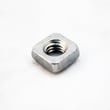
No. Table saw arbor nuts are not universal; the nut’s thread size and direction must match the arbor shaft on your specific saw. For a Craftsman model 113298060 table saw, you need an arbor nut that matches the saw’s arbor threads and the blade flange setup, not just the blade’s arbor hole size.
What’s usually standardized (and what isn’t)
Most 10-inch table saw blades share a 5/8-inch arbor hole, but that does not mean the arbor nut is the same across brands or models.
- Blade arbor hole: commonly 5/8 inch on many 10-inch saw blades
- Arbor shaft threads: vary by saw design (diameter, pitch, and sometimes direction)
- Nut style: can be hex, flange nut, or use a washer plus nut
- Left-hand vs right-hand threads: some saws use left-hand threads so the nut self-tightens in use
- Wrench size: varies even when thread size is similar
How to identify the correct arbor nut for 113298060
Use these checks before ordering or substituting a nut:
- Remove power and take off the blade and outer flange/washer
- Confirm whether the nut loosens clockwise or counterclockwise (thread direction)
- Measure arbor diameter (common sizes include 5/8 inch and 1/2 inch, but others exist)
- Match the thread pitch using a thread gauge (or compare to a known matching nut)
- Inspect the flange/washer stack; the nut must clamp the blade securely without bottoming out
Quick compatibility guide
| What you’re matching | Why it matters | What to look for |
|---|---|---|
| Arbor thread diameter | Prevents stripping and wobble | Exact shaft diameter |
| Thread pitch | Ensures full engagement | Same pitch as arbor |
| Thread direction | Prevents loosening during cutting | Left-hand or right-hand |
| Nut and washer style | Ensures proper blade clamping | Correct flange/washer fit |
Why it matters
Using the wrong arbor nut can cause blade wobble, poor cut quality, or the nut loosening during operation. Correct arbor hardware helps keep the blade aligned, the flange clamping evenly, and the saw cutting safely and accurately.
Related DIY help
If you’re removing the blade to check the arbor hardware, follow a proven process like how to replace a table saw blade.
Last updated: February 2026
How much should I spend on a table saw?
For most DIY and homeowner projects, we recommend budgeting $200 to $600 for a table saw; spend closer to $200 to $400 for a basic jobsite saw, and $400 to $600 for better fence accuracy and smoother cuts. If you need cabinet-saw performance, plan on $1,500+.
What drives the price (and what to prioritize)
If you are shopping with the Craftsman 113298060 style of use in mind (general ripping, crosscuts, and occasional bevels), accuracy and safety features matter more than raw motor claims.
- Fence quality and repeatability (biggest upgrade per dollar)
- Flat table and trunnion alignment (reduces burning and wandering cuts)
- Motor type (universal jobsite vs induction contractor/cabinet)
- Dust collection (helps visibility and motor cooling)
- Safety features (riving knife/splitter, blade guard, anti-kickback pawls)
Quick budget guide
| Budget | Typical saw type | Best for | Tradeoffs |
|---|---|---|---|
| $200 to $400 | Jobsite/portable | Small shops, occasional projects | Louder, lighter fence, more vibration |
| $400 to $900 | Better jobsite or entry contractor | Frequent DIY, better accuracy | Heavier, more setup time |
| $900 to $2,500+ | Contractor/hybrid/cabinet | Furniture work, daily use | Higher cost, needs space and dust control |
How to choose the right spend for your projects
Use these rules to land on the right range quickly:
- If you cut sheet goods often, pay more for a stable fence and outfeed support.
- If you cut hardwood regularly, prioritize torque, a sharp blade, and low vibration.
- If you need clean bevels, plan on time for setup and use a guide like how to adjust a table saw blade.
- If your cuts look off even with a good blade, troubleshoot alignment using table saw bad angle cuts.
- If you are new to table saws, prioritize technique and guarding using how to use a table saw safely.
Why it matters
A table saw that holds alignment and has a dependable fence produces safer, straighter cuts with less binding and kickback risk. Spending a bit more up front often saves money on wasted material and frustration.
Last updated: February 2026
Who makes 113298060 table saws?
Craftsman model 113298060 is a Craftsman-branded table saw; the actual factory that built a specific unit is identified on the saw’s data plate, not by the model number alone. Use the ID plate details to match the correct parts and repair procedures for your exact saw.
How to identify the manufacturer on your saw
Look for the rating/data plate (commonly on the back of the cabinet, inside the stand, or under the table). Record the full information exactly as shown.
- Find a line such as “MFG,” “Manufactured by,” “Mfr,” or a company name/address
- Write down the full model number 113298060 and the serial number
- Note the electrical ratings (volts, amps, phase) from the motor plate
- Capture any type number or additional codes on the tag (often used for parts matching)
- Take a clear photo of the plate for reference when ordering parts
What the “113” prefix means (and what it does not)
The 113 prefix is a Craftsman model-number family that’s often associated with certain design eras and parts layouts, but it is not a reliable, model-specific proof of the original manufacturer. The data plate is the correct source for maker identification.
| Where to look | What you’re trying to find | Why it helps |
|---|---|---|
| Data plate on saw | Manufacturer name/address | Confirms who built the unit |
| Motor nameplate | Motor brand and ratings | Helps match switches, brushes, and wiring |
| Parts diagrams | Exact component shapes and mounting | Prevents ordering look-alike parts |
Why it matters for repairs
Knowing the exact build information helps you get the right replacement parts and avoid fit issues when troubleshooting alignment, height/tilt mechanisms, or motor performance.
- For cut accuracy issues, use table saw bad angle cuts
- For safe blade service steps, use how to replace a table saw blade
- For broader troubleshooting, use table saw symptoms landing page
Last updated: February 2026