Installation guide
 Owner’s manual
 Error Codes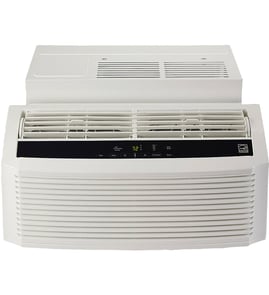




How big of a room can 5100 BTU cool?
A 5,100 BTU room air conditioner like Kenmore model 25370051010 typically cools about 100 to 150 sq. ft. (for example, a small bedroom or office). Room layout, sun exposure, insulation, and heat sources can push that number up or down.
Quick sizing guide (what 5,100 BTU fits best)
- Best fit: 100 to 150 sq. ft.
- Okay with ideal conditions: up to about 160 sq. ft. (shaded room, good insulation)
- Often too small: 170 sq. ft. and larger, or rooms with heavy sun and high ceilings
- If the room is under 60°F: the unit is not designed to cool below that temperature (cooling performance and icing issues can show up)
How to estimate your room size
- Measure length x width in feet.
- Multiply to get square feet.
- Adjust for real-world conditions.
| Room condition | What to do with the estimate |
|---|---|
| Lots of sun (south or west window) | Treat the room as larger |
| Poor insulation or air leaks | Treat the room as larger |
| Kitchen area or heat-producing equipment | Treat the room as larger |
| Shaded room, good insulation | Your estimate is usually accurate |
Why it matters
If BTU capacity is too small, the air conditioner can run for long periods and still feel warm. If capacity is too large, it can cool quickly but remove less humidity, leaving the room feeling clammy. Our Kenmore troubleshooting guidance also notes that BTU size affects whether a unit cools properly for the room.
Tips to get the best cooling from your 25370051010
- Set the thermostat lower than room temperature.
- Keep doors and windows closed while cooling.
- Make sure the front of the unit is not blocked by furniture or drapes.
- Clean the air filter regularly (a dirty filter reduces airflow and cooling).
- Use a higher fan speed during very hot weather.
For operating details and cooling tips specific to this model, use the 25370051010 owner's manual.
Last updated: February 2026
How much should I pay for a window AC unit?
For a window (room) air conditioner like Kenmore model 25370051010, a typical unit price is $150 to $750, with cost driven mainly by BTU capacity, efficiency, and features (remote, heat mode, smart controls). Use the installation guide to match the unit to your window and plan a safe install.
Typical price ranges (what drives the cost)
Most window AC pricing follows capacity and features:
- 5,000 to 8,000 BTU: lowest cost; small rooms
- 8,000 to 12,000 BTU: mid-range; common for bedrooms and living areas
- 12,000 BTU and up: higher cost; larger spaces
- Heat function (AC with heater): higher price than cooling-only
- Higher efficiency: higher upfront cost, lower operating cost
| What you’re buying | Typical unit price | Best for |
|---|---|---|
| Basic cooling-only window AC | $150 to $400 | Smaller rooms, simple controls |
| Mid-range window AC | $300 to $550 | Most homes, better comfort features |
| Premium window AC (high BTU, heat, smart) | $500 to $750+ | Larger rooms, more features |
Fit and installation details that affect total cost
For the Kenmore 25370051010 installation style shown in the guide, plan for common add-ons like a support bracket, foam seals, and help lifting. The installation guide also gives the key fit requirements for this unit:
- Designed for standard double-hung windows
- Window opening width: 23 to 36 inches
- Minimum clear vertical opening: 14 inches
- Two people are needed to move and install the unit safely
- Set a slight outdoor tilt (about 1/4 to 1/2 inch) to help drainage
Why it matters
Paying the right price is only half the decision. Correct sizing and correct installation improve cooling, reduce noise and vibration, and help prevent common problems like water leaks and evaporator icing.
If you run into a display code after installation, use Kenmore error codes.
Last updated: February 2026
How do I find the model number on my 25370051010?
For Kenmore room air conditioner model 25370051010, the model number is printed on the unit’s serial plate. You’ll find that plate on the outside of the cabinet, or behind the air filter at the bottom of the unit (a flashlight helps).
Where to look on the air conditioner
Check these common serial plate locations:
- Outside of the cabinet (typically on a side panel)
- Behind the air filter at the bottom of the unit
- Just inside the front grille area (after removing the front panel)
- Near the control panel area (less common)
Quick steps to find it
- Unplug the air conditioner for safety.
- Remove the front grille and slide out the air filter.
- Look for a sticker or metal tag that lists Model Number and Serial Number.
- Use a flashlight; the tag is often low and partially hidden.
- Write the numbers down exactly as shown.
What the label usually shows
| Label item | What it’s used for | Example format |
|---|---|---|
| Model number | Ordering the correct parts and diagrams | 253.70051 or 25370051010 |
| Serial number | Identifying production run details | Letters and numbers |
| Purchase date (you record it) | Warranty and service records | Month/Day/Year |
Why it matters
Kenmore model numbers can look similar across window air conditioner series. Using the exact model number from the serial plate ensures you match the right parts list, wiring diagram, and troubleshooting steps in the [25370051010 owner’s manual].
Last updated: March 2026