Owner’s manual
 Error Codes



How to read Kenmore washer model numbers?
Kenmore washer model numbers are structured so you can identify the manufacturer and the exact version of the washer. For Kenmore model 11021112020, the 110 prefix points to the manufacturer family, and the remaining digits narrow down the specific design and feature set for ordering the correct parts.
Most Kenmore model numbers follow this pattern:
- Prefix (first 3 digits): identifies the manufacturer family (example: 110)
- Core model digits (middle group): identifies the base platform or series
- Suffix digits (last group): identifies version changes such as color, control style, or production revision
| Section | Example from 11021112020 | What it tells you |
|---|---|---|
| Prefix | 110 | Manufacturer family used for parts lookup |
| Remaining digits | 21112020 | The specific washer design and variation |
To avoid ordering the wrong lid lock, drain hose, or control board, match the model number exactly as printed on the washer’s model tag. We also recommend confirming the installation and care details in the owner's manual.
- Parts can look identical but use different connectors or mounting points
- Control and sensor parts can vary by revision
- Some assemblies (lid, console, tub) are model-specific
- Diagrams and troubleshooting steps are tied to the exact model
When you search parts for 11021112020, use the full model number (all digits) so the parts list filters correctly. For example, common model-matched items on this model’s parts list include the lid lock-sol W11700916 and the washer water inlet valve W11165546.
Reading the model number correctly is the fastest way to get the right Kenmore washer parts the first time, especially for electrical parts (actuator, control unit, lid lock) where small differences can prevent the washer from operating.
Last updated: February 2026
How to reset a Kenmore 11021112020 washer?
To reset your Kenmore 11021112020 washer, we recommend doing a simple power reset: unplug the washer (or turn off the breaker) for 1 minute, then restore power and start a cycle again. This clears many temporary control glitches and stuck-cycle conditions.
- Press Pause/Cancel once to stop the cycle.
- Unplug the washer (or switch the circuit breaker OFF).
- Wait 60 seconds.
- Plug the washer back in (or switch the breaker ON).
- Lift and close the lid once, then select a cycle and press Start.
These checks fix the most common “won’t start” or “won’t run” complaints after a reset:
- Confirm the outlet is a grounded 3-prong outlet (no adapter or extension cord).
- Make sure the lid is fully closed and the strike lines up with the lock.
- Try a different cycle (for example, Bedding or a normal wash) to rule out a cycle-specific issue.
- If the washer fills but will not agitate or spin, the shift system may be involved.
- If the lid will not lock, inspect the lock and strike for cracks or looseness.
| Symptom after reset | What it usually points to | Part to check for this model |
|---|---|---|
| Lid will not lock, no start | Lid lock or lid strike issue | Lid lock-sol W11700916, washer lid strike W11457841 |
| Fills but will not agitate/spin | Actuator or drive system problem | Washer actuator W10913953, whirlpool washer drive pulley W10721967 |
| No fill or very slow fill | Water inlet valve or supply issue | Washer water inlet valve W11165546 |
A reset clears the control’s temporary state, but repeated “needs a reset” behavior usually means an underlying issue such as a lid-lock sensing problem, a shifting/actuator fault, or a drive component starting to fail.
For model-specific operating steps and electrical safety guidance, follow the owner's manual.
Last updated: February 2026
How many cubic feet is a Kenmore Model 11021112020?
The exact tub capacity (cubic feet) for Kenmore washer model 11021112020 is typically listed on the model’s specification sheet or in the product literature; it is not shown in the installation and care instructions. Most Kenmore 110 top-load washers of this design commonly fall in the about 3.0 to 4.3 cu. ft. range.
Check these places first because they are the most reliable for your exact model:
- The specifications/features section in the 11021112020 owner's manual
- Any tech sheet stored inside the cabinet (often behind the control panel or on an interior side panel)
- The model’s product listing details (if you still have the original paperwork)
If you cannot locate the spec, you can estimate tub volume by measuring the inside of the basket.
- Measure inside diameter of the basket (in inches)
- Measure usable depth to the normal fill line (in inches)
- Convert to cubic feet using the cylinder formula
| What you measure | Typical range on many top-loaders | What it usually indicates |
|---|---|---|
| Basket inside diameter | ~20 to 24 in. | Larger diameter usually means higher capacity |
| Usable depth | ~12 to 16 in. | More depth usually means higher capacity |
| Estimated capacity | ~3.0 to 4.3 cu. ft. | Common range for many Kenmore 110 designs |
Capacity affects how much laundry you can wash per load, how much water the washer uses, and how well the load balances during spin (unbalanced loads can increase vibration and noise).
A properly leveled washer reduces vibration and helps the load balance correctly during spin. The leveling steps in the 11021112020 owner's manual are worth following any time you move the washer.
Last updated: February 2026
How to unclog drain hose on Kenmore washer?
To unclog the drain hose on your Kenmore washer model 11021112020, unplug the washer, remove standing water, then disconnect and flush the drain hose and check the drain pump inlet for debris. Reinstall the hose using the correct standpipe height and insertion depth from the 11021112020 owner's manual.
- Unplug the washer before touching hoses or the pump area
- Keep a shallow pan and towels ready for water in the hose
- Wear gloves; coins, pins, and clips can be sharp
- Turn off both water faucets if you need to move or tip the washer
- Remove water from the tub: bail into a bucket or use a wet/dry shop vacuum at the standpipe/laundry tub.
- Access the drain hose: pull the washer forward and locate the hose at the back.
- Disconnect the hose: remove it from the home drain and from the washer drain port.
- Flush the hose: run water through it; push out debris with a flexible brush or small drain snake.
- Check the pump inlet path: if the hose is clear, look for socks, lint, or small items at the pump inlet area.
- Reinstall and test: secure clamps, avoid kinks, then run a drain/spin.
| What to check | Target for 11021112020 | Why it matters |
|---|---|---|
| Hose inside standpipe/tub | 4.5 in. | Too much can cause siphoning or poor draining |
| Standpipe/laundry tub height | 39 in. to 96 in. | Wrong height can cause drain issues |
| Minimum siphon break | 28 in. | Helps prevent siphoning |
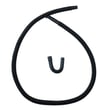
- Hose asm - d W11244231 (replacement drain hose)
- Pump asm, dr W11396717 (drain pump assembly)
- Clamp WP285655 (hose clamp)
A partially clogged drain path leaves water in the tub, slows cycles, and reduces spin performance. Correct hose routing prevents siphoning that can look like a drain failure.
Last updated: February 2026