Owner’s manual
 Error Codes



What is the life expectancy of a side-by-side refrigerator?
A side-by-side refrigerator typically lasts about 12 to 15 years. For your Whirlpool WSF26C3EXB01, lifespan depends most on installation conditions (good airflow, correct room temperature) and routine maintenance like keeping seals tight and filters fresh; see the WSF26C3EXB01 owner's manual for care and operating guidance.
Typical life expectancy (what to expect)
Most side-by-side refrigerators fall into this range when used in a normal indoor kitchen:
| Usage and care level | Typical lifespan | What usually shortens life |
|---|---|---|
| Normal use, basic cleaning | 12 to 15 years | Dirty condenser area, warm room, frequent door openings |
| Heavy use (large family, lots of dispensing) | 10 to 13 years | Higher compressor run time, more ice maker wear |
| Excellent care and ideal conditions | 15+ years | Fewer heat and airflow stresses |
What matters most for the WSF26C3EXB01
Your manual calls out installation and environment factors that directly affect how hard the compressor and fans have to work.
- Keep ventilation clearance: about 1/2 inch on the sides and top, and about 1 inch behind the refrigerator.
- Keep the room in a normal operating range; this model is intended for locations roughly 55°F to 110°F.
- Level the refrigerator so doors align and seal correctly (misalignment can cause warm air leaks).
- Avoid placing the refrigerator next to strong heat sources (oven, radiator).
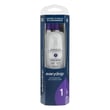
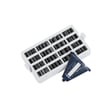
- Replace consumables on schedule, such as the refrigerator air filter W10311524 if your unit uses it for odor control.
Signs your refrigerator is nearing end of life
These symptoms often show up more as the unit ages:
- Compressor runs much longer than it used to (especially in normal room temperatures)
- Temperatures drift or food spoils faster
- Ice maker or dispenser performance becomes inconsistent
- Excess frost buildup or recurring defrost issues
- Door gaskets no longer seal well even after cleaning and adjustment
Why it matters
Knowing the typical lifespan helps you decide whether to repair or replace. If your WSF26C3EXB01 is already in the 12 to 15 year range, investing in major sealed-system parts (compressor, evaporator) often makes less sense than fixing common wear items (gaskets, valves, ice maker components).
Last updated: February 2026
What is the most common problem with a Whirlpool refrigerator?
The most common Whirlpool refrigerator problem is a cooling complaint (refrigerator too warm, freezer too warm, or temperature swings). On the Whirlpool WSF26C3EXB01, the fastest wins are confirming the controls are on, allowing a full 24 hours after setup, and checking airflow and fan operation per the WSF26C3EXB01 owner's manual.
What we see most often (and what to check first)
- New installation or recent power loss: allow 24 hours for full cool-down.
- Controls not set correctly: make sure cooling is turned on and temperatures are set to normal ranges.
- Airflow blocked: avoid packing items tightly against vents in the fresh food and freezer sections.
- Dirty condenser area: clean dust from the condenser area so the system can shed heat.
- Evaporator fan issue: weak or no airflow from the freezer can point to a fan or motor problem.
Quick symptom-to-cause guide
| Symptom | Most common cause | What to do next |
|---|---|---|
| Fridge warm, freezer OK | Airflow restriction or damper/vent issue | Clear vents; confirm strong airflow |
| Freezer warm, fridge warm | Cooling not on, dirty condenser, fan/compressor issue | Verify controls; clean; listen for fans |
| Noisy but cooling OK | Normal operating sounds | Compare sounds to manual “normal noises” |
| Ice maker or dispenser acts up | Water supply, valve, or ice maker issue | Check water line; test fill and harvest |
When it is “normal” (not a failure)
Your WSF26C3EXB01 can sound different than older refrigerators because the compressor and fans adjust for efficiency. These are typically normal: buzzing/clicking from the water valve, popping during cool-down, gurgling during defrost, and sizzling when water hits the defrost heater.
Parts that commonly relate to these problems
If troubleshooting points to a specific failure, these model-matched parts are often involved:
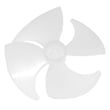
- Evaporator motor 4389144 (drives airflow through the evaporator)
- Refrigerator defrost heater WPW10495967 (helps prevent frost buildup that blocks airflow)
- Refrigerator water inlet valve WPW10341320 (feeds the ice maker and dispenser)
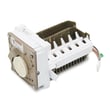
- Refrigerator ice maker assembly WPW10251076 (ice production issues)
Why it matters
Cooling and airflow problems can lead to food spoilage quickly, and ice maker or water valve issues can create leaks or poor ice production. Starting with the simple checks (controls, 24-hour cool-down, airflow, cleaning) prevents unnecessary part replacement.
Last updated: February 2026
How do I find the model number on my WSF26C3EXB01?
Your Whirlpool refrigerator’s model number and serial number are printed on a label inside the fresh food (refrigerator) compartment. On the WSF26C3EXB01, look on the inside wall of the refrigerator section and copy the full model number exactly as shown.
Where to look (fast checklist)
- Open the refrigerator (fresh food) door, not the freezer door
- Check the inside wall of the refrigerator compartment
- Look for a rating label with Model and Serial fields
- Use a flashlight; the label is often near the crisper area or side wall
- Write the model number exactly (letters and numbers), then take a photo for your records
What the label helps you do
Having the correct model number lets us match the right diagrams and parts for your exact Whirlpool configuration.
| You need it for | Example result |
|---|---|
| Ordering replacement parts | Correct fit for bins, gaskets, valves, and controls |
| Troubleshooting | Accurate steps and error-code info |
| Service history | Tracking serial number and production details |
Why it matters
Even small model-number differences can change door bins, ice maker style, control boards, and water system parts. Using the label inside the refrigerator compartment prevents ordering the wrong part and speeds up diagnosis.
Next step
Use the location details shown in the owner's manual to confirm the label position, then use that exact model number when selecting parts.
Last updated: March 2026