 Error Codes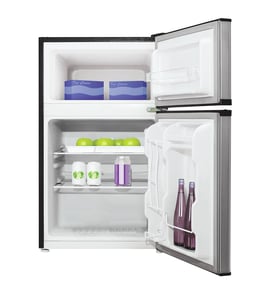

How do I know what size my Kenmore refrigerator is?
Your Kenmore compact refrigerator model 56493445100 “size” is usually described two ways: outside dimensions (how it fits in your space) and capacity in cubic feet (how much it holds). We measure dimensions with a tape measure; we estimate capacity by measuring the inside and converting to cubic feet. For parts and model lookups, use 56493445100 on Sears PartsDirect.
Measure the outside dimensions (fit)
Use a tape measure and record in inches:
- Height: floor to top of cabinet (include hinges only if they stick up)
- Width: left to right across the cabinet
- Depth: front to back (measure cabinet only, then note a second number including the handle)
- Clearance: leave space for door swing and airflow behind the unit
Typical compact refrigerator ranges
| What you’re measuring | Typical compact range | Why it matters |
|---|---|---|
| Width | 18 to 24 in. | Fits under counters or in tight spaces |
| Height | 30 to 36 in. | Fits in dorms, offices, basements |
| Depth | 18 to 24 in. | Door swing and walkway clearance |
Estimate storage capacity (cubic feet)
Capacity is based on inside space, not outside cabinet size.
- Measure the interior width, depth, and height (in inches). Measure the main compartment; ignore small door bins if you want a realistic number.
- Multiply: W × D × H = cubic inches.
- Convert to cubic feet: cubic inches ÷ 1,728 = cubic feet.
Example: 18 × 17 × 28 = 8,568 cubic inches; 8,568 ÷ 1,728 = 4.96 cu. ft.
Why it matters
- Dimensions prevent delivery and installation surprises.
- Cubic feet helps you compare compact refrigerators fairly.
- Accurate measurements also help when selecting shelves, door bins, or other replacement parts by model.
Last updated: February 2026
What are the most common issues with 56493445100?
The most common issues we see with the Kenmore 56493445100 compact refrigerator are warm temperatures, water leaking or puddling, unusual noises, and door sealing problems. These symptoms usually trace back to airflow restrictions, dirty condenser areas, a blocked defrost drain, or a worn door gasket.
Most common symptoms and what they usually mean
- Not cooling or weak cooling: blocked vents, dirty condenser coils, or a failing compressor start device
- Frost buildup on the back wall: door not sealing, frequent door openings, or defrost system trouble
- Water on the floor or inside the cabinet: clogged defrost drain or a tilted cabinet causing poor drainage
- Buzzing, rattling, or clicking: unit not level, fan blade hitting ice, or compressor start components cycling
- Door won’t close tightly: warped gasket, cabinet not level, or overpacked shelves
Quick checks we recommend first
- Confirm temperatures: set the control to mid-range; allow 24 hours to stabilize.
- Check airflow: keep items from blocking interior vents; leave space around the cabinet for ventilation.
- Clean heat-exchange areas: vacuum dust from accessible condenser areas and the rear/bottom.
- Level the refrigerator: front slightly higher than the back helps doors self-close.
- Inspect the door gasket: look for gaps, tears, or hardened sections.
Symptom-to-fix guide
| Symptom | Most likely cause | Best first action |
|---|---|---|
| Warm fridge | Poor airflow or dirty condenser | Clear vents; clean condenser area |
| Puddles | Defrost drain issue or leveling | Clear drain path; re-level |
| Noise | Leveling or fan/ice contact | Level unit; defrost if fan is hitting ice |
| Frost | Door seal problem | Clean gasket; check for gaps |
Why it matters
Compact refrigerators rely on tight door sealing and steady airflow to maintain safe food temperatures. Small issues like dust buildup or a slight tilt can quickly cause warm temps, frost, and water leaks.
Helpful DIY guides
- For water leaks and puddles: how to get rid of refrigerator puddles
- For door sealing problems: how to fix a fridge door seal
- For fan-related cooling and noise issues: how to fix your evaporator cooling fan
Last updated: March 2026
Why is my Kenmore mini fridge not cold?
If your Kenmore compact refrigerator model 56493445100 is not getting cold, the most common causes are poor airflow (dirty condenser coils), a failed evaporator fan, a temperature control problem, or a sealed-system issue (compressor or refrigerant). Start with cleaning and basic checks, then move to electrical tests.
Quick checks we recommend first
- Confirm the temperature control is set colder and the door is closing tightly.
- Clean the condenser coils and make sure the unit has breathing room (blocked vents cause warm temps).
- Listen for the compressor: a steady hum is normal; repeated clicking can point to a start device or compressor problem.
- Check for frost buildup on the back wall or inside the freezer compartment (can indicate a defrost or airflow issue).
- Verify the evaporator fan runs (if your mini fridge design uses one); no airflow means no cooling in the fresh-food area.
Step-by-step troubleshooting (most likely to least likely)
1) Airflow and heat removal problems
Dirty coils or restricted airflow make a mini fridge run warm even if the compressor is working.
| What you notice | Likely cause | What to do |
|---|---|---|
| Runs a lot, not cold | Dusty condenser coils | Unplug, vacuum/brush coils, restore airflow clearance |
| Warm cabinet sides | Normal heat rejection, but worse when dirty | Clean coils, avoid tight enclosures |
2) Evaporator fan or airflow path issue
If the evaporator fan is not running (on models that have one), cold air will not circulate.
- Open the door and listen for fan noise (some stop when the door is open).
- Check for ice blocking vents or the evaporator cover.
For more help with this symptom, use our DIY guide: how to fix your evaporator cooling fan.
3) Temperature control or thermostat problem
A faulty thermostat/temperature control can prevent the compressor from running long enough to cool.
- If the compressor never runs, the control circuit is a top suspect.
- If it runs constantly but never cools, look more toward airflow or sealed-system issues.
4) Sealed-system problem (compressor, refrigerant, restriction)
If coils are clean and airflow is good but temperatures stay warm, the sealed system is often the cause. This typically requires a technician.
Why it matters
A mini fridge depends on steady airflow across the condenser and consistent cold-air circulation. Fixing a simple airflow problem early prevents overheating, long run times, and food-safety temperature issues.
You can look up diagrams and replacement items for model 56493445100 by searching on Sears PartsDirect.
Last updated: February 2026





