Installation guide
 Owner’s manual
 Error Codes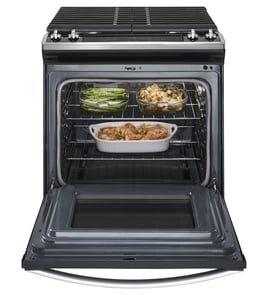





What is the convection setting on a gas oven?
On the GE PGS930SEL4SS gas range, the convection setting is a cooking mode that uses a fan to increase air circulation in the oven for more even baking and better browning. You will typically use Convection Bake for multi-rack baking and Convection Roast for roasting meats; details and mode behavior are listed in the owner's manual.
What convection does (and what you will notice)
Convection improves heat distribution by moving hot air around the oven cavity. In day-to-day cooking, that usually means:
- More even results across multiple racks (cookies, sheet pans, casseroles)
- Better browning on roasts and baked goods
- Fewer hot and cool spots compared to traditional Bake
- You may need to check food a bit earlier when roasting
Convection modes on this model
Your PGS930SEL4SS includes convection cooking modes on the control panel.
| Mode | Best for | Preheat? | What changes vs Bake/Broil |
|---|---|---|---|
| Convection Bake (Multi Rack) | Baking on multiple racks | Yes | Fan-driven air movement improves evenness; times can be slightly longer on multiple racks |
| Convection Roast | Whole cuts of meat on a single rack | Not usually | Improves browning and can reduce cook time; check food earlier |
Auto recipe conversion (temperature)
This model can automatically convert a standard (non-convection) recipe temperature when you use Convection Bake or Convection Roast.
- Turn it on or off in the Settings menu (Auto Conversion)
- It converts temperature, not cook time
- Always follow the display prompts and preheat when the mode calls for it
Why it matters
Using the right convection mode helps you match the oven’s airflow to the food. Convection Bake is the go-to for even multi-rack results, while Convection Roast is designed to brown and finish roasts efficiently.
Last updated: February 2026
How to use self-clean on GE Spectra oven?
On the GE PGS930SEL4SS gas range, Self Clean runs a very high-heat cycle to burn off baked-on soil. Start with the oven at room temperature, remove items that should not be cleaned, close the door, then press Clean, select Self Clean, and press Start/Enter (see the owner's manual).
Before you start (important prep)
- Start with the oven at room temperature.
- Wipe up excess grease and loose spills from the oven floor and inside of the door.
- Remove all items except self-clean (black) racks and grates (if your grates are approved for self-cleaning).
- Remove nickel-plated (silver) racks; leaving them in can tarnish them and make them hard to slide.
- Plan for the door to lock; you cannot open it during the cycle.
Self Clean steps (PGS930SEL4SS)
- Close the oven door.
- Press Clean.
- Select Self Clean.
- Press Start/Enter.
- When the cycle ends, let the oven cool; then wipe out any ash.
Choosing the right cycle time
| Soil level | Typical Self Clean time | What to expect |
|---|---|---|
| Moderate | 3 hours | Light ash residue to wipe out after cooling |
| Heavy | 5 hours | More ash; longer cool-down before the door unlocks |
Cleaning grates during Self Clean (if applicable)
Your manual includes specific grate placement options. Use one of these approved setups:
- On self-clean racks: place racks in positions 1, 3, and 5 (or 2 and 4), then set one grate on each rack.
- On the oven bottom: remove all racks, place one grate upright on the center of the oven bottom, then stack remaining grates only as shown in the manual.
- After the cycle, wipe any white residue off grates with a damp sponge; if spots remain, use a 50/50 vinegar and water wipe.
Why it matters
Self Clean reaches temperatures high enough to lock the door and burn residue to ash. Correct rack and grate handling helps prevent tarnishing, sticking racks, and enamel damage.
Last updated: February 2026
Can you leave the racks in a GE self-cleaning oven?
Yes, on the GE PGS930SEL4SS gas range you can leave only self-clean (black) racks or enameled (not shiny) racks in the oven during Self Clean. Remove nickel-plated (silver/shiny) racks; leaving them in will tarnish them and can make any rack harder to slide. See the owner's manual for rack type details.
What to remove (and what can stay)
Before starting Self Clean, we recommend sorting items by finish and material:
- Remove: nickel-plated (silver/shiny) oven racks
- Can stay: self-clean (black) racks (if your range has them)
- Can stay: enameled racks (not shiny)
- Remove: any cookware, foil, thermometers, and loose oven accessories
- Check grates: only some grates can be self-cleaned, and rubber bumpers must be removed from the oven first
Quick guide by rack type
| Rack appearance | Common description | Leave in during Self Clean? | What happens if left in |
|---|---|---|---|
| Silver, shiny | Nickel-plated rack | No | Tarnishing; may become difficult to slide |
| Black | Self-clean rack | Yes | May still slide harder afterward |
| Dark, not shiny | Enameled rack | Yes | May still slide harder afterward |
If racks are hard to slide after self-clean
It is normal for racks to feel sticky after high-heat cleaning. To improve sliding:
- Let the oven cool completely
- Wash racks with warm, soapy water; rinse and dry
- Rub a small amount of vegetable oil on the left and right rack edges (not on the rack supports)
- Avoid using abrasive cleaners that can damage finishes
Why it matters
Self Clean uses very high temperatures. Keeping the wrong racks inside can permanently discolor the finish and increase friction, which makes racks bind or scrape. Removing the right items also helps protect cooktop components like grates and any rubber bumpers.
If you need replacement parts for your PGS930SEL4SS, you can order from the parts list for this model or search by model number on Sears PartsDirect.
Last updated: February 2026
How do I reset the error code on my GE oven?
To reset an error code on your GE PGS930SEL4SS gas range, press Cancel/Off to stop the current function, let the oven cool (about 1 hour for many “F-” codes), then restore operation. If the code returns, do a power reset at the breaker for at least 30 seconds.
Step-by-step reset (most “F-” function codes)
- Press Cancel/Off once to clear the active cooking mode.
- If the display shows an “F-” plus a number/letter, let the oven cool for 1 hour.
- Try using the oven again.
- If the code repeats, turn OFF the range circuit breaker for 30 seconds.
- Turn the breaker back ON and re-test.
- If the code keeps coming back, the issue is typically in the temperature sensing or control circuit; use the troubleshooting guidance in the PGS930SEL4SS owner's manual.
What the reset does (and does not do)
A reset clears temporary control glitches and stops a cycle that is stuck. If the same code returns after cooling and a breaker reset, the range is detecting a real fault that needs correction.
Common causes when the code returns
- Oven temperature sensing problem (sensor out of range or wiring issue)
- Keypad or touch control input problem
- Control board problem
- Loose or damaged wire connection (especially after cleaning or moving the range)
Parts that commonly relate to repeat error codes
| Symptom after reset | What to check next | Example part for this model |
|---|---|---|
| Error returns during bake/broil | Temperature sensing circuit | Range oven temperature sensor WB24X25557 |
| Random beeping or repeated faults | Control electronics | Range oven control board WB27X29497 |
Why it matters
Repeated error codes are the range’s way of preventing unsafe or inaccurate heating. Resetting is a good first step, but a repeat code usually points to a sensor, wiring, or control issue that affects temperature control and cooking results.
Last updated: February 2026