Owner’s manual
 View engine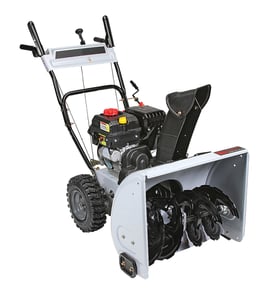


How to tell if a snowblower auger belt is bad?
On the Craftsman 536887990 gas snow thrower, a bad auger drive belt usually shows up as weak or no snow discharge even though the engine runs normally. Common clues include the auger/impeller not turning under load, belt slippage, or visible belt damage when you inspect it using the steps in the 536887990 operator’s manual.
Quick signs the auger belt is failing
- Auger/impeller slows down or stops when you hit heavier snow
- Snow throws a much shorter distance than normal
- Squealing, chirping, or a burning rubber smell from the belt area
- Belt looks cracked, frayed, glazed (shiny), or has exposed cords
- Belt tension is out of spec (too loose even after adjustment)
Model-specific check you can do (belt deflection)
The 536887990 manual calls for checking auger belt deflection with the auger clutch engaged. With moderate finger pressure, the belt should deflect about 1/2 inch (12.5 mm). If it deflects much more, the belt may be loose, stretched, or worn.
| What you see | What it usually means | What to do next |
|---|---|---|
| Belt is shiny/glazed or smells burnt | Slipping from wear, heat, or a jam | Inspect for damage; replace if glazed/cracked |
| Belt deflects more than ~1/2 inch | Loose belt or cable/tension issue | Adjust belt and then re-check |
| Belt has cracks/fraying/cords showing | Belt is worn out | Replace the belt |
| Auger won’t turn but belt looks OK | Possible cable adjustment or shear bolt issue | Check cable adjustment and shear bolts |
If you need the correct replacement part
For this model, the auger drive belt is listed as snowblower gas belt 585416MA.
- Replace the belt if it’s damaged, stretched, or glazed
- After belt service, re-check auger cable adjustment (a misadjusted cable can mimic a “bad belt”)
- If the auger suddenly stopped after hitting something, also inspect shear bolts before assuming the belt failed
Why it matters
A slipping auger belt reduces snow-throwing performance and can overheat, which accelerates belt wear and can lead to repeated failures during heavy snow.
Last updated: January 2026
Is it worth fixing an old snowblower?
For the Craftsman 536887990 gas snow thrower, it’s often worth fixing if the engine still runs well and the main wear items (belts, shear bolts, friction wheel) are the issue. If repairs point to major drivetrain or repeated engine problems, replacement can make more sense.
Quick decision checklist (for model 536887990)
- Fix it if it needs routine wear parts, seasonal maintenance, or minor adjustments.
- Fix it if it still throws snow strongly after basic tune-up steps.
- Consider replacing if it has recurring hard-starting, low power, or heavy vibration that returns after repairs.
- Consider replacing if the auger/drive system needs multiple major components at once.
- Consider replacing if repair cost approaches a large share of a comparable new unit.
Common “worth fixing” repairs on this model
These are typical, practical repairs for the Craftsman 536887990 and are covered in the troubleshooting and service sections of the manual.
- Replace a worn auger belt if it won’t discharge snow
- Replace a worn ground drive belt if it won’t propel
- Replace broken shear bolts after hitting debris
- Replace a worn friction wheel if it slips or won’t move consistently
Helpful references: Craftsman 536887990 owner’s manual, friction wheel 1501435MA
Cost-to-value comparison (simple guide)
| What you’re seeing | Likely scope | Usually worth fixing? |
|---|---|---|
| Won’t move, but engine runs strong | Drive belt or friction wheel | Yes |
| Won’t throw snow, auger stops under load | Auger belt or shear bolts | Yes |
| Excessive vibration that persists | Possible impeller/auger damage or loose parts | Maybe |
| Repeated engine performance issues | Fuel system, ignition, compression | Maybe/No |
Why it matters
A well-maintained dual-stage unit like the Craftsman 536887990 (29-inch, 9 HP class) can stay useful for many seasons. The key is whether you’re replacing normal wear parts or chasing repeated major failures that reduce reliability and snow-clearing performance.
Last updated: January 2026
Where is the serial number on a snowblower?
For Craftsman gas snow thrower model 536887990, the operator’s manual identifies the model number but does not specify a single exact physical location for the serial-number label. In practice, the serial number is usually on a product ID label attached to the frame or engine area; you’ll need to inspect the unit to find it. See the 536887990 operator's manual for model identification and safety labeling context.
Where to check first on this Craftsman model
Start with the most common label and tag locations on a two-stage snow thrower:
- Rear frame near the handle supports or lower handle mounting area
- Side of the main frame near the wheels or drive system
- Engine shroud or engine mounting area (engine may also have its own ID tag)
- Near the chute base or auger housing (less common)
- Under or behind a removable cover (belt cover or panel) if a label was placed there
What numbers you may see
You may find more than one ID tag. Use this guide to record the right information.
| ID on label | What it identifies | Notes |
|---|---|---|
| Model number | The snow thrower configuration | For this unit: 536887990 (also shown as 536.887990 in the manual) |
| Serial number | Your specific snow thrower | Format varies; record exactly as printed |
| Engine model/spec | The engine itself | Useful for engine-specific parts and tune-up items |
Tips to read the label accurately
- Brush off snow and wipe away grime; labels can be hard to read when wet.
- Use a flashlight and take a close-up photo to confirm characters.
- Write down every character, including dashes or dots.
- If the label is missing, use the model number (536887990) to match parts diagrams and assemblies.
Why it matters
The model number gets you the correct Craftsman parts breakdown (auger housing, drive system, chute). The serial number helps identify your exact unit when you’re confirming production details for service.
Last updated: January 2026
How many years should a snowblower last?
For Craftsman model 536887990, the owner’s manual doesn’t list an expected “service life” in years, so we can’t give a model-specific lifespan number. In general, a gas snowblower can last many seasons when it’s maintained on schedule and wear items are replaced before they cause bigger damage.
What we can confirm for model 536887990
The manual for this model emphasizes routine maintenance that directly affects how long the engine and drive system stay reliable; see the schedule and procedures in the 536887990 operator’s manual.
Key model-specific maintenance items called out include:
- Checking engine oil before use and about every 5 hours of operation
- Changing engine oil about every 25 hours or at least yearly
- Lubricating chains about every 25 hours
- Inspecting fasteners, controls, and the auger after each use
What usually determines “how long it lasts”
These factors matter more than the calendar:
- Hours of use per season (a few storms vs. frequent heavy use)
- Snow conditions (wet, heavy snow and gravel driveways increase wear)
- Storage practices (fuel stabilization, dry storage, rust prevention)
- Maintenance consistency (oil level, oil changes, lubrication)
- How quickly you address symptoms (slipping belts, vibration, poor drive)
Wear parts that can shorten lifespan if ignored
On model 536887990, these common wear items often decide whether the machine feels “worn out” early:
| Symptom | Likely wear area | Example compatible part |
|---|---|---|
| Won’t move or slips under load | Ground drive belt or friction drive | Snowblower drive belt 1733324SM or friction wheel 1501435MA |
| Auger turns weakly or won’t throw snow | Auger drive belt or cable adjustment | Snowblower gas belt 585416MA |
Why it matters
A snowblower often gets replaced because performance drops, not because the engine is “done.” Following the model 536887990 maintenance intervals and replacing belts or the friction wheel when symptoms start can extend useful life significantly.
Last updated: January 2026