 Owner’s manual
 Error Codes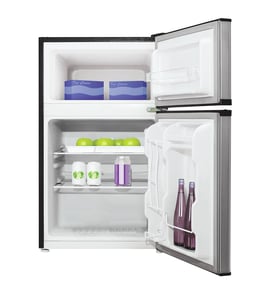

Are there any 32 inch wide refrigerators?
Yes. 32-inch wide refrigerators are a common size, and you can find them in several styles (top freezer, bottom freezer, and French door), including counter-depth options for tighter kitchens. For fit and clearance planning, we recommend checking the measurements guidance in your owner's manual.
What “32-inch wide” means when shopping
Manufacturers list width a few different ways, so we always recommend confirming the exact spec before you buy.
- Nominal width: marketed as “32-inch” but the actual cabinet may be slightly under or over
- Door and hinge clearance: hinges and handles can add width beyond the cabinet
- Depth and swing space: counter-depth models often need extra room for door swing
- Ventilation clearance: freestanding units need airflow space around the cabinet
Quick fit checklist (what we measure)
Use this checklist to avoid a tight install or doors that will not open fully:
- Opening width at the front and back of the cabinet cutout
- Clearance for hinges and handle on the side where the door swings
- Space behind the unit for cord and airflow
- Floor level; an unlevel floor can affect door sealing
- Pathway width (doorways, hallways) for delivery
Typical size ranges you will see
These are common ranges for “32-inch class” refrigerators.
| Spec | Typical range | Why it matters |
|---|---|---|
| Advertised width | 32 in. | Helps narrow your search |
| Actual cabinet width | ~31 1/2 to 32 3/4 in. | Determines if it fits the opening |
| Recommended side clearance | ~1/2 to 3 in. | Prevents overheating and noise |
Why it matters
A refrigerator that is even 1/4 inch too wide can bind in the opening, reduce airflow, and make the doors hard to open. Planning for clearance also helps prevent warm spots and moisture issues caused by poor door sealing.
Last updated: February 2026
How to tell cubic feet of Kenmore refrigerator by model number?
For Kenmore model 56429701992, the most reliable way to get cubic feet is to check the capacity listed in the product literature for your exact model, then use that value for comparisons and storage planning. When capacity is not printed on the rating label, measuring the interior and calculating volume gives a solid estimate.
Best ways to find capacity (in order)
- Check the specs/capacity section in the owner's manual.
- Look for a model and serial label inside the cabinet (often on a side wall, ceiling, or near the crisper area).
- If you have the interior dimensions, calculate cubic feet (see formula below).
- If your unit has a freezer compartment, calculate fresh food and freezer sections separately, then add them.
- Use the capacity to set realistic loading expectations (overpacking reduces airflow and cooling performance).
How to calculate cubic feet from measurements
- Measure the usable interior space in inches:
- Height (H)
- Width (W)
- Depth (D)
- Multiply: H × W × D = cubic inches
- Convert to cubic feet: (H × W × D) ÷ 1728 = cubic feet
| What you measure | Use this | Notes |
|---|---|---|
| Interior height | inches | Measure usable space, not the outer cabinet |
| Interior width | inches | Exclude thick door bins if you want “shelf space” |
| Interior depth | inches | Measure to the back wall, not into door storage |
Why the model number usually is not enough
Kenmore model numbers can indicate series and configuration, but they do not consistently encode the exact cubic-foot capacity. Capacity also varies with shelf design, freezer layout, and insulation thickness, even when models look similar.
Related help for Kenmore refrigerators
If you are troubleshooting cooling or display issues while you are checking specs, our Kenmore 106 model refrigerator error codes guide can help you interpret common error code patterns.
Last updated: February 2026
Is there a reset button on a Kenmore 56429701992?
The Kenmore 56429701992 compact refrigerator does not use a dedicated “reset button” like some appliances. When it acts up, the practical reset is a power reset (unplugging the refrigerator briefly, then restoring power) and then checking common causes like door seal, leveling, and dirty condenser coils per the owner's manual.
How to reset (power reset)
- Unplug the refrigerator.
- Wait 5 minutes.
- Plug it back in and allow 15 to 30 minutes for the compressor and cooling cycle to stabilize.
If the unit was in a defrost cycle or the compressor was protecting itself, it may take a little time before you hear it run again.
What to check if “resetting” only helps temporarily
These items commonly cause warm temps or odd cycling on compact refrigerators:
- Door fully closed and not blocked by shelves or food
- Leveling so the door seals tightly
- Condenser coils on the back cleaned of lint and dust
- Airflow around the cabinet (not pushed tight against a wall)
- Normal sounds (gurgling refrigerant, compressor hum, clicking on and off)
The manual’s troubleshooting section specifically calls out door closure, leveling for a good seal, and cleaning the back condenser coils to improve performance.
Quick symptom guide
| Symptom | Most likely check first | Why it matters |
|---|---|---|
| Freezer or fridge too warm | Door seal and leveling | Warm air leaks in and raises temps |
| Runs a lot | Dirty condenser coils | Poor heat release reduces cooling efficiency |
| Noisy or clicking | Clearance and coil cleanliness | Vibration and restricted airflow increase noise |
| Odor inside | Spoiled food and cleaning | Odors linger in small compartments |
Why it matters
A “reset” can clear a temporary control or compressor protection state, but temperature problems usually come back if airflow, coil cleanliness, or the door seal is the real issue. Fixing the root cause protects food and reduces compressor wear.
Last updated: February 2026





