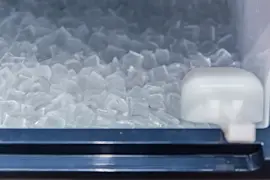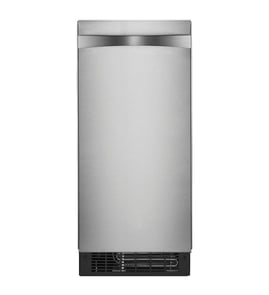

Can I leave my countertop ice maker on all the time?
Yes. You can leave a countertop ice maker like the GE XPIO13BCBT running all the time because it’s designed to cycle on and off to maintain ice production; for best hygiene and longer life, we recommend turning it off and drying it out when you will not use it for a day or more.
If you run your freestanding icemaker continuously, focus on airflow, clean water, and routine cleaning so the unit is not constantly fighting heat and mineral buildup.
- Keep the unit on a hard, level surface to reduce vibration and noise.
- Maintain clearance around vents so the condenser can reject heat.
- Use clean, fresh water; change the reservoir water regularly.
- Empty old ice periodically so it doesn’t absorb odors.
- Clean and sanitize on a routine schedule to prevent slime or mold.
Turning the unit off is the better choice when ice demand is low or the machine will sit unattended.
- Overnight if you do not need ice and the room is warm
- When leaving home for a weekend or vacation
- If you notice slow production, odd taste, or cloudy ice (often mineral related)
- Before deep cleaning and descaling
Most countertop units are not freezers; they store ice in an insulated bin. Some melting is normal, and the meltwater typically returns to the reservoir and gets reused.
| Situation | What you’ll notice | What to do |
|---|---|---|
| Warm room or poor ventilation | Faster melting, more cycling | Improve airflow; consider turning off when not needed |
| Ice left in bin for days | Odor pickup, clumping | Dump old ice; clean the bin |
| Hard water | Scale buildup, smaller batches | Descale more often; use filtered water |
Running 24/7 increases run time on the compressor, fan, and pump, and it can accelerate scale buildup. Turning it off occasionally lets you fully dry the bin and water path, which helps prevent odors and sanitation issues.
For DIY safety and planning, we recommend reviewing are diy appliance repairs safe.
Last updated: February 2026
Why is my free standing ice maker not making ice?
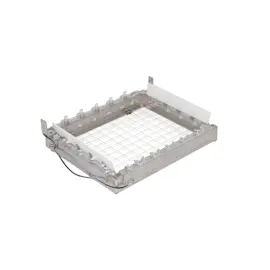
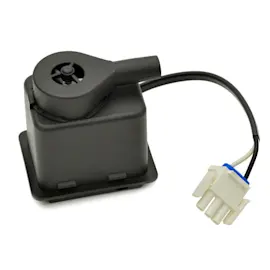
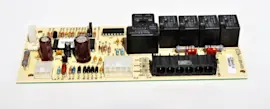
If your GE XPIO13BCBT freestanding ice maker powers on and runs but produces no ice, the most common causes are a water supply problem, a failed recirculation pump, a cutting grid issue, a control board problem, or a sealed system (cooling) failure. Start by confirming water flow and basic operating conditions.
- Make sure the water supply valve is fully open and the supply line is not kinked.
- Confirm the inlet water is actually reaching the unit (disconnect at the valve only if safe to do so).
- Verify the unit is level; many freestanding ice makers are sensitive to tilt.
- Check that the bin is seated correctly and not holding the unit in a “bin full” condition.
- Unplug the ice maker for 5 minutes, then restore power to reset the control.
| What you notice | Likely area to check | What it usually means |
|---|---|---|
| Runs, no water sound, no fill | Water supply/inlet path | No water getting to the reservoir |
| Water present, no circulation | Recirculation pump | Water is not moving over the evaporator |
| Ice slab forms but won’t release/cut | Cutting grid | Ice cannot be cut into cubes |
| Random behavior, won’t start a cycle | Electronic control board | Commands/sensors not being processed |
| Warm interior, never forms ice | Sealed system | Cooling system is not removing heat |
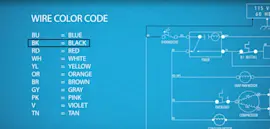
- If you suspect an electrical issue, unplug the unit before removing any panels.
- Look for loose connectors, pinched wires, or corrosion at harness plugs.
- Use a meter to check continuity on simple components (when accessible) and verify outlet voltage.
- If you need guidance on electrical testing, use our how to use a multimeter to test electrical parts video.
An ice maker that “runs but makes no ice” usually fails at one of two points: water delivery (no water to freeze) or cooling/circulation (water cannot freeze into a slab). Narrowing it down prevents replacing the wrong part and reduces downtime.
Last updated: February 2026
What is the most common problem with GE refrigerators ice maker?
The most common issue that stops a GE ice maker from producing ice is a water-delivery problem (restricted flow, frozen water path, or a valve that is not opening). For the GE XPIO13BCBT freestanding icemaker, the most common cause is a water supply issue at the reservoir (low water level, poor water quality, or a tank seating problem).
- Refill the reservoir to the proper level; reseat the tank fully so it can feed water.
- Use fresh, cold water; dump and refill if water has been sitting.
- Empty the ice bin; an overfull bin can stop production.
- Clean and descale the water system on schedule; mineral buildup slows or stops ice making.
- Unplug for 5 minutes, then restart to clear a control glitch.
- Confirm the ice maker is turned on in the control settings.
- Check the water filter and replace if flow is weak.
- Verify the freezer is cold enough for ice production (typically near 0°F).
- Inspect for a frozen fill path or ice jam at the ice maker.
- If the mold fills but will not harvest, the ice maker module can be failing.
| Appliance type | Water source | Most common “no ice” cause | First action |
|---|---|---|---|
| XPIO13BCBT freestanding icemaker | Manual-fill reservoir | Low/poor water supply at tank; scale buildup | Refill and descale |
| GE refrigerator with ice maker | Household water line | Restricted flow (filter/line/valve) | Check filter and water supply |
Ice makers depend on consistent water delivery. A refrigerator relies on household water pressure and filtration; a freestanding unit like the XPIO13BCBT relies on a properly seated, clean reservoir and a scale-free water circuit.
For model identification and ordering the correct replacement parts for your exact appliance, use how to find your appliance model number (and what it means for parts).
Last updated: February 2026