Owner’s manual
 Error Codes



What does the number 23 signify?
On the Samsung RF23HCEDBWW refrigerator, the “23” is part of the model series name and is commonly used to indicate the approximate capacity class (about 23 cubic feet) for that French door, bottom-mount platform. It is not an error code or a control-panel message; it is a model identifier.
In practice, “23” shows up in places that identify the product, not its operating status:
- The model number on the rating label and paperwork (RF23HCEDBWW)
- Parts listings and diagrams used to match components to your refrigerator
- The documentation for features and temperature settings in the owner's manual
- Service and compatibility references for items like the ice maker, water filter, and sensors
Your temperature display uses real temperature setpoints, not the model’s “23” series number.
| Display item | What it represents | Typical range on this model family |
|---|---|---|
| Freezer setting | Freezer target temperature | -8°F to 5°F (recommended 0°F) |
| Fridge setting | Fresh food target temperature | 34°F to 44°F (recommended 37°F) |
| “OFR” | Cooling Off mode indicator | Not a temperature |
Using the full model number (RF23HCEDBWW) helps ensure correct fit and function because Samsung often has multiple “RF23” variants with different hinges, ice makers, and dispenser components.
- Match parts by model number first
- Compare the part description to your symptom (cooling, ice, water, door sealing)
- Use the troubleshooting and feature details in the owner's manual
If you are seeing a flashing message or an icon and think it relates to “23,” check the control-panel section in the manual first; many display messages are mode indicators (like Cooling Off), not model identifiers.
Last updated: February 2026
What are the disadvantages of a bottom freezer?
Bottom-freezer refrigerators like the Samsung RF23HCEDBWW put fresh food at eye level, but the tradeoff is that frozen items sit lower in a pull-out drawer. The main disadvantages are more bending, heavier drawer loads, and slightly more maintenance around drawer alignment, seals, and airflow.
- You bend more to reach frozen foods, especially items at the back of the drawer.
- The freezer drawer can get heavy when fully loaded; that extra weight increases wear on slide rails and drawer components.
- Organization can be harder if you do not use bins; items stack and get buried.
- Frost and temperature swings happen faster if the drawer is left open too long.
- Door and drawer clearances are tight; pinch points are common when kids are nearby (we follow the safety guidance in the owner's manual).
Bottom-freezer designs put more stress on moving parts and seals. If you see gaps, rubbing, or moisture, address it early.
| Symptom | Likely cause | What to do first |
|---|---|---|
| Drawer feels rough or sags | Overloaded drawer, rail wear, misalignment | Reduce load; re-seat the drawer; check rails for damage |
| Frost on freezer walls | Blocked vents, drawer not closing fully | Clear vents; ensure the drawer closes squarely |
| Condensation or warm spots | Door/drawer left open, poor sealing | Shorten open time; check gasket contact |
- Keep heavier frozen items low and centered so the drawer tracks straight.
- Leave space around vents so air can circulate freely (blocked vents can lead to frost buildup).
- Open the freezer drawer for shorter periods to reduce frost and temperature rise.
- Do not overfill; items can shift and prevent a full close.
- If you have kids at home, keep hands away from tight clearances and pinch points.
Most bottom-freezer complaints come from drawer weight, airflow restrictions, and sealing issues. Managing load and keeping vents clear helps your Samsung RF23HCEDBWW cool evenly, reduce frost, and avoid premature wear on drawer hardware.
Last updated: February 2026
What's the lifespan of a bottom freezer fridge?
A bottom-freezer refrigerator like the Samsung RF23HCEDBWW typically lasts 15 to 20 years with normal household use. Real-world lifespan depends most on compressor run time, airflow/venting, door seal condition, and how well the defrost and ice maker systems stay maintained.
Most bottom-mount and French door refrigerators land in the same general range, but a few factors can shorten or extend service life:
- Ventilation clearance around the cabinet (poor airflow makes the compressor work harder)
- Door openings and door seal condition (warm air intrusion increases run time and frost)
- Ice maker and water system health (valves, filters, and leaks can create repeat repairs)
- Defrost performance (frost buildup can reduce cooling and strain fans)
- Cleaning and loading habits (blocked vents reduce air circulation)
For model-specific care and operating guidance, follow the airflow and storage recommendations in the owner's manual.
Use this as a practical rule-of-thumb when deciding whether to repair or replace.
| Refrigerator age | What we typically see | Practical next step |
|---|---|---|
| 0 to 5 years | Minor issues, adjustments | Repair is usually worthwhile |
| 6 to 10 years | Wear parts start showing up | Repair if the fix is targeted |
| 11 to 15 years | More frequent component failures | Compare repair cost vs. replacement |
| 16 to 20 years | End-of-life failures become common | Replacement often makes sense |
These steps reduce compressor workload and prevent common bottom-freezer problems:
- Keep food clear of rear vents so air circulates freely.
- Minimize door-open time to reduce frost buildup.
- Replace the water filter on schedule; for this model, a common option is the refrigerator water filter DA29-00019A.
- If you see frost on freezer walls, remove obstructions and make sure drawers close fully.
- If you will be away more than three weeks, empty the unit, unplug it, close the water valve, dry the interior, and leave doors open (per the manual guidance).
A refrigerator that runs longer and harder than it should uses more energy and wears out key components faster. Good airflow, tight door sealing, and a healthy water/ice system are the biggest controllable factors for extending lifespan.
Last updated: February 2026
What is the most common problem with Samsung refrigerators ice?
The most common ice problem we see in Samsung refrigerators like model RF23HCEDBWW is ice clumping and freeze-ups in the bucket or chute. That causes weak dispensing, jammed ice, or no ice; it often follows moisture intrusion, restricted water flow, or a power-outage refreeze (see the RF23HCEDBWW owner's manual).
- Cubes fused into a solid mass in the bucket
- Auger sound but little or no ice dispenses
- Ice production slows or stops
- Bucket is hard to remove
- Ice jams at the chute
- Dump old ice, wash the bucket with mild detergent, rinse, and dry completely
- After a power failure, discard melted-refrozen ice and dispense once to clear residual water
- Confirm the water supply valve is fully open and the line is not kinked
- Allow 24 hours after installation or a full defrost for normal ice production
- Replace an overdue filter; restricted flow commonly leads to small cubes and clumping (use refrigerator water filter DA29-00019A)
| Symptom | Likely cause | Part to check |
|---|---|---|
| No ice or slow fill | Low water flow or valve issue | Refrigerator water inlet valve DA62-04027A |
| Ice maker won’t cycle or won’t harvest | Ice maker failure | Refrigerator ice maker DA97-13718A |
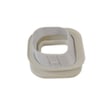
| Ice jams at dispenser opening | Air leak at chute | Refrigerator dispenser ice chute cap and gasket assembly DA97-12594A |
Freeze-ups keep re-jamming the auger and dispenser and can turn a simple cleanup into repeated no-ice complaints until water flow and air leaks are corrected.
Last updated: February 2026