 Owner’s manual
 Error Codes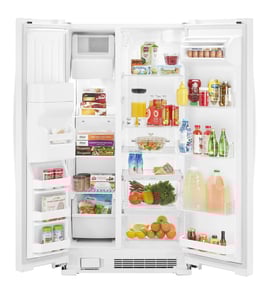



How to move a JennAir refrigerator?
To move a Jenn-Air JS42SEDBDA built-in side-by-side refrigerator, we protect the floor, clear the path, and follow the moving guidance in the owner's manual. This model is a built-in unit and is not designed for frequent moving, so careful prep prevents cabinet, floor, and water-line damage.
- Unplug the refrigerator (or switch power off at the main power switch if your installation uses it).
- Remove food, bins, and loose shelves so nothing shifts.
- Turn off the water supply to the refrigerator and plan for a small amount of water in the line.
- Protect finished flooring with plywood, cardboard, or another rigid barrier.
- Make sure the floor under the refrigerator is level with the surrounding finished floor.
- Clearances first: Open both doors and confirm you have room to pull the unit straight out without twisting it.
- Disconnect water as needed: If the water line limits movement, disconnect it carefully and keep a towel handy.
- Pull straight out: Use slow, even force from the cabinet sides (not the door handles) to avoid racking the frame.
- Move in short increments: Re-check the floor protection and cord/water line slack as you go.
- Reposition and re-level: Once back in place, re-level the refrigerator so doors seal correctly.
| Task | Why it matters |
|---|---|
| Protect the floor before sliding | Prevents scratches and gouges on finished surfaces |
| Shut off water supply | Prevents leaks and water damage |
| Pull straight out, no twisting | Prevents cabinet and hinge alignment issues |
| Re-level after moving | Helps doors seal and temperatures stay stable |
Built-in refrigerators like the Jenn-Air JS42SEDBDA fit tightly in cabinetry. Sliding without protection or pulling at an angle can damage the floor, kink the water line, or cause door alignment and sealing problems that lead to warm temperatures or frost.
Last updated: February 2026
What are common problems with JennAir refrigerators?
Common problems we see on Jenn-Air refrigerators like model JS42SEDBDA include not cooling, water leaks, dispenser issues, ice maker failures, doors not sealing or closing, and the unit not running. Many of these trace back to airflow, water supply, door sealing, or basic power and control settings in the owner's manual.
- Not cooling or warm temperatures: dirty condenser, blocked vents, evaporator fan issue, frequent door openings
- Leaking water: water line connection seepage, clogged/iced drain, dispenser or filter housing leaks
- Ice maker not working: water supply off, low water pressure, ice jam, freezer temperature too warm
- Water dispenser not working: filter or bypass plug missing, door open, lock enabled, low water pressure
- Door not closing or not sealing: misalignment, items holding the door open, worn or dirty gasket
- Won’t run: power cord unplugged, tripped breaker, main power switch off, ON/OFF pad not enabled
- Confirm the refrigerator has power (outlet works, breaker not tripped) and the unit is turned ON.
- Make sure doors are fully closed; an open door can stop dispensing and affect cooling.
- If your model has a dispenser, verify a water filter or bypass plug is installed.
- Check the household water supply valve is open and water pressure is adequate.
- Look for packaging or bins preventing the door from sealing.
- Clean the condenser area if the refrigerator runs too long or cools poorly.
| Symptom | Most likely checks | What to do next |
|---|---|---|
| Not cooling | Condenser dirty, airflow blocked, fan issue | Review airflow and fan diagnostics in how to fix your evaporator cooling fan |
| Dispenser won’t dispense | Filter/bypass missing, door open, lock on, low pressure | Install filter/bypass, close door, disable lock, verify supply |
| Runs too long | Dirty condenser, warm room, door not sealing | Clean condenser; inspect gasket and door closure |
| Door hard to open | Normal pressure equalization | Wait a few seconds after closing one door |
Cooling, ice, and water systems all depend on steady airflow and correct water supply. A dirty condenser or a missing filter/bypass plug can create symptoms that look like a major failure, so these basic checks save time and prevent food temperature problems.
Last updated: February 2026
What is the life expectancy of a JennAir refrigerator?
A Jenn-Air refrigerator typically lasts 15 years. For your Jenn-Air JS42SEDBDA side-by-side refrigerator, regular cleaning, good airflow around the machine compartment, and keeping door seals tight are the biggest factors that help it reach that lifespan; check the JS42SEDBDA owner's manual for model-specific care and service guidance.
Most premium built-in and high-end refrigerators, including Jenn-Air models, deliver a 15-year service life in normal home use.
- Typical life expectancy: 15 years
- Common “end-of-life” drivers: sealed system wear (compressor, evaporator, condenser), control issues, chronic airflow problems
- Best-case outcome: consistent temperatures, clean condenser area, and strong door sealing
These are the maintenance and usage items that most directly affect longevity.
- Keep the condenser and machine compartment area clean so heat can dissipate properly.
- Confirm the doors close and seal fully; warm air leaks force longer run times.
- Avoid overpacking; blocked vents reduce airflow and can cause warm spots.
- Set stable temperatures (avoid frequent large adjustments).
- Address unusual noises early (often fans or airflow related).
| What you notice | What it often points to | What we recommend |
|---|---|---|
| Fridge warm, freezer OK | Airflow issue (evaporator fan, frost buildup) | Follow how to fix your evaporator cooling fan steps and check for blocked vents |
| Both sections warm | Heat not being rejected well (condenser area, sealed system) | Clean condenser area; verify airflow around the unit |
| Moisture/condensation | Door seal or high humidity | Inspect/clean gasket; reduce door-open time |
A refrigerator that runs longer and hotter than it should (from dirty condenser areas, poor airflow, or leaky door gaskets) wears major components faster. Keeping airflow and sealing in good shape is the simplest way to protect the compressor and maintain consistent food-safe temperatures.
Last updated: February 2026





