Owner’s manual



Where to find model on GE washer?
On the GE GFWH1200D1WW washer, the model and serial number label is on the side of the washer cabinet. On many front-load washers, you can also spot the rating label when the door is open, around the door opening area. See the GFWH1200D1WW owner’s manual for the exact label location and what the tag looks like.
Common places to check on a GE front-load washer
Look for a sticker or metal tag with Model and Serial printed on it. Check these spots:
- Side of the main cabinet (often easiest to see from the front corner)
- Door opening area (door jamb or around the opening)
- Behind the control panel area (less common, but possible)
- Rear panel area (occasionally used on some designs)
What to write down (and why)
Record both numbers exactly as shown; they help us match the correct GE parts and diagrams.
| What to record | Example format | Why it matters |
|---|---|---|
| Model number | GFWH1200D1WW | Ensures the right parts list and fit |
| Serial number | Letters and numbers | Helps identify production version |
Tips if the label is hard to read
- Wipe the tag gently with a damp cloth and dry it
- Use your phone camera and zoom in for clarity
- Copy characters carefully (O vs 0, I vs 1)
- If the washer is installed tight in a closet, open the door and check the door opening area first
Why it matters
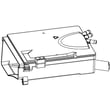
GE often uses multiple revisions within the same washer platform. Using the exact GFWH1200D1WW model number helps us avoid mismatched items like a control board, door lock, or drain pump.
Last updated: February 2026
Why is my GE front load washer leaking from the bottom?
If your GE GFWH1200D1WW front load washer is leaking from the bottom, the most common causes are a loose or misrouted drain hose, a clogged pump filter causing overflow, or a door boot (gasket) issue that lets water run down the front and appear to leak underneath. Use the GFWH1200D1WW owner's manual checks below to pinpoint the source.
Quick checks (fastest way to find the leak)
- Unplug the washer; then dry the floor and run a short rinse to see where water first appears.
- Check the fill hoses at the faucets and at the washer for drips; tighten if needed.
- Inspect the drain hose for kinks, cracks, or the washer sitting on it; confirm it is secured at the standpipe.
- Make sure there is an air gap at the standpipe (do not shove the drain hose too far down).
- Look for water trails from the door area; water can run down and pool underneath.
Clean the pump filter (very common bottom-leak lookalike)
This model has a pump filter access door on the front. A clogged filter can cause poor draining and water where it should not be.
- Open the small access door.
- Place a shallow pan and towels; expect about a cup of water.
- Pull down the pour spout, then slowly remove the filter (counterclockwise).
- Clean debris and reinstall the filter; tighten securely.
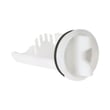
If the filter housing or seal is damaged, replace the washer drain pump filter WH11X34741.
Door boot and clamps: leaks that end up on the floor
A torn or unseated door gasket can drip down the front and look like a bottom leak.
| What you see | Likely cause | What to do |
|---|---|---|
| Drips from the front corners | Door boot not seated or torn | Wipe and inspect the gasket folds; replace if torn |
| Water after opening the door | Normal drip from the door seal | Wipe the seal and door opening |
| Small leak that gets worse with items in pockets | Gasket damage from debris | Check pockets; inspect gasket carefully |
If you find a torn boot or loose clamp, common related parts for this model include the washer door boot WH08X10064, washer door boot spring clamp, outer WH01X10279, and washer door boot spring clamp, inner WH01X10277.
Why it matters
Bottom leaks can damage flooring and can also point to a draining problem (pump filter, drain hose routing) that leads to repeated overflows and poor wash performance.
Last updated: February 2026
Why is my GE washing machine not draining water?
If your GE GFWH1200D1WW washer is not draining, the most common causes are a clogged pump filter, a kinked or siphoning drain hose, or a household drain restriction. Start by cleaning the pump filter and confirming the drain hose is routed correctly.
Quick checks we recommend first
- Unplug the washer before inspecting the pump area.
- Run Drain & Spin after redistributing the load (an out-of-balance load can stop draining/spinning).
- Check the drain hose for kinks, crushing, or the washer sitting on it.
- Make sure the standpipe has an air gap; the hose should not be shoved too far down the drain (prevents siphoning).
- If the standpipe or sink backs up, the household drain is clogged.
Clean the pump filter (most common fix)
GE notes that small articles can get into the pump area and the washer uses a filter to catch them. Cleaning it often restores normal draining.
Use the steps in the GFWH1200D1WW owner’s manual to open the access door, drain the small amount of water into a shallow pan, remove the filter, clear debris, then reinstall and tighten securely.
| What you notice | What it usually means | What to do |
|---|---|---|
| Water remains in tub, slow drain | Pump filter clogged | Clean pump filter, retry Drain & Spin |
| Humming but no drain | Pump jammed or failing | Check filter for items; replace pump if needed |
| Drains sometimes, not always | Hose routing or intermittent clog | Correct hose routing; check standpipe |
When a part is likely needed
If the filter is clean and the hose and household drain are good, the drain system parts are the next suspects.
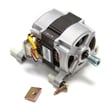
- If the pump is noisy, seized, or won’t move water: consider the washer drain pump assembly WH23X10028.
- If the filter housing is damaged or won’t seal: consider the washer drain pump filter WH11X34741.
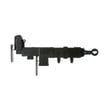
- If the door won’t lock, some cycles may not advance to drain properly: check the washer door lock WH10X10006.
Why it matters
A no-drain condition can leave clothes soaking wet, trigger longer cycle times, and strain the drain pump. Clearing the pump filter and correcting drain hose siphoning are the fastest ways to restore normal operation.
Last updated: February 2026